You sat through the forty-minute demo and came in with one question: what does this cost me a month? You got the answer you have heard from more than one vendor. “It depends on your volume. Let me build you a custom quote.” That is not a price. That is the start of a negotiation you did not agree to, against someone who prices a dozen of these a week and knows where you will land.
Here is the short version. Procore does not publish pricing and it does not price per user. It prices on your Annual Construction Volume, so the bigger your year, the bigger your bill, even if nobody new logs in. Builders report an effective rate near $1,000 a year for every $1 million of volume (Projul), putting a small-to-mid contractor at $10M to $50M in volume around $15,000 to $30,000 a year for the core product, before a dime of implementation (OneCrew). Procore is an excellent platform, built for the $100M-plus commercial GC, not for a shop doing 6 to 40 jobs a year. This teardown shows how the model works, what it costs in year one, three scenarios, and the transparent tools a small builder should price instead.
In this post
- How Procore actually prices: the ACV model
- The real numbers builders report
- What you get, and the first-year costs nobody quotes
- Three real cost scenarios
- Where Procore breaks, and what to price instead
- Steal this: how to pin a rep down on price
- The fine print, and the line item none of this covers
- Common objections
- Frequently asked questions
- Sources
How Procore actually prices: the ACV model
Start with the model, because it explains everything else. Most software is priced per user or per tier, so you know the number before you talk to anyone. Procore charges an annual fee, per product, based on your Annual Construction Volume instead (Projul). ACV is the total dollar value of the work you put in place in a year. If you build $12 million of projects, that is the number the price is built around, no matter how many people log in. Add ten field guys, a dozen subs and every client, and the subscription does not move, because seats are not what you pay for. Jump to $18 million in a strong year, and your renewal climbs with it, even though your usage never changed.
That is a rational model for Procore, and a worse one for you. A public number would scare off small shops or undercharge big ones, so the price stays off the website and the quote lands where the rep thinks you will pay. For a builder doing 6 to 40 jobs a year, that means negotiating a figure with no anchor. One wrinkle: the core contract is unlimited users, but the Field Productivity product is priced per worker, so the “no per-user fees” line has an asterisk once you add field modules (Projul).
The real numbers builders report
Because Procore publishes nothing, every figure here comes from user reports and third-party analysis, not a price sheet. Treat them as the shape of the thing, then get your own quote.
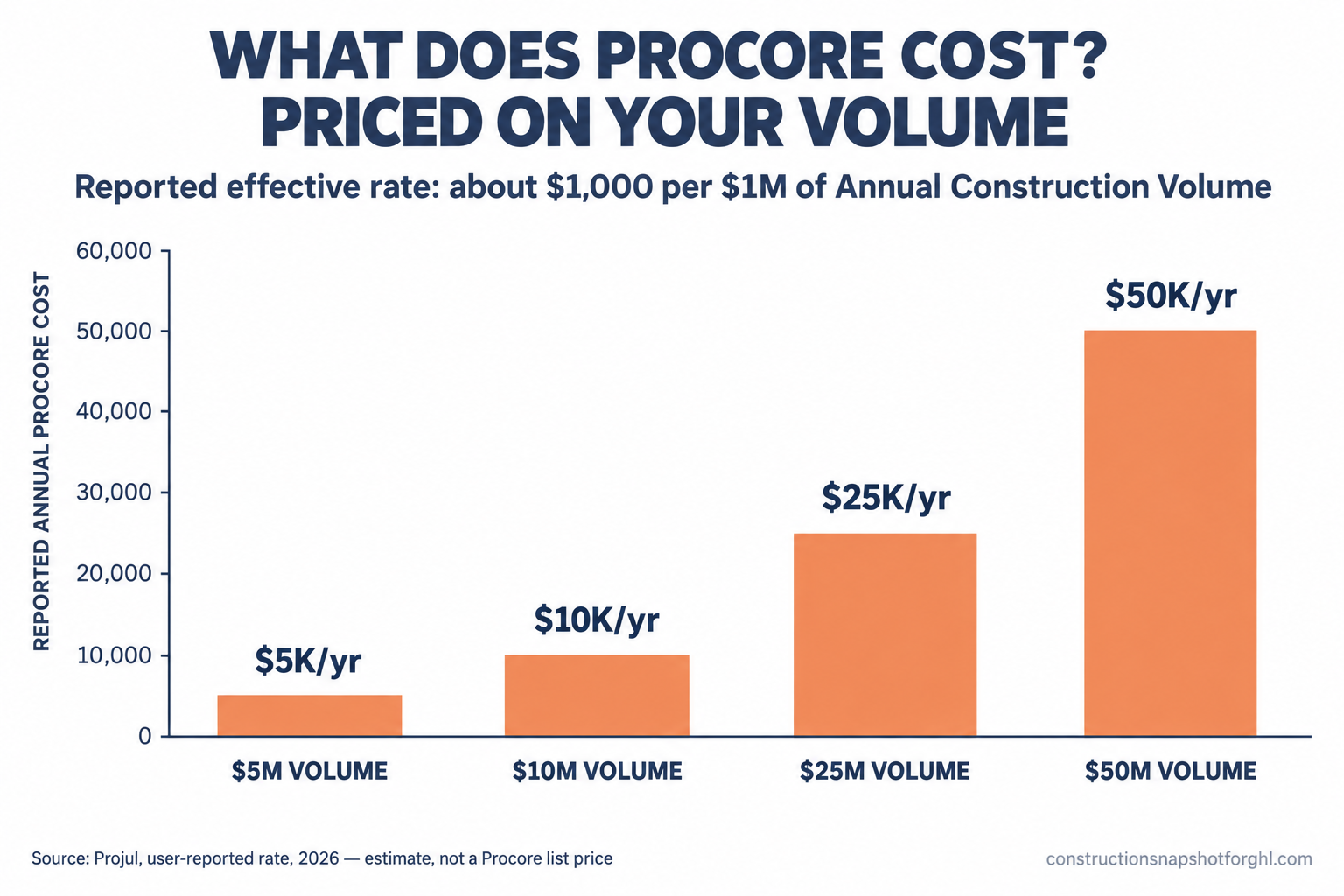
The most useful datapoint is the effective rate. One long-time customer reported paying roughly $500 per $1 million of volume when they signed, and about $1,000 per $1 million now, against a Capterra-listed start near $10,000 a year (Projul). For a small-to-mid contractor at $10M to $50M in volume, reported core cost clusters around $15,000 to $30,000, though bands stretch anyone under $50M in revenue from $10,000 to $80,000 depending on products (OneCrew).
Run the rule of thumb against your own number. At roughly $1,000 per $1M of volume, the math looks like this.
Reported annual Procore subscription at the user-reported rate of roughly $1,000 per $1M of volume, US dollars, 2026. This is a reported effective rate, not a Procore list price, and excludes implementation and add-ons. Source: Projul.
A shop that pushes volume from $25M to $50M in a breakout year faces a subscription that reportedly doubles, on a tool nobody is using any differently. That is the most important thing to understand before you get a quote.
What you actually get for the money
It would be unfair to tear down the price without being honest about the product. The core contract includes unlimited users with no per-seat fee, unlimited storage, 24/7 support, and every update during your term (Projul). For a large GC coordinating hundreds of people across twenty or thirty concurrent jobs, that unlimited-seat model is a genuine bargain, and the depth of its financials, preconstruction and ERP integrations fits complexity a big builder actually has. This is not a “Procore is bad” post. It is priced for someone much bigger than you, and the question for a small builder is whether you will ever use enough of that depth to justify enterprise money. Usually, you will not.
The first-year costs nobody quotes you
The subscription is the smallest part of year one. Three line items rarely make the first conversation, and each is where a quote turns real.
Implementation and onboarding. Procore often calls onboarding “included,” but a real rollout still carries cost. Projul puts a consultant at $10,000 to $30,000, data migration at $2,000 to $5,000, ERP setup at $2,000 to $10,000, and training at $150 to $500 per person, landing a mid-size first year around $35,000 to $75,000 (Projul). Where it breaks: builders budget the subscription, forget the setup, and the year-one invoice arrives at double the plan. Ask what the first twelve months cost, not the first month.
Add-on modules. The base quote may not include the feature you came for. Reported add-ons run $2,400 to $5,000 a year for Quality and Safety, $2,400 to $4,800 for Preconstruction, and $1,200 to $3,600 for Advanced Analytics (Projul). Where it breaks: you compare Procore’s base to a competitor’s loaded plan, think it is close, then add the modules you need and the gap reopens.
Renewal creep. Standard annual renewals are reported to climb 10% to 14% a year (Projul). A $30,000 subscription at 10% is about $40,000 by year four, before you ever grow your volume. Where it breaks: the switching cost of migrating off Procore is so high that most firms just absorb the increase, which is exactly what the model counts on.
Three real cost scenarios
The honest answer changes with the size of your shop. Here are three, from the builder who should walk past it to the one for whom it pencils out.
The solo-to-small operator, $3M to $8M in volume, 2 to 4 office users. At the reported rate this is a $3,000 to $8,000 subscription, which sounds fine until you add implementation and training time. You are now paying four figures for a platform whose depth you will barely scratch. Price it once, prove it is overkill, and cross it off.
The growing mid-size builder, $12M to $25M in volume, 5 to 10 users. This is the builder Procore sales works hardest, and where the quote gets dangerous. A reported $15,000 to $30,000 subscription, plus a $10,000-plus first-year implementation, plus the modules you actually turn on, lands a realistic first year near $35,000 and up, then climbs at renewal (Projul). Price the three-year total and put it next to a transparent tool before you sign.
The large residential or light-commercial GC, $40M-plus, 15-plus users, 20-plus concurrent jobs. Here the model works for you. Unlimited seats across a big team, deep financials and a dedicated admin to run it all can justify the spend. If you are coordinating hundreds of people and the alternative is chaos, Procore is a defensible buy.
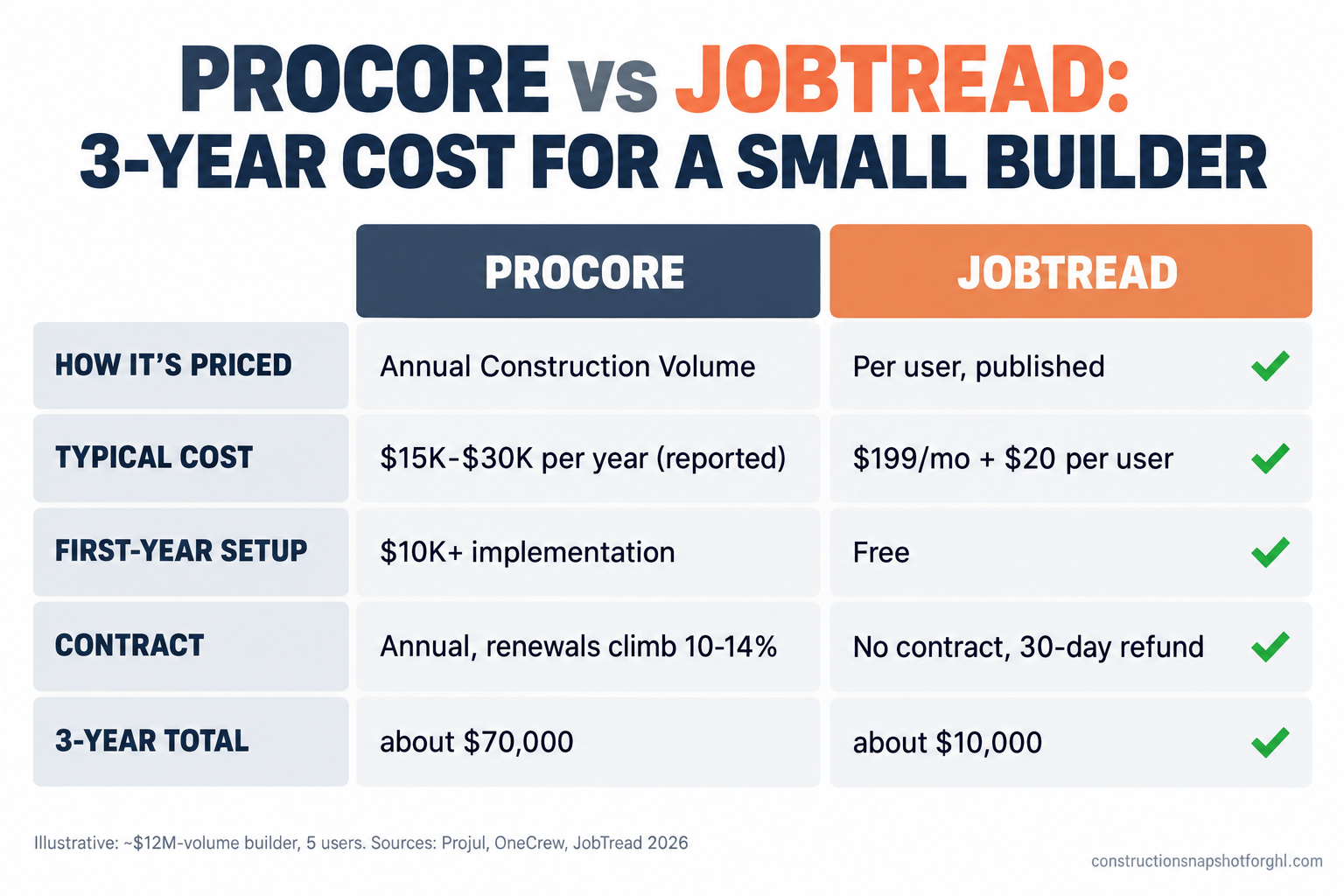
Here is the gap the rep will never put on a slide: three years of Procore against three years of a transparent per-user tool for that $12M, 5-user builder.
Three-year total cost of ownership, illustrative, for a ~$12M-volume builder with 5 internal users, 2026. Procore estimated at a ~$18,000 core subscription, ~$10,000 first-year implementation and 10% annual renewal increases (Projul, OneCrew). JobTread at its published $199/mo base plus four users at $20/mo, no setup (JobTread).
Procore vs a transparent tool for a ~$12M-volume builder
| Feature | Procore | JobTread |
|---|---|---|
| How it's priced | Annual Construction Volume, quote-only | Per user, published |
| Reported / published cost | ~$15K-$30K/yr core (reported) | $199/mo incl. 1 user, +$20/user |
| First-year implementation | ~$10K+ (consultant, migration, training) | Free implementation and training |
| Renewal increases | ~10%-14%/yr on standard terms | No contract, 30-day money-back |
| Best fit | $100M+ GCs, 20+ concurrent jobs | Owner-operators and small-to-mid shops |
Where Procore breaks for a small builder
Price aside, the volume model punishes the builder it is worst suited to. You have a great year, your volume jumps, and your renewal jumps with it, for software your team uses exactly as before. And because migrating off Procore means moving years of data and retraining a team, the switching cost locks you in while renewals climb.
If your real pain is chasing estimates, keeping homeowners calm, and not losing a lead to voicemail, a six-figure platform is answering a question you did not ask. For the multi-way view, our Buildertrend vs Procore vs JobTread comparison puts the three side by side, and the full software pricing teardown covers the rest of the field.
What to price instead
If you are under $50M in volume, price the transparent tools that publish a number and build for your size.
JobTread is the clean benchmark: $199 a month including your first user, additional internal users at $20 each (dropping to $5 past 31 users), with subs, vendors and clients on a free portal so you only pay for internal seats. No setup fees, no contract, annual billing saves 20%, and monthly plans carry a 30-day money-back guarantee (JobTread). It covers estimating, budgeting, scheduling and change orders.
Contractor Foreman is the budget pick that is not a toy, from $49 a month up to about $332 for the unlimited tier (Capterra). Knowify leans into job-costing and QuickBooks accuracy, from around $99 a month plus about $29 per user (Capterra). BuildBook is the simplest, communication-first option at about $79 a month (Capterra), and Houzz Pro fits design-build remodelers who already pull Houzz leads, near $399 a month (Capterra). We broke those three down in JobTread vs BuildBook vs Knowify, and there is a dedicated CoConstruct migration guide if you are coming off a retired product. Every one does the core jobs for a fraction of a Procore quote, and every one tells you the price without a demo.
Steal this: how to pin a rep down on price
The quote-only model works because most builders do not know what to ask.
The seven questions that get you a real number:
- “What is the all-in annual subscription for my volume, in writing, including every module I would use?”
- “What is the one-time implementation cost, and is onboarding, migration and training included or billed separately?”
- “What is your standard annual renewal increase, and will you cap it in the contract?”
- “Which of my products are priced per worker rather than by volume?”
- “What is the contract length, and what happens to my data and my cost if I cancel?”
- “What does the quote look like if my volume drops 30% next year?”
- “Can you put me in touch with a current customer at my size?”
The email that forces a written quote. Send this before you book a second demo.
Subject: Written quote for [Your Company], ~$[X]M annual volume
Hi [Rep], before we go further I need the numbers in writing. Please send: (1) the all-in annual subscription for our volume with the modules we discussed, (2) the one-time first-year implementation and training cost, (3) the standard renewal increase and whether you will cap it, and (4) the contract term and cancellation terms. I am comparing against a published per-user tool, so an itemized year-one and year-three total would help.
The decision rule. With both numbers in front of you, the test is not which is cheaper. It is whether you will switch on enough of Procore’s depth in two years to justify paying several times more than a tool that does your core jobs today. If the answer is no, you have your decision.
The fine print your software spend hides
Two kinds of fine print cost builders real money, neither in a demo.
Contract terms. On any tool, read for the renewal increase and whether it is capped, the cancellation terms and whether annual plans refund, and who can export your data if you leave. Procore’s high switching cost is a feature of its contract, not an accident, so a month-to-month tool with a money-back window like JobTread’s 30-day guarantee is cheaper insurance than an annual discount when you are unsure the tool fits (JobTread).
The rule your software cannot keep for you. No platform makes you compliant. If you build in California, your CSLB license number has to appear in your advertising, and the state tightened its licensing threshold for 2026 (CSLB). Any contract you close in a homeowner’s house for $25 or more carries a federal three-business-day right to cancel under the FTC’s Cooling-Off Rule (FTC). Software stores the paperwork; it does not replace knowing the rule.
The line item none of this covers
Here is the part worth sitting with. Procore, Buildertrend, JobTread, all of them run the job after it is signed. Not one brings you a new lead or saves an estimate that went quiet. The money a small builder actually loses leaks out before the job exists: the missed call that goes to a competitor, the estimate nobody followed up, the homeowner who got anxious and ghosted. We mapped exactly where in where the profit leaked on your last job. That is why a volume-based PM platform is often the wrong first purchase for a small shop. Spend the money where the leaks are, then add a tool priced for your size once the front of the business is tight.
Common objections
“If Procore is this good, isn’t it worth stretching for?” Worth is about fit, not quality. Procore is excellent at coordinating large, complex commercial work. If that is not your business, you are paying for an engine you will drive at ten miles an hour, and that is how software becomes the line item you resent.
“I already got a Procore quote and it wasn’t crazy.” Then price year three, not month one. Add the implementation, add the modules you will actually switch on, and apply the reported 10% to 14% annual renewal increase (Projul). The first-year number is the friendliest you will ever see. Decide on the total.
“Aren’t the cheaper tools a downgrade?” For a small builder, usually the opposite. A tool built for owner-operators, with a published price and free onboarding, gets adopted because it is not drowning you in enterprise features. Adoption beats depth, and the best platform is the one your crew actually opens. If you are stuck mid-contract, price your options now and negotiate the renewal with a written competitor quote in hand.
Frequently asked questions
How much does Procore cost per month?
Procore does not price or bill per month. It charges an annual fee based on your Annual Construction Volume, so there is no public monthly figure. Reported annual cost for a small-to-mid contractor ($10M to $50M in volume) lands around $15,000 to $30,000 for the core platform, before implementation (OneCrew, Projul 2026).
What is Annual Construction Volume pricing?
The price is tied to how much you build in a year, not how many people use the software. The total dollar value of the work you put in place sets the fee, which is why a strong building year can raise your Procore renewal even though your team and usage never changed.
Does Procore charge per user?
No, the core platform includes unlimited users with no per-seat fee, a real advantage for a large team. One exception: the Field Productivity product is reported to be priced per worker, so field modules add per-head cost on top of the volume-based base (Projul 2026).
Is Procore worth it for a small contractor?
Usually not. Third-party analysis and user reports agree Procore rarely pencils out below roughly $50M in volume or fewer than 10 to 15 concurrent projects. A small builder typically pays enterprise money for depth it never turns on, and a transparent tool like JobTread does the core jobs for far less.
What are the best Procore alternatives for a small builder?
The transparent, published-price options are JobTread ($199/mo including one user), Contractor Foreman ($49 to $332/mo), Knowify (from ~$99/mo), BuildBook (from ~$79/mo) and Houzz Pro (up to ~$399/mo). Each tells you the price without a demo and is built for small-to-mid shops.
Sources
- Projul, Procore Pricing Analysis 2026
- OneCrew, Procore Pricing 2026
- Costbench, Procore Pricing 2026
- JobTread pricing
- Capterra, Contractor Foreman pricing
- Capterra, Knowify pricing
- Capterra, BuildBook pricing
- Capterra, Houzz Pro pricing
- NAHB, Three States Drive Over 20% of Remodeling Activity (Aug 2026)
- FTC, Buyer’s Remorse: The Cooling-Off Rule
- California CSLB