
It is a Tuesday in mid-November and you are looking at your schedule for February. It is close to empty. Six weeks ago you were turning work away, crews double-booked, phone ringing while you were up a ladder. Now the last big job is wrapping, two spring clients have gone quiet, and the backlog that felt bottomless in July has a lot of white space on it. You tell yourself it always works out, and it mostly does, but every winter the same knot sits in your stomach: payroll does not take the season off. This is the feast-or-famine cycle, and it is not bad luck. It is a demand curve, and you can plan around it.
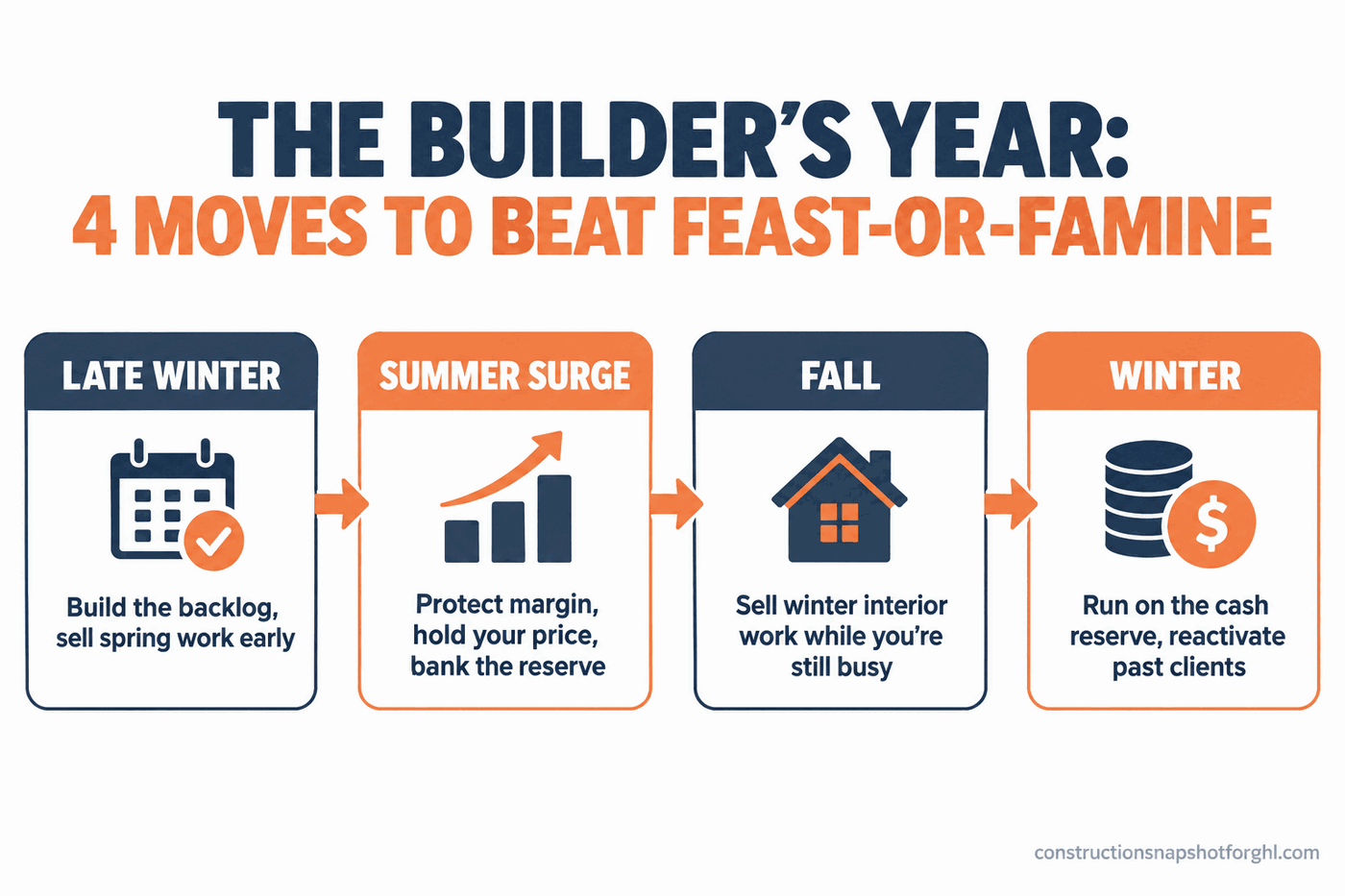
Short version: construction is a seasonal business, and the feast-or-famine swing is predictable enough to run a system against. The builders who stay steady work the year in four moves: build the backlog in late winter before everyone else wakes up, protect margin through the summer surge instead of overcommitting, start selling winter work in the fall while you are still busy, and run the slow season on a cash reserve and a reactivation list instead of panic-priced jobs. The pain is not the slow season itself, it is hitting it with an empty pipeline, no cash cushion, and a price list you are about to cut out of fear.
In this post
- Why the slow season hurts more than it should
- What the feast-or-famine cycle actually costs you
- Move 1: Build the backlog in late winter
- Move 2: Protect margin through the summer surge
- Move 3: Sell winter work in the fall
- Move 4: Run the slow season on reserves and reactivation
- Steal this: the off-season messages
- Three ways this plays out by shop size
- The money side: reserves and not panic-pricing
- Common objections
- Where to start this week
- FAQ
- Sources
Why the slow season hurts more than it should
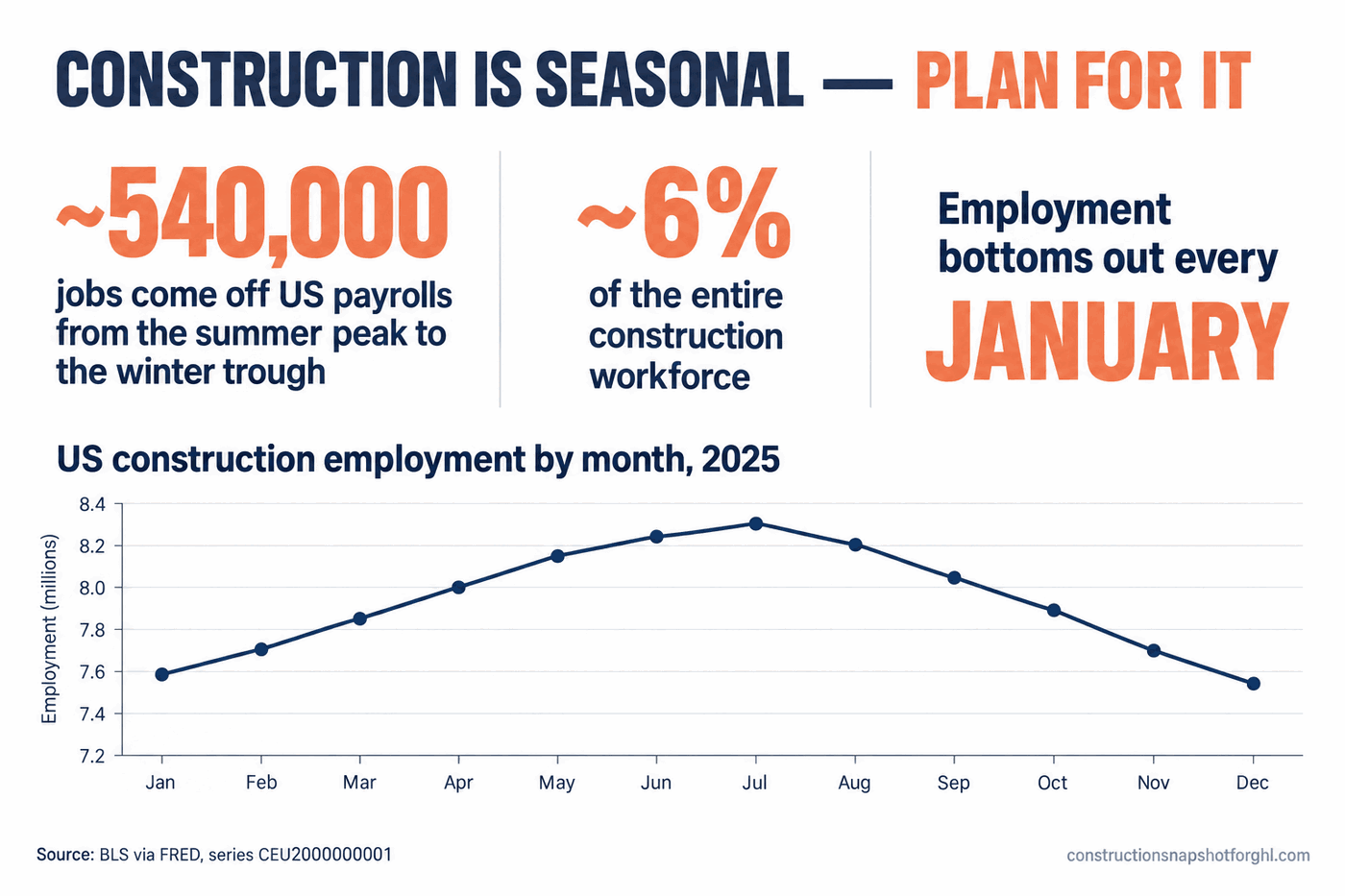
The slow season is not a surprise. It happens on the same schedule every year, and the national numbers prove it. US construction employment, counted without seasonal adjustment, peaks in mid-summer and bottoms out every January. In 2025 it ran from about 8.48 million workers in July down to about 7.94 million the prior January, a swing of roughly 540,000 jobs, close to 6% of the entire construction workforce (BLS via FRED, series CEU2000000001). That is the whole industry breathing in and out on a yearly rhythm.
US construction employment by month in 2025, not seasonally adjusted, in thousands. The summer hump and the January trough repeat every year. Source: BLS Current Employment Statistics via FRED, series CEU2000000001.
So if the cycle is this predictable, why does it still hurt? Because most builders treat it as weather instead of a demand curve they can get ahead of. They run flat out in the busy months with no time to sell the next quarter, then wake up in the slow season with an empty pipeline and sell from a standstill. By the time the January calls come in, it is February work at best, and the gap is paid out of the owner’s own pocket. Knowify, which builds job-costing software for contractors, puts it plainly: contractors who do not understand their own seasonality run a real risk of cash-flow problems and missed chances to improve profit (Knowify). The cycle is not the problem. Getting surprised by it is.
What the feast-or-famine cycle actually costs you
The first cost is panic pricing. When the backlog empties and payroll is still due, a builder takes a job at a rate they would laugh at in June. One bad-rate job is survivable, but the referral comes in expecting that same number, and you have quietly reset your market a year backward. The slow-season discount is the most expensive marketing you will ever do.
The second cost is your crew. Lay good people off in December and some do not come back in March, because a competitor who kept their crew busy hired them first. Then you spend the spring surge short-handed, turning away work you cannot staff. The slow season shows up as a hiring problem in the busy one.
The third cost is the owner. With 128,000 remodeling firms in the country now, nearly double the 69,000 in 2000 (NAHB, August 2026), the builder who rides the cycle blind pays for it in stress and in savings pulled to cover a brutal winter. The four moves below flatten the curve so the whole year pays you, not just five months of it.
Move 1: Build the backlog in late winter
The spring rush does not start when the weather turns. It starts with the homeowners who spent the winter staring at the kitchen they hate, and the builder in front of them in February wins the spring. Late winter is your selling season for spring and early-summer work: run the estimates, lock the deposits, and start the selection and permit clock while your competitors are still hibernating. Walk into the thaw with the first two or three months already booked, not dialing when the sun comes out. This is also when your speed-to-lead discipline matters most, because the few winter leads are high-intent and shopped hard: the builder who answers in five minutes and quotes in two days takes the job from the one who calls back next week.
Where it breaks: treating winter as time off. If you disappear in January and surface in March, you are selling into a market that has already picked its builder. Keep the lights on and keep selling the next season while it is still cheap to.
Move 2: Protect margin through the summer surge
When the work is pouring in, the temptation is to say yes to everything. That is how you end up overcommitted, running three jobs that should be two, bleeding margin on overtime and mistakes. The surge is not the time to grow recklessly. It is the time to be picky, hold your price, and bank the margin that carries you through the slow months. Summer demand means you do not have to be the cheapest bid, so do not bid like it. The margin you protect in July is the reserve that stops you panic-pricing in January, the same discipline behind reading your win rate honestly instead of just bidding more.
Where it breaks: overbooking. Taking on more than you can staff turns your best season into your most stressful one, and the jobs that slip into the fall run into weather and blow their own margin. Book to your real capacity, not your optimism.
Move 3: Sell winter work in the fall
This is the move almost nobody makes, and it is the one that flattens the curve. The fall, while you are still busy, is when you sell the work that keeps crews paid in December and January: interior projects that do not care about the weather. Basements, kitchens, bathrooms, finish work, anything under a roof. A homeowner who wants a kitchen done has no reason to wait for spring, and a winter start means they beat the spring price increase and the spring backlog.
Build a simple fall campaign to your own list and warm leads (“winter crew availability for interior projects, book now for a January start”), then wire it so it goes out, because a CRM built for contractors can run it on autopilot. Fill the winter calendar in October, do not hope for it in January.
Where it breaks: waiting until you are slow to start selling. By the time the schedule is visibly empty, the winter buyers have committed to whoever asked first. Sell winter from a position of being busy, not desperate.
Move 4: Run the slow season on reserves and reactivation
Two things carry you through winter: cash you set aside and clients you already have. The cash is the reserve you built by protecting summer margin, sized to cover a few months of payroll and overhead so a quiet January is a planned event, not an emergency. Knowify recommends exactly this, a contingency fund sized to the next slow period plus a line of credit as backup, and warns against taking bad-rate jobs just to bring cash in the door (Knowify).
The leads are your own past clients: the homeowner you built a deck for two summers ago is your warmest, cheapest winter lead, sitting in your CRM doing nothing. A database reactivation campaign through the slow months, plus a steady email nurture rhythm, turns a quiet list into booked interior work without a dollar of new ad spend.
Where it breaks: no reserve and a cold list. Hit January with no cushion and a list nobody has touched in a year, and you have one lever left, price, and pulling it is how the cycle wins.
Steal this: the off-season messages
You do not need to reinvent the wording. These carry the fall-and-winter campaign. Keep them in your CRM, fill in the brackets, and send on a schedule.
Three ways this plays out by shop size
The four moves are the same at every size. What changes is how much reserve you need and who runs the off-season selling.
Solo operator or two-person shop (6 to 15 jobs a year). You feel the cycle hardest, because one slow month is a big share of your year and you have no bench. Automate the reactivation texts and the winter-availability offer so the fall campaign runs when you have no time to run it. Your edge is that you can run a tiny winter crew cheaply, so even a couple of interior jobs keep you whole.
Mid-size builder (15 to 30 jobs, a few crews). Your problem is payroll. A real crew means winter is expensive, so the fall sell is how you avoid layoffs you will regret in March. Build the reserve to cover the gap, and make the fall winter-work campaign a standard owned by your admin or a GoHighLevel VA, not a thing you remember too late.
Larger GC or production builder (30 to 40 jobs, 10-plus people). At your size the cycle is a planning and cash problem more than a selling one. You smooth it with a backlog managed as a number, a line of credit sized to the seasonal gap, and weather-independent work carried into the winter. The reactivation and nurture run continuously off your CRM’s workflow automation, so the pipeline is a dial you turn up in the fall, not a fire you fight in January.
The money side: reserves and not panic-pricing
It all comes down to cash discipline. Protect summer margin and park a share in a reserve sized to your winter burn. That reserve buys you the right to say no: when the bad-rate job shows up in January, a builder with three months of cushion can pass, while one living draw to draw cannot.
Your billing rhythm matters too: stagger milestones and draws so cash is still landing in the slow months, the same thinking behind a disciplined draw schedule and the reason a profitable build can still leave you broke if the timing is wrong.
Common objections
“My work is weather-dependent, I can’t just invent winter jobs.” You are not inventing them, you are shifting the mix. Exterior-heavy shops still have interior work to sell, and the ones that survive winter well market it in the fall instead of assuming the phone stays silent. If your trade is truly all-exterior, the reserve and the spring pre-booking matter even more.
“I’m too slammed in the summer to think about winter.” That is exactly why it has to be a system, not a decision you make when you have time, because you never will. The fall campaign and the reactivation list run on automation, so being busy does not stop them. Ten minutes to approve a campaign in September keeps your crew paid in January.
“Isn’t a cash reserve just money sitting idle?” It is the cheapest insurance you can buy. The alternative is a line of credit at interest, panic-priced work that resets your margins, or dipping into savings. A reserve that lets you turn down one bad job pays for itself the first winter.
Where to start this week
It is November, the right week for two moves at once. First, look at your pipeline for January and February, be honest about how empty it is, then build and schedule one fall campaign to your past-client list this week: the winter-availability offer and the reactivation text, aimed at interior work. Second, decide what share of your summer margin goes into a winter reserve, and actually move it so it is not available to spend. The fall sell and the reserve are 80% of beating the cycle. Everything else is running the same four moves the same way next year, so the slow season becomes a plan instead of a knot in your stomach.
FAQ
Why is construction so seasonal?
Weather drives it. Cold, snow, and short daylight slow or stop exterior work, and homeowners buy less in winter. The national data is clear: US construction employment, measured without seasonal adjustment, peaks in mid-summer and bottoms out every January, a swing of roughly 540,000 jobs or about 6% of the workforce.
How do builders survive the slow winter season?
With four moves run on a schedule: sell winter interior work in the fall while you are still busy, protect summer margin so you have a cash reserve, keep the pipeline warm with past-client reactivation through the slow months, and avoid panic-pricing jobs just to bring cash in. The steady ones plan the whole year, not just the busy part.
How big should a contractor's cash reserve be?
Enough to cover your fixed burn, payroll plus overhead, through your slow months, which for a shop with a real crew often means two to three months of operating costs. The point is having enough cushion to turn down a bad-rate job in January instead of taking it out of fear. Knowify recommends a contingency fund sized to the next slow period plus a line of credit as backup.
What work can contractors sell for the winter?
Anything under a roof: kitchens, bathrooms, basement finishing, interior remodels, flooring, trim and finish carpentry, and painting all run fine in cold weather. Market that interior work in the fall with a clear offer: book now for a January start and beat the spring rush and the spring price increase.
When should I start selling winter work?
In the fall, while you are still slammed, not in January when the schedule is already empty. By the time your calendar is visibly quiet, the winter buyers have committed to whoever reached out first. A fall campaign to your own list and warm leads, run on automation so being busy does not stop it, is what fills the winter calendar.
Can I automate off-season marketing?
Yes, and you should, because the off-season campaign has to run when you have no time to run it. The fall winter-availability offer, the past-client reactivation texts, and the email nurture can all fire on a schedule from a CRM or GoHighLevel setup built for contractors, so the pipeline keeps filling whether or not you are at a desk.
Sources
- BLS Current Employment Statistics via FRED, All Employees: Construction, not seasonally adjusted (CEU2000000001) (summer peak near 8.48 million in July 2025 versus a January trough near 7.94 million, a swing of about 540,000 jobs).
- NAHB, Three States Drive Over 20% of Remodeling Activity, August 2026 (128,000 remodeling firms, nearly double the 69,000 in 2000).
- Knowify, Strategies for Managing Construction Seasonality (seasonality and cash-flow risk, contingency fund sizing, and the warning against bad-rate slow-season work).