
It is a Tuesday in month four after you handed over the keys, and the text comes in at 6:52am: “Hey, there’s a crack in the drywall above the master door and the guest bath faucet drips. Can someone come look?” You are already loading the truck for a different job. You fire back “Will get someone out,” and then the day eats the message whole. Nobody logs it. Nobody schedules it. Two weeks later the homeowner texts again, angrier, and this time they mention they were about to leave you a review. Now you are not fixing a hairline crack, you are rescuing a reference.
Here is the short version. A callback is not a nuisance, it is the last stage of the job, and most builders have no process for it, so it gets handled by whoever happens to see the text. That is where the margin leaks and the reviews die. The fix is a simple, repeatable callback system: one intake channel so nothing gets lost, a one-day triage that sorts every request into warranty work, a missed punch-list item, normal wear, or a paid change, a scheduled fix with the right person paying for it, and a close-the-loop message that asks for the review at the exact moment the homeowner is relieved. Run it the same way every time and callbacks stop costing you money and start earning you your next job.
In this post
- What callbacks actually cost you
- Why callbacks are a system problem, not a people problem
- Stage 1: Set the warranty terms in the contract
- Stage 2: Close out clean so there is less to call back about
- Stage 3: One intake channel, logged every time
- Stage 4: Triage every callback within a day
- Stage 5: Schedule the fix and decide who pays
- Stage 6: Close the loop and ask for the review
- Steal this: the four messages that run the whole process
- Three ways this plays out by shop size
- The legal part: warranty windows and the clauses that protect you
- Common objections
- Frequently asked questions
- Sources
What callbacks actually cost you
Rework is the quiet line item nobody puts on the job cost sheet. A 2026 study published by the American Society of Civil Engineers measured field rework on a contractor’s real projects at about 0.76% of contract value once post-completion corrections were counted, with a single project hitting 7.34%, and the authors noted earlier estimates have run as high as 12.4% of contract value when change orders and quality issues are combined (ASCE). The researchers also flagged that the real number is routinely under-reported, because the post-completion fixes, the callbacks, mostly never make it into the cost data at all. That is the part that hits a small builder hardest. On a $180,000 remodel, even 1% is $1,800 of unbilled labor and material you already spent and will never invoice.
Field rework and defect-correction cost as a percentage of contract value. Measured figures are from a single contractor’s projects; the high-end figure is from earlier estimates combining change orders and quality issues. Source: ASCE Civil Engineering Source, 2026.
Then there is the cost that does not show up on any sheet: the review. A homeowner who had a problem and got it fixed fast will often say so in public. A homeowner who had a problem and got ignored will also say so in public, and that one travels further. Review behavior backs this up. In BrightLocal’s 2025 survey, 74% of consumers said they use two or more websites when researching a local business, and only 4% said they never read reviews at all (BrightLocal). For a builder who lives on referrals and a Google profile, one furious callback review is not a bad day, it is a dent in your lead flow for the next year. Callbacks are where your margin and your reputation get decided at the same time, which is exactly why you cannot leave them to chance.
Why callbacks are a system problem, not a people problem
Walk into most 6-to-40-job shops and ask who handles callbacks. The honest answer is “whoever the homeowner happens to text.” Sometimes that is you, sometimes the lead carpenter, sometimes the office. The request arrives as a text, a voicemail, an email, or a comment to a crew member on site, and it lives in that one channel until someone remembers it. There is no list. There is no owner. There is no clock. That is not a discipline problem, it is a design problem, and you cannot fix a design problem by telling people to try harder.
The builders who do this well are not more conscientious than you. They just route every callback into one place, sort it the same way every time, and let a system, not their memory, carry it from “homeowner has a problem” to “problem fixed and logged.” That is the whole move. The six stages below are that system. You can run it on paper, in a spreadsheet, or inside a CRM built for how contractors work, but the stages do not change.
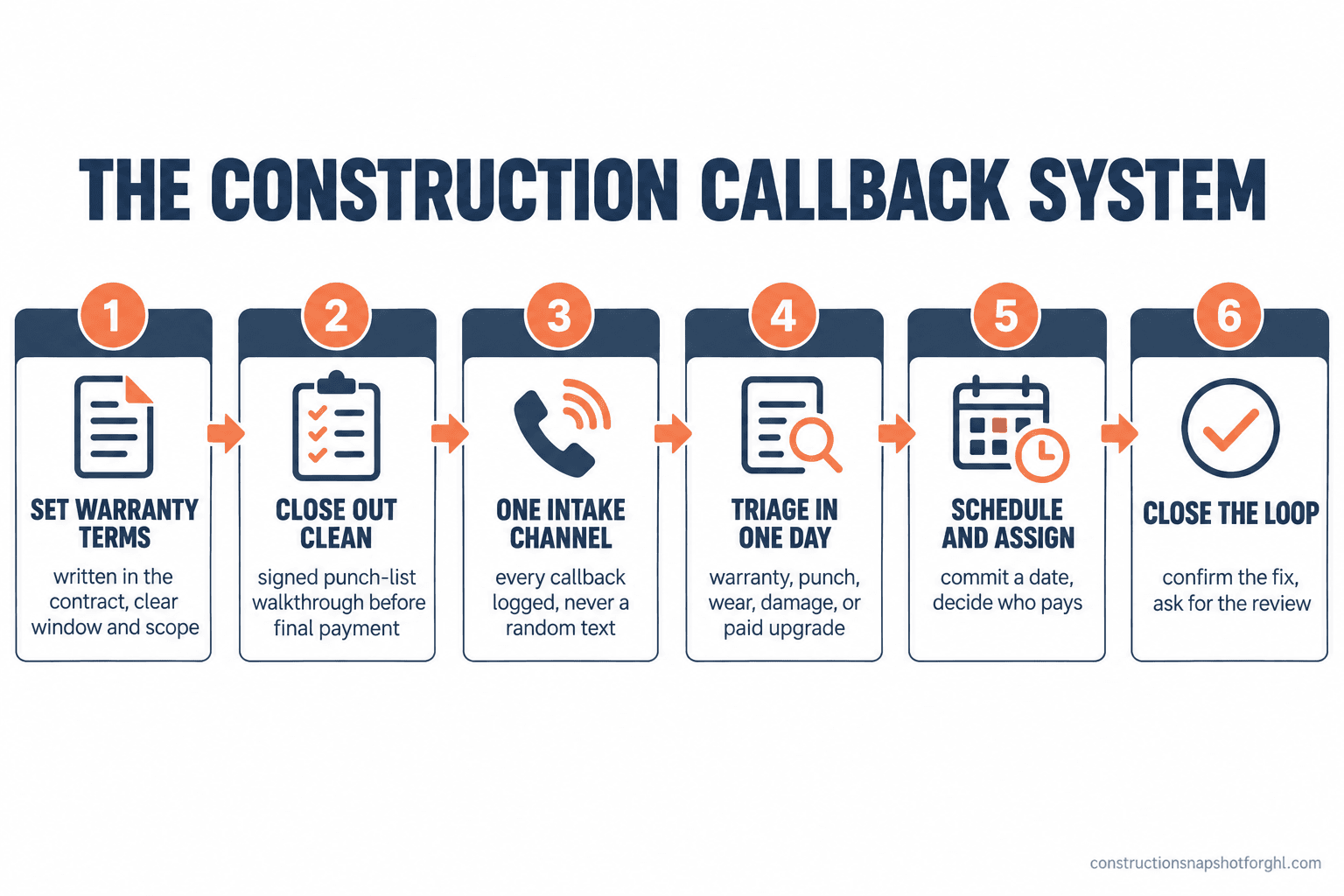
Stage 1: Set the warranty terms in the contract
The callback process starts before the first callback, in the contract. If your agreement does not spell out what your warranty covers, for how long, and what it does not, then every callback becomes a negotiation, because the homeowner’s expectation and yours were never written down. The industry has a well-worn shorthand for new-home coverage, the “1-2-10” structure: roughly one year on workmanship and finishes, two years on systems like plumbing and electrical, and up to ten years on structural elements (2-10 Home Buyers Warranty). You do not have to adopt that exact split, but you do have to write down yours.
Put three things in plain language. What is covered (defects in your workmanship and the materials you supplied). How long (your workmanship period, commonly one year for a remodeler). What is not covered (normal wear, homeowner-caused damage, maintenance items, and anything outside the signed scope). Then hand it to the homeowner at closeout, not buried on page nine of the contract they signed months ago.
Where it breaks: the vague warranty. “We stand behind our work” feels generous and costs you dearly, because it has no end date and no edges, so a homeowner can read it to mean you will fix anything forever. Write a real window and a real scope. A clear one-year workmanship warranty you honor fast beats an open-ended promise you quietly resent.
Stage 2: Close out clean so there is less to call back about
The cheapest callback is the one that never happens because you caught it at closeout. Most of what comes back in the first month is not a true warranty defect, it is a punch-list item that was missed or rushed at the end. A disciplined punch-list process that gets a signed walkthrough before final payment is your single biggest callback-reduction tool. Walk the home with the owner, write every item down together, fix them, and get a sign-off that the work is accepted.
That sign-off does double duty. It knocks out the small stuff before it becomes a 7am text, and it creates a clean line between “work we still owed you” (punch) and “something that came up later” (callback). Without that line, every later request can be framed as “you never finished,” and you lose the argument before it starts.
Where it breaks: the rushed final walkthrough. When you are chasing the last draw and the homeowner is desperate to move in, it is tempting to skip the formal walkthrough and just “handle anything that comes up.” That is how three months of dribbling callbacks replace one afternoon of punch work. Slow down for the walkthrough. It is the best-paying hour on the whole job.
Stage 3: One intake channel, logged every time
Here is the rule that fixes more callback chaos than any other: every callback goes to one place, and that place creates a record. Not your personal cell. Not a crew member’s text thread. One channel, whether that is a dedicated phone line, a short web form you give every client at closeout, or a reply to the warranty email you already sent them. The moment a callback lands, it becomes a logged item with a date, the homeowner’s name, the job, and a description, and it stays open until it is closed.
Why this matters so much: a callback you cannot see is a callback you cannot manage. If three requests are sitting in three different crew members’ phones, you have no list, no priority, and no way to know the oldest one is now three weeks old and about to become a review. A single logged channel turns “did anyone ever deal with the Hendersons’ faucet?” into a question you can answer in five seconds.
This is also the stage that is easiest to automate. A missed-call text-back and intake workflow can catch the after-hours warranty call, text the homeowner back automatically so they feel heard, capture the details, and drop a logged task in front of whoever owns callbacks, all before you have put the coffee down.
Where it breaks: the side-channel text. The homeowner has your personal number from the build, so of course they text it. The fix is not to scold them, it is to redirect warmly and consistently: “Glad you caught that. So it does not get lost, can you send it to [your intake], and I will make sure it is scheduled.” Do that every time and the channel trains itself.
Stage 4: Triage every callback within a day
Not every callback is your problem, and not every callback is free. The single most expensive mistake builders make is treating all of them the same, either fixing everything for free (and bleeding margin) or arguing about everything (and bleeding reviews). The fix is a one-day triage that sorts each request into one of five buckets, because who pays depends entirely on which bucket it lands in.
Callback triage: what you are actually looking at
| Feature | Who pays for it | How you handle it |
|---|---|---|
| Warranty defect (your work or material failed) | You, or your sub | Fix it fast at no charge, log it, keep the proof |
| Missed punch-list item | You | Complete it, it was always owed, no debate |
| Normal wear or maintenance | Homeowner | Explain kindly, point to the home-care notes |
| Homeowner-caused damage | Homeowner | Document it, offer a paid repair quote |
| New request or upgrade | Homeowner (paid) | Write a change order or a fresh estimate |
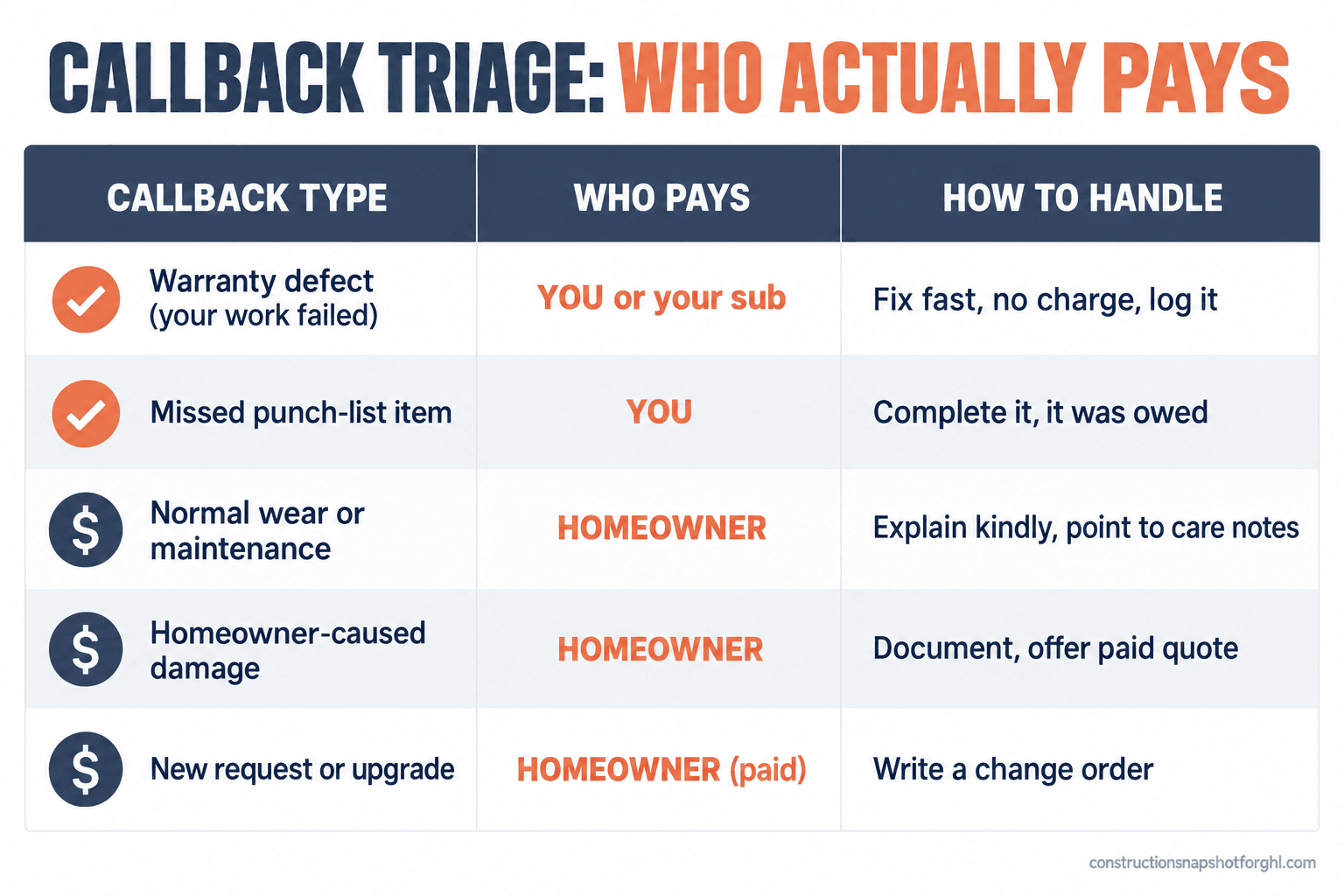
The decision rule is simple: did our work or the material we supplied fail to perform the way it should have within the warranty window? If yes, it is warranty, and you move fast and eat the cost with a smile. If no, it is one of the other four, and you handle it honestly but you do not pay for it. The speed of this triage is what keeps a small issue from curdling. A homeowner can accept “that is a maintenance item, here is how to handle it” without resentment if you answer within a day and explain it kindly. The same answer three weeks late reads as a dodge.
Where it breaks: the free-fix reflex. To avoid an awkward conversation, you quietly fix the out-of-scope stuff for free, over and over, and call it good customer service. It is not, it is an unfunded warranty you never agreed to, and it trains the homeowner to send you everything. Being fast and warm on true warranty work earns you the right to say “that one is not covered, but here is what I can do” on the rest.
Stage 5: Schedule the fix and decide who pays
Once a callback is triaged as warranty work, two things have to happen fast: it gets on a schedule with a committed date, and you decide internally who does the work and who absorbs the cost. If the failure is in a sub’s scope, the sub fixes it or pays for it, and your contracts with your subs should say exactly that. A good subcontractor agreement carries the warranty obligation down to the trade that did the work, so a bad window unit or a leaking supply line is the HVAC or plumbing sub’s callback, not a line item you eat out of your own margin.
Give the homeowner a real date, not “sometime soon.” A committed window, even one a week out, lands far better than a vague promise, because the anxiety in a callback is rarely about the crack itself. It is about whether the builder is going to disappear now that the check has cleared. A date says you did not disappear. Then batch the small stuff. If you are already sending a crew across town, pull the open callbacks in that area and knock out three truck rolls in one, which is where you claw back the margin that rework quietly took.
Where it breaks: the sub who has moved on. The hardest callbacks are the ones that belong to a sub who is now busy on someone else’s job and slow to come back for warranty work. Two defenses: hold a small retention or make warranty response an explicit term in the sub agreement, and keep a backup trade who will do warranty fixes for pay when the original sub ghosts. Either way, the homeowner never waits on your dispute with a sub. You fix it, then you settle up behind the scenes.
Stage 6: Close the loop and ask for the review
This is the stage almost everyone skips, and it is the one that turns a cost into an asset. When the fix is done, you confirm it with the homeowner in writing, mark the callback closed in your log, and, right then, ask for the review. The timing is the whole trick. A homeowner is never more favorably disposed toward you than in the hour after you showed up on time and fixed their problem for free. That is the moment the five-star review is easiest to get, and it is the exact moment most builders pack up the van and say nothing.
Tie the ask to the relief. “Really glad we got that sorted for you. If you have 30 seconds, a quick Google review helps other homeowners find us, here is the link.” A review-harvesting workflow can fire that message automatically the moment a callback is marked closed, so you never have to remember and the request always lands at the peak moment. The callback that started as a 7am panic text ends as a public endorsement, which is the whole reason to run this process instead of winging it.
Where it breaks: the silent close. You fix it, you leave, and you never confirm it is done or ask for anything. The homeowner is left wondering if that was really the end of it, and the goodwill you just earned evaporates unused. Say the fix is done. Ask for the review. Close the loop out loud.
Steal this: the four messages that run the whole process
Three ways this plays out by shop size
The same six stages scale, but what you automate and who owns the process changes with your size.
The solo operator or small remodeler (6 to 12 jobs, 1 to 3 people). Your whole callback list might be two or three open items at a time, and you are the one fixing them. Your risk is not volume, it is that callbacks arrive while you are on a ladder and get forgotten. Keep it dead simple: one intake number or form, a single running list you check every morning, and the four messages above saved as text snippets on your phone. Automate just the intake, so an after-hours call texts the homeowner back and logs itself. That one piece removes the “I forgot” failure almost entirely.
The mid-size design-build or remodeling firm (15 to 25 jobs, 5 to 10 people). Now callbacks come in faster than one person can track in their head, and the handoff between office and field is where things fall through. Assign one owner for callbacks, usually the office or a project coordinator, and run every request through a shared log so the owner and the crew see the same list. This is the size where automating the triage routing and the review ask pays off, because the volume is high enough that manual follow-up quietly slips. A trained coordinator or GHL VA can own the whole loop end to end.
The larger GC or production builder (30 to 40 jobs, 10-plus people). At this volume, callbacks are a department, not a task, and the real money is in the seventh stage this list implies: tracking patterns. When your log shows the same defect, say a specific window unit or a flashing detail, coming back across jobs, you have found a recurring cost you can kill at the source by changing a product, a spec, or a sub. That is where a small builder’s callback list becomes a large builder’s quality program, and it only works if every callback was logged in one place from the start. The front end of the business is where profit leaks worst; the back end is where it leaks quietest.
The legal part: warranty windows and the clauses that protect you
Two legal realities shape how you write your warranty, and both vary enough by state that a national template will be wrong for someone. Scope yours to where you actually build.
First, you may owe a warranty even if you never wrote one. Many states recognize an implied warranty of good and workmanlike construction, a duty that your work meet a basic standard of competence, and in some states it cannot be easily disclaimed. Texas, for example, has held that repair work carries a non-waivable implied duty of good and workmanlike performance (Florida Bar Journal). The practical lesson: a written warranty does not just create an obligation, it also lets you define and bound one that may already exist by law.
Second, defects can surface for years, and how long you are exposed is set by your state’s statute of repose, the outer deadline for a defect claim measured from substantial completion. These run roughly 6 to 10 years in most states, with some shorter and a few with none at all, so the window a homeowner can come back in is not something you get to decide (CAI state chart). You are not required to service every item for that whole period, but your workmanship warranty should be written with your state’s exposure in mind, and your records should outlive your warranty window.
Typical new-home warranty windows in years under the common 1-2-10 structure. Your written workmanship warranty is usually the one-year band; structural exposure can run far longer under state law. Source: 2-10 Home Buyers Warranty.
Two more clauses worth baking into your templates while you are in there. If you ever close a deal in the homeowner’s home for more than $25, the FTC Cooling-Off Rule gives the buyer three business days to cancel and requires you to give written notice of that right at the time of sale (FTC). And if you build in California, your CSLB license number is required by law in all your advertising, from your website to your trucks, under Business and Professions Code 7030.5 (California BPC 7030.5). None of this is legal advice, and a contract lawyer in your state is cheap insurance against an expensive callback that turns into a claim.
Common objections
“Won’t a formal callback process annoy clients who just want it fixed?” The opposite. What annoys clients is uncertainty, the silence after the text, the not knowing if anyone heard them. A process is what lets you answer within a day with a real date, which is exactly what they want. The form or the logged channel is invisible to them. All they see is a builder who responds fast and follows through, which is the whole point.
“I already pay for project-management software, doesn’t it handle this?” Check, because most project-management tools go quiet the day the job closes, which is the day callbacks start. They are built to run the active build, schedules, budgets, selections, not the warranty tail that comes after. If yours has a warranty or ticket module, use it. If it does not, the intake and follow-up piece is exactly the kind of gap a front-end CRM and automation layer fills, sitting in front of or beside the PM tool.
“My subs should just handle their own warranty work, why is this on me?” Because the homeowner signed with you, not your sub, and they will review you, not your sub. You can and should push the cost and the labor down to the trade that did the work, but you own the relationship and the clock. The process keeps that clean: you take the callback, you triage it, and if it is the sub’s, you dispatch and settle behind the scenes. The homeowner never waits on your argument with a trade.
“We only get a few callbacks, is this worth the setup?” A few callbacks a year is exactly when a system pays off, because low volume is when you are most likely to forget one, and one forgotten callback can cost you a referral stream worth more than a year of jobs. The setup is an afternoon: pick your intake channel, write your five triage buckets, save the four messages. You are not building a bureaucracy, you are making sure the three that do come in never fall through.
Where to start this week
Go back to that 6:52am text. The builders who come out of it with a review instead of a feud are not working harder, they just never let the message disappear. Pick your one intake channel today and tell your next three closeout clients to use it. Write your warranty window and your five triage buckets on a single page. Save the four messages. That is the whole system, and it is the difference between callbacks that quietly drain your margin and callbacks that hand you the next job. The front-end automation that logs, routes, and follows up on all of it is the piece we build.
Frequently asked questions
What is a construction callback?
A callback is any request from a homeowner to come back after the job is finished, whether to fix a genuine warranty defect, complete a missed punch-list item, address normal wear, or handle a new request. Treating all callbacks the same is the core mistake. The right process sorts each one into who-pays buckets and handles it accordingly, fast.
How long should a contractor's workmanship warranty last?
The most common workmanship warranty for residential work is one year, which lines up with the 'fit and finish' band of the industry 1-2-10 structure (one year workmanship, two years systems, up to ten years structural). You set your own written window, but it should be a real, bounded period with a clear scope, not an open-ended 'we stand behind our work' promise that never ends.
Who pays when a subcontractor's work fails after the job is done?
The sub should, and your subcontractor agreements should say so explicitly, carrying the warranty obligation down to the trade that did the work. But from the homeowner's side, it is your callback, because they signed with you. Best practice is to take the request, schedule the fix, and settle the cost with the sub behind the scenes so the homeowner never waits on your dispute.
Do I have to honor a warranty I never put in writing?
Possibly. Many states recognize an implied warranty of good and workmanlike construction, a legal duty that your work meet a basic standard, and in some states it is hard to disclaim. A written warranty does not only create an obligation, it lets you define and bound one that may already exist by law. Check your state, and have a local contract lawyer review your template.
How do I get a review out of a callback instead of a bad one?
Timing. Ask for the review in the hour after you fixed the problem, because that is when the homeowner is most relieved and most favorable. Confirm the fix is done in writing, close the callback out, and send a short, warm review request with a direct link right then. A review-harvesting workflow can fire that message automatically the moment a callback is marked closed.
What is the fastest way to stop losing callbacks?
Route every callback to one logged channel instead of whoever the homeowner happens to text. The single most common cause of a lost callback is that it lived in one person's phone with no record and no owner. One intake channel that creates a dated, trackable item, and a quick same-day acknowledgement, removes almost all of the 'we forgot' failures by itself.
Sources
- ASCE Civil Engineering Source: How much does field rework in construction actually cost? (2026)
- BrightLocal: Local Consumer Review Survey 2025
- 2-10 Home Buyers Warranty: Builders warranty basics (1-2-10)
- Florida Bar Journal: Deconstructing Warranties in the Construction Industry
- CAI: State construction defect statutes of limitation and repose chart
- FTC Cooling-Off Rule
- California BPC 7030.5 (license number in advertising)
- NAHB: Three states drive over 20% of remodeling activity (Aug 2026)