
The job is closed out. The client is happy, the punch list is done, and you finally sit down to reconcile the numbers. The estimate said this remodel would leave you with a decent margin. The bank balance says something else. You made money, sort of, but nowhere near what the bid promised, and you cannot point to the one thing that went wrong. There was no disaster. No lawsuit, no failed inspection, no sub who walked. The profit just is not there, and you are left with the same feeling you had after the last three jobs: it leaked out somewhere and you never saw it go.
Here is the short version. Profit does not usually vanish in one big mistake. It leaks, in small amounts, from six predictable places: an estimate built on soft assumptions, change orders you did the work for but never priced or signed, selection and allowance overages you quietly ate, rework and sub no-shows that make you pay for the same work twice, slow draws and retainage that force you to finance the client, and the pile of estimates you chased that never closed. None of them looks big on its own. Together they are the difference between the margin on the bid and the margin in the bank. This post walks each leak, shows you how to find it on the job you just finished, and gives you the exact messages and rules that plug it before the next one starts.
In this post
- Made money vs. kept money: the two numbers that matter
- The six places your profit actually leaks
- Run the leak audit on your last job
- Steal this: the messages that plug the three biggest leaks
- The same leaks look different at three sizes
- The legal side of the change-order leak
- Common objections
- Frequently asked questions
- Sources
Made money vs. kept money: the two numbers that matter
Before you can find the leak, you have to know which number you are watching. Most builders quote a gross margin and feel the pain in the net one, and the gap between the two is where every leak in this post lands.
Gross margin is what is left after the direct cost of the job: materials, labor, and subs. Net margin is what is left after that and your overhead: the truck, the office, the insurance, the estimator, you. The numbers are humbling. In the NAHB Cost of Doing Business study, single-family home builders ran a 20.7 percent gross margin and an 8.7 percent net margin in 2023, which was near the highest net in three decades (NAHB via Eye on Housing). Remodelers in 2024 ran a 29.9 percent gross and a 6.3 percent net, the best net since 1996 (Pro Remodeler, NAHB data). Read that again. In a good year, a remodeler keeps about six cents on the dollar.
Gross vs. net profit margin, single-family home builders (2023) and residential remodelers (2024), from the NAHB Cost of Doing Business studies (builders, remodelers). The gap between the two bars is overhead, and it is where every leak in this post shows up.
That thin net is the whole reason leaks matter so much. When you keep six to nine cents on the dollar, a small hole is not small. A job that leaks two points of margin has given away a quarter to a third of the profit it should have made. You do not need a catastrophe to lose money on a good job. You need three or four small leaks running at once, which is exactly what happens on most builds.
The six places your profit actually leaks
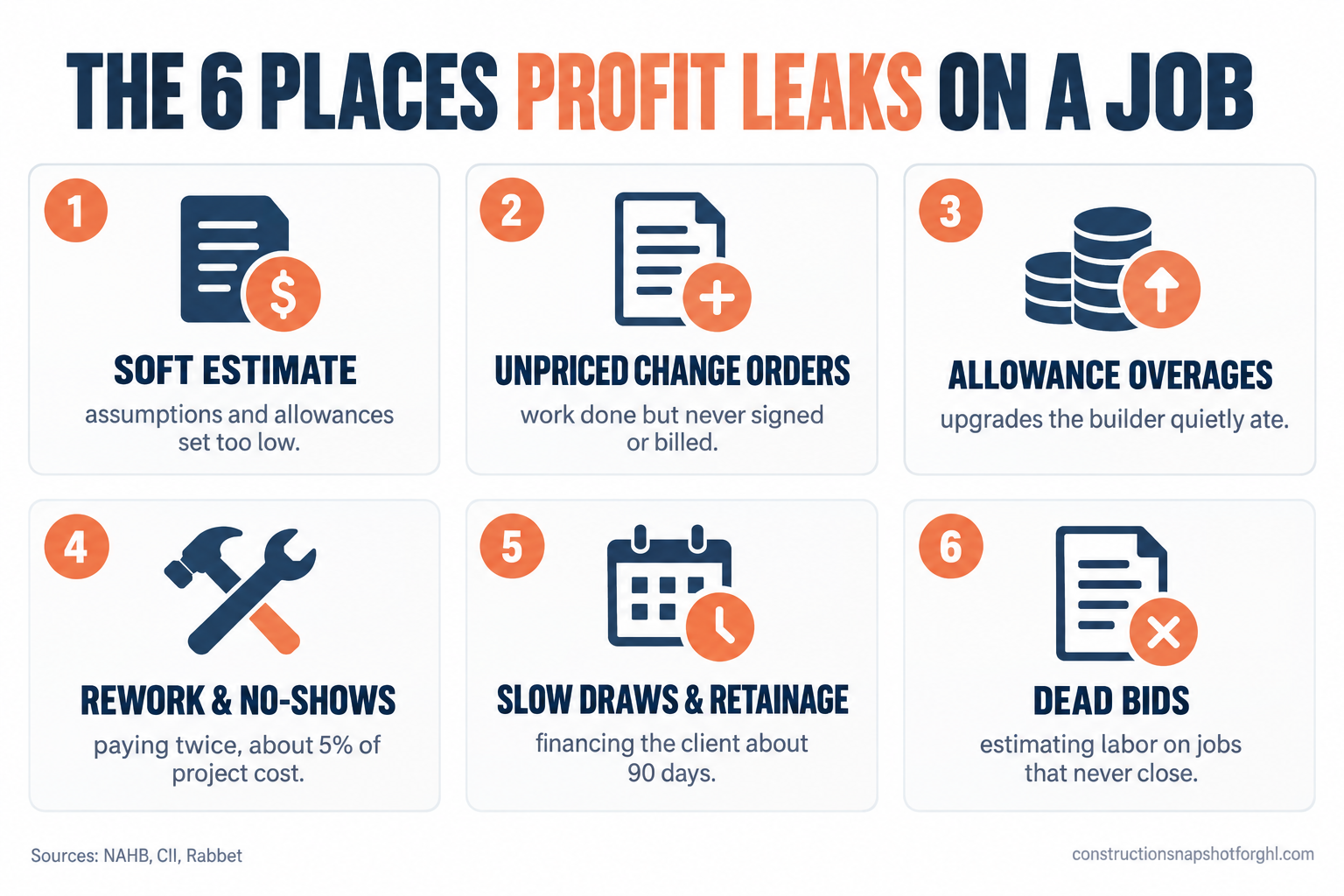
Here they are, in the order they hit a job. Each one has a way it hides, which is why you finish the build knowing you lost money without knowing where.
Leak 1: The estimate was soft before you swung a hammer. Most margin is won or lost before the job starts. An estimate built on last year’s material prices, a labor number you guessed instead of tracked, or an allowance you set low to keep the bid competitive is a leak with a delayed fuse. It looks fine on paper and bleeds all through the build. Where it hides: you never compare the final job costs back to the estimate line by line, so the same optimistic assumptions ride into the next bid and leak again. The fix is boring and it works: track actual costs per phase on the job you just finished, and build the next estimate from what things really cost, not what you hoped they would.
Leak 2: Change orders you did but never priced or signed. This is the single most common leak I see, and the most avoidable. The client asks for a small change on the jobsite. You say sure, we will sort it out later, and you do the work. Later never comes, or it comes as one ugly line on the final invoice that starts a fight. At a 6 percent net margin, an unbilled $4,000 change order is not a $4,000 loss. You have to sell and build about $67,000 of brand-new work just to earn that $4,000 back. Where it hides: verbal approvals on site, never written down. The fix is a hard rule, covered in detail in our change-order breakdown: nothing that moves the price gets built until it is priced and signed.
Leak 3: Allowance overages you quietly ate. The client picks the $9,000 tile against a $4,000 allowance, and somewhere between the showroom and the invoice the extra $5,000 becomes your problem instead of theirs. Same story with the upgraded appliance package, the extra can lights, the better windows. Each one feels too small to make a thing of, so you eat it, and by closeout you have absorbed real money. Where it hides: allowances set too low at bid time to win the job, then a soft spine when the overage lands. The fix is honest allowances set from real prices and a selections process that turns every over-allowance choice into a signed change order before you order the product.
Leak 4: Rework and sub no-shows that make you pay twice. When a sub does not show and the schedule collapses, or work gets built wrong and has to be torn out and redone, you are paying for the same square footage twice. This is not a rounding error. The Construction Industry Institute found that field rework averages about 5 percent of total project cost, and reaches the low double digits on the worst jobs, with nearly half of it caused by poor or late information rather than bad workmanship (CII). On a $300,000 remodel, 5 percent is $15,000, which is most of the net profit on the whole job. Where it hides: rework gets absorbed into general labor and never tracked as its own cost, so you never see how big it is. The fix is scheduling discipline and confirmed commitments, the same problem we dig into with subcontractor no-shows.
Leak 5: Slow draws and retainage, where you finance the client. You have paid your subs and your suppliers, but the client’s draw has not cleared, so the money going out is yours. The average construction invoice took about 90 days to get paid in 2024, and 82 percent of contractors said they waited longer than expected, up sharply from two years earlier (Rabbet). On top of the slow pay, retainage of 5 to 10 percent is commonly held back until the job is substantially complete (Corpay). Every day that money sits with the client, you are financing their project out of your pocket, and if you are carrying a line of credit to do it, the interest is a straight subtraction from net. Where it hides: cash-flow pain feels like a banking problem, not a job-costing one, so it never gets attributed to the job that caused it. The fix is a tight draw schedule tied to milestones and an invoicing rhythm that goes out the day a phase is done, not the week you get to it.
Leak 6: The estimates you chased that never closed. Every bid you write costs you real hours, and most of them never become work. The estimating labor on a dead bid does not disappear. It becomes overhead that your live jobs have to carry, which pushes your break-even up on everything you do win. Where it hides: estimating time is almost never tracked, so the cost of losing feels like zero. It is not zero. The fix is qualifying harder before you bid and, just as important, actually following up on the estimates you send, because a large share of bids die from silence, not from a no.
Run the leak audit on your last job
You do not need accounting software to find these. Pull the file on the job you just finished and answer six questions honestly. Each one maps to a leak above, and the pattern tells you where your money is actually going.
The six-question leak audit (run it on your last closed job)
| Feature | Ask yourself | If the answer is bad, the leak is |
|---|---|---|
| Estimate accuracy | Did final costs land within 5% of the estimate, per phase? | Soft estimate (Leak 1): rebuild the next bid from actuals |
| Change orders | Was every scope change priced and signed before it was built? | Unpriced changes (Leak 2): make signed-before-built a rule |
| Allowances | Did any over-allowance upgrade get absorbed instead of billed? | Overages eaten (Leak 3): set honest allowances, sign the delta |
| Rework | Did you pay to redo or re-sequence any completed work? | Rework (Leak 4): track it, then fix the info that caused it |
| Cash flow | How many days did your money sit ahead of the client's? | Slow draws (Leak 5): milestone draws, same-day invoicing |
| Estimating load | How many hours went into bids that never closed? | Dead bids (Leak 6): qualify harder, follow up every bid |
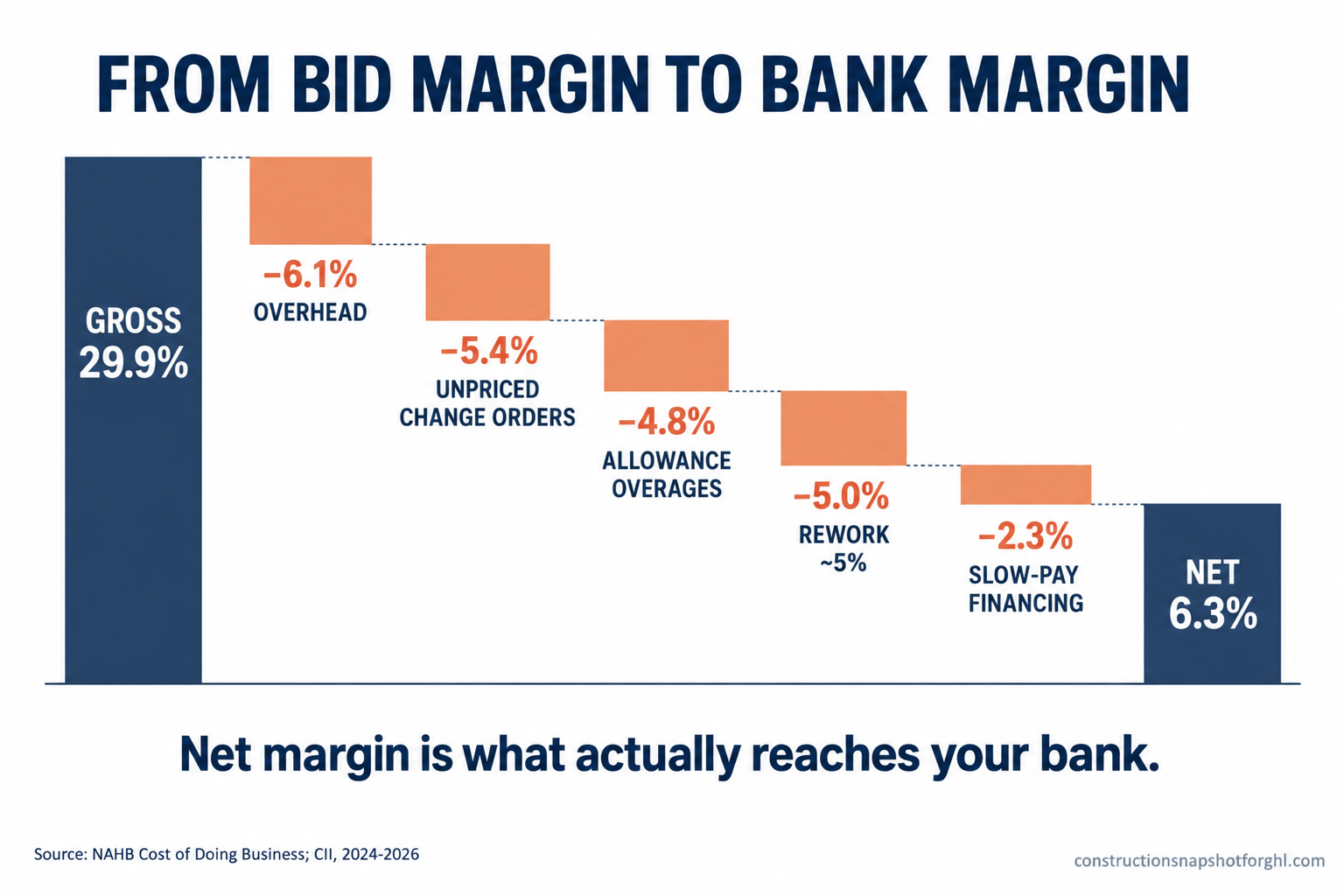
The point of the audit is not to feel bad about the last job. It is to find the two leaks that are costing you the most, because they are rarely the ones you assume. Most builders blame material prices, which they cannot control. When they actually run the numbers, the biggest holes are usually change orders and rework, both of which are process problems you can fix without lowering a single bid.
One more reason to run it: the market is not going to bail you out. There are about 128,000 remodeling firms in the US as of early 2025, up from 69,000 in 2000, and home-improvement spending is projected to reach roughly $522 billion by the end of 2026, with growth slowing from 2.9 percent to 1.6 percent over the year (NAHB, JCHS via Qualified Remodeler). More firms, slowing demand, and thin margins mean the builder who plugs leaks keeps the profit the disorganized competitor gives away.
Steal this: the messages that plug the three biggest leaks
Most leaks close with a conversation you keep meaning to have and never do on a busy week. Here is the exact wording for the three that matter most, ready to send. Copy them, change the brackets, and put them to work on your next job.
Sending these by hand works right up until the week you are slammed, which is every week. The smartest move is to trigger the change-order confirmation, the draw reminder, and the retainage request off the job’s milestones so the message never depends on you being at a desk. That is the same follow-up discipline that decides whether your bids ever get signed, pointed at the decisions and payments that decide whether the job you already won actually pays.
The same leaks look different at three sizes
How you plug these depends on how big you are, because who is watching the numbers changes everything.
The solo operator or small remodeler (6 to 12 jobs a year). You are the estimator, the PM, and the guy on the roof, so the leaks that hurt most are the ones that depend on you remembering. Change orders and draw reminders slip because you are on a jobsite when they should go out. Your highest-return fix is automation on those two, plus a simple habit of comparing final costs to the estimate on every closed job so your bids stop repeating the same soft assumptions. You cannot out-hustle six cents on the dollar; you have to protect it with a system that runs without you.
The mid-size design-build or remodeling firm (15 to 25 jobs). Now the leak is not one dramatic loss, it is a few points shaved off every job at once, spread thin enough that nobody notices it adding up. This is the tier where an inconsistent process across several active jobs quietly costs the most. Standardize the change-order rule, the allowance methodology, and the invoicing rhythm so every job and every PM runs them the same way, and give one person ownership of job-costing so leaks get caught during the build, not at closeout. This is also where deciding whether your project-management software actually earns its cost starts to matter, because the tool only helps if the process behind it is consistent.
The larger custom builder (30 to 40 jobs). At this scale job-costing is a formal discipline, and the risk shifts from “I forgot” to “the system is inconsistent across a dozen jobs and three PMs.” Lock the leak controls into a documented standard: signed-before-built change orders, milestone draws with same-day invoicing, tracked rework, and a per-phase cost review on every job. A leak of even one point across 35 jobs a year is serious money, and consistency is the only thing that plugs it at volume. If chasing the paperwork is the bottleneck, a trained GHL virtual assistant can own the change-order and draw cadence so it never depends on a PM’s memory.
The legal side of the change-order leak
The change-order leak is the one place where plugging it is not just good business, it is the law in several states, and getting it wrong turns a margin problem into a liability. This is not legal advice and the rules vary, so confirm yours before you finalize a contract or a template.
Change orders often must be in writing. In California, a home-improvement contract and any change to it must be in writing and signed by both parties before the covered work begins, and the change order has to spell out the scope, the added or subtracted cost, and the effect on the payment schedule (California BPC 7159). That makes the “we will sort it out later” habit not just a margin risk but a compliance one.
In-home closes carry a cancellation window. If you close a sale or a significant upgrade at the client’s home, the FTC Cooling-Off Rule gives the buyer three business days to cancel most sales of $25 or more made there (FTC). If your change orders get signed at the kitchen table, know the clock exists and provide the required notice.
Licensing rules follow the money. In California your CSLB license number is required on your contracts and advertising (California BPC 7030.5), and the license threshold rose to work of $1,000 or more, up from the old $500 line many contractors still quote. Texas, by contrast, has no statewide general-contractor license and pushes registration down to the city. A change order that pushes a small job over a threshold has to respect the same rules the base contract does.
Common objections
“My margins are fine, this is for guys who do not know their numbers.” Maybe. But the builders with the healthiest net margins are almost never the ones who bid highest; they are the ones who lose the least between the estimate and the closeout. Even at the near-record margins of the last couple of years, remodelers kept about six cents on the dollar (NAHB). Run the six-question audit on one finished job. If nothing leaked, you have lost ten minutes. If something did, you just found it.
“I already use Buildertrend or JobTread, does that not handle this?” Your project-management tool can store a budget, a change-order form, and an invoice, and the good ones do it well. What it does not do on its own is chase the client the day a change goes unsigned, or send the draw request the hour a phase passes inspection. The leak is rarely the software’s feature list. It is the human follow-up that never happens, which is a workflow problem, not a storage one.
“I do not want to nickel-and-dime my clients over every little change.” Signing a change order is the opposite of nickel-and-diming. Nickel-and-diming is the surprise line on the final invoice for work the client forgot they asked for. A priced, signed change order handed over before the work happens is the most transparent thing you can do, because the client knows the cost before they commit. Clients do not resent being told the price. They resent being surprised by it.
“Tracking all this is more admin than I have time for.” It is less admin, moved earlier and made automatic. The hour you spend setting up a change-order rule and a draw reminder once is a fraction of the time you lose reconstructing an unbilled change at closeout, financing a slow-paying client, or eating an overage you never wrote down. Front-loaded and automated, leak control is the cheapest overhead you will ever carry.
Where to start on your next job
Do not try to fix all six at once. Pull the file on the job you just finished and run the six-question audit. Find your two biggest leaks, which for most builders are change orders and rework, and fix only those on the next job. Write the change-order rule down, set the reminder that sends the draw request the day a phase is done, and compare your final costs to the estimate so the next bid is built on real numbers. Two plugged leaks on a six-cent net margin is not a small win. It can be the difference between a job that paid and a job that only felt like it did. The reminder-and-follow-up piece, the part that actually depends on someone remembering, is exactly what the Construction Snapshot for GoHighLevel automates, so the message that protects your margin goes out whether or not you are at a desk.
Frequently asked questions
Why did I make less profit than my estimate said I would?
Almost always because profit leaked in small amounts from several places at once rather than vanishing in one mistake. The six most common leaks are a soft estimate built on optimistic assumptions, change orders you did but never priced or signed, allowance overages you absorbed, rework and sub no-shows that made you pay for work twice, slow draws and retainage that forced you to finance the client, and estimating hours spent on bids that never closed. Because net margins in residential construction are thin, often 6 to 9 percent, even two or three small leaks can take a large share of the profit a job should have earned.
What is a healthy profit margin for a construction or remodeling business?
According to the NAHB Cost of Doing Business studies, single-family home builders averaged a 20.7 percent gross and an 8.7 percent net margin in 2023, near a 30-year high, and residential remodelers averaged a 29.9 percent gross and a 6.3 percent net in 2024, the best net since 1996. Your target depends on your market and overhead, but the key insight is the gap between gross and net: that gap is where overhead and leaks live, so protecting net margin is mostly about losing less between the estimate and the closeout, not bidding higher.
How much does rework really cost on a construction project?
The Construction Industry Institute found that direct field rework averages about 5 percent of total project cost, with a range from roughly 2 percent to over 12 percent on the worst projects, and that nearly half of it is caused by poor or late information rather than bad workmanship. On a $300,000 job, 5 percent is $15,000, which can equal most of the net profit on the entire build. Rework usually hides because it gets absorbed into general labor and is never tracked as its own line, so the first fix is simply measuring it.
How do I stop losing money on change orders?
Make one rule and never break it: nothing that changes the price gets built until it is priced and signed. When a client requests a change, describe it, state the added cost and the schedule impact, send a written change order, and wait for the signature before you order materials or schedule the work. In California and several other states this is also a legal requirement, since a home-improvement contract and any change to it must be in writing and signed before the covered work begins. Automating the change-order message so it goes out the moment a change comes up is the single most reliable way to plug this leak.
Why is my construction business always short on cash even when jobs are profitable?
Because a profitable job on paper can still leave you financing the client. The average construction invoice took about 90 days to get paid in 2024, and most contractors waited longer than expected, while retainage of 5 to 10 percent is commonly held until substantial completion. If you have already paid your subs and suppliers but the draw has not cleared, the gap is coming out of your pocket, often on a line of credit whose interest subtracts straight from net. A milestone-based draw schedule and same-day invoicing when a phase is done are the fastest ways to close the gap.
Do I need software to find where my profit is leaking?
No. You can find every leak by pulling the file on your last finished job and answering six questions: did final costs land within about 5 percent of the estimate per phase, was every change priced and signed before it was built, did you absorb any over-allowance upgrade, did you pay to redo any work, how long did your money sit ahead of the client's, and how many hours went into bids that never closed. Software helps you plug the leaks consistently at volume, especially by sending the follow-up messages on time, but the diagnosis itself just takes an honest hour with the job file.
Sources
- NAHB Cost of Doing Business, builder margins 2023 (via Eye on Housing)
- NAHB Remodelers’ Cost of Doing Business, remodeler margins 2024 (via Pro Remodeler)
- Construction Industry Institute: the cost of rework in construction (~5% of project cost)
- Rabbet: 2024 Construction Payments Report (~90-day pay cycle)
- Corpay: how construction retainage works (5–10% held back)
- KPMG Global Construction Survey, “Climbing the Curve” (only 31% of projects within 10% of budget, 2015)
- U.S. Bureau of Labor Statistics: Business Employment Dynamics (firm survival data)
- NAHB: Three states drive over 20% of remodeling activity (Aug 2026)
- JCHS: Remodeling growth set to downshift in late 2026 (LIRA, via Qualified Remodeler)
- California BPC 7159 (home-improvement contracts and change orders in writing)
- California BPC 7030.5 (license number in advertising and contracts)
- FTC: Cooling-Off Rule for sales made at the buyer’s home