
It is a slow Thursday afternoon and you have three browser tabs open, each one a different construction software with a free-trial button glowing at you. You built a shortlist that everyone recommends: JobTread, BuildBook, Knowify. All three tell you the price without a sales call, which already puts them ahead of Buildertrend and Procore. But they all promise the same six things on the homepage, the demos all look clean, and you still cannot tell which one is built for a shop like yours. So the tabs stay open for another week, and you keep running the business off a spreadsheet and a group text.
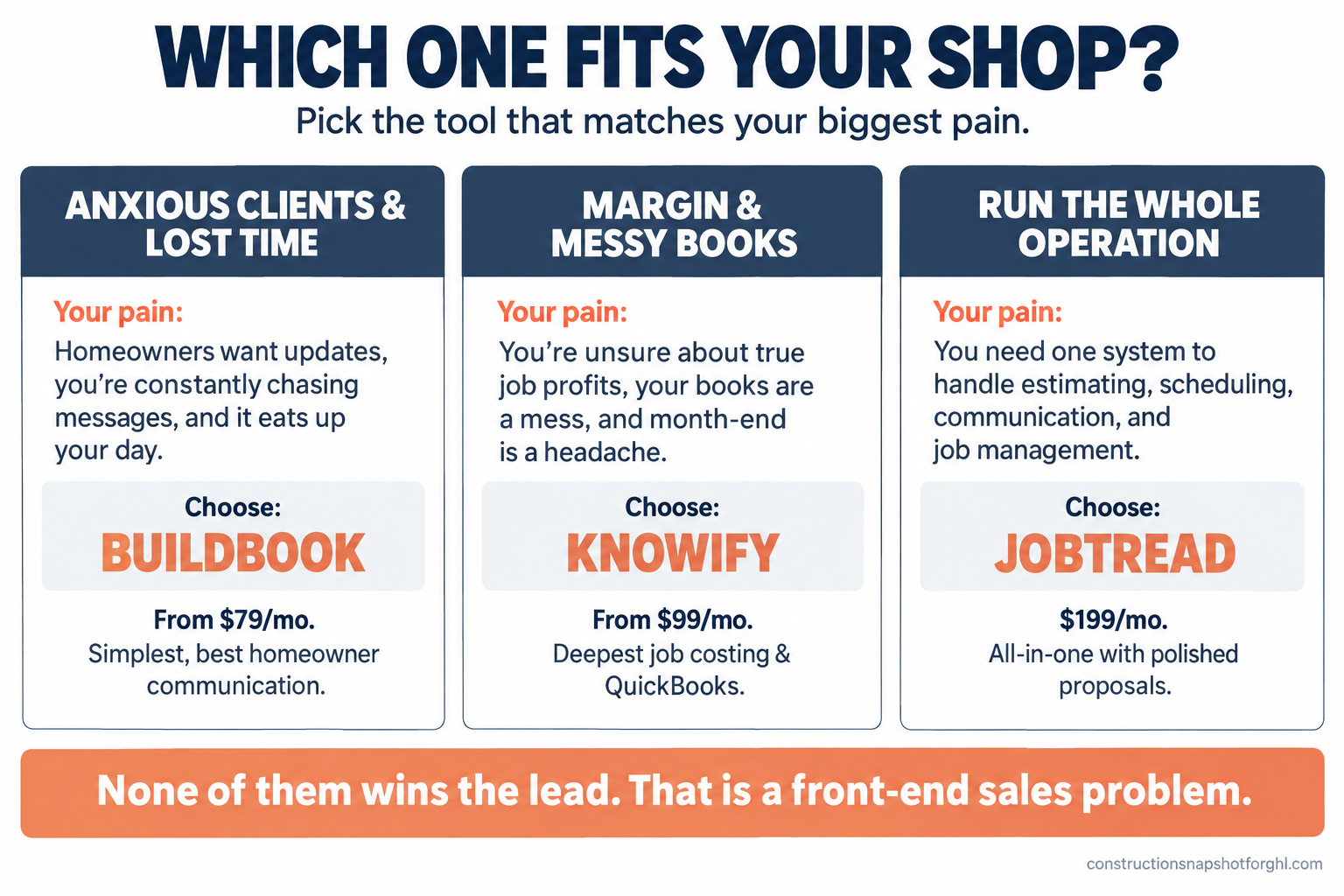
Here is the short version, so you can close two of those tabs today. These three tools look similar but are built for three different builders. BuildBook is the simplest and most communication-first, starting at $79 a month, and it fits a small custom builder or remodeler who mostly needs to keep homeowners calm and proposals moving (Capterra). Knowify is the finance-first pick, from $99 a month on its Core plan, and it fits a contractor whose real pain is job costing and clean books, with the deepest QuickBooks sync of the three (Capterra). JobTread is the all-in-one middle ground at $199 a month including one user, and it fits a general contractor who wants polished client-facing proposals, scheduling and a portal in one place (Capterra). Below is the eight-criteria breakdown, real 2026 pricing, and, more useful than any of that, where each one breaks.
In this post
- Why these three end up on the same shortlist
- Meet the three tools in one paragraph each
- 1. Who each one is actually built for
- 2. Pricing and what your real seat count costs
- 3. Estimating and proposals
- 4. Client communication and the homeowner portal
- 5. Scheduling, subs and the field
- 6. Financials, job costing and QuickBooks
- 7. Setup and learning curve
- 8. Contracts, migration and getting your data out
- The whole field on one screen
- Three shops, three right answers
- The compliance work none of them do for you
- Common objections
- Frequently asked questions
- Sources
Why these three end up on the same shortlist
Start with why these three names travel together, because it explains a lot of the confusion. All three publish their pricing on a page you can read in under a minute. That is not a small thing. The two biggest names in the category, Buildertrend and Procore, both hide their number behind a demo and quote to your revenue or your construction volume, which is exactly why so many owners get quote fatigue and go looking for tools that just tell them the price. JobTread, BuildBook and Knowify are the answer to that fatigue.
They also target the same size of business: the residential builder or remodeler doing a handful to a few dozen jobs a year, not the enterprise commercial GC that Procore is built around. So a search for “Buildertrend alternative for a small shop” surfaces all three, they land on the same shortlist, and the owner assumes they are interchangeable.
They are not. Underneath the similar homepages, each one was built by people solving a different problem. BuildBook came at it from client experience and sales, Knowify from accounting and job costing, JobTread from running the whole general-contracting operation in one place. That origin still shows, and it is the thing that should decide your pick. With 128,000 US remodeling firms competing for work, up from 69,000 in 2000 (NAHB), the tool that fits how you run jobs is a real edge, and the one that fights you is a tax you pay every day.
Meet the three tools in one paragraph each
BuildBook is the simplest of the three and the most focused on the homeowner. Messaging, proposals, a clean client portal, basic scheduling and budget tracking, in an interface a non-technical owner adopts in an afternoon. It starts at $79 a month on the Solo plan (Capterra), built for custom builders and remodelers who want to look professional and stop fielding “any update?” texts.
Knowify is the finance engine of the group: estimates, fixed-price and cost-plus contracts, AIA-style progress billing, phase-level job costing, sub compliance tracking, and the tightest QuickBooks Online sync of the three. Core starts at $99 a month for one user, though the real job-costing depth lives on the $249 Advanced plan (Projul). It is built for contractors and subs whose margin problem is really an accounting problem.
JobTread is the all-in-one that runs the whole job from lead to final invoice: CRM, estimating and takeoff, budgeting, purchase orders, scheduling, change orders, a client portal and a two-way QuickBooks sync. It is $199 a month including your first user, about $20 per extra seat, with no contract, free training and a 30-day money-back guarantee (Capterra). It is built for the general contractor who wants one system and sells partly on how polished it looks to the client.
1. Who each one is actually built for
This is the criterion that should carry the most weight, so it goes first. Buy the tool built for your kind of shop and the other seven criteria mostly take care of themselves.
BuildBook fits the small custom-home builder or remodeler running 6 to 20 jobs a year where the owner is still close to every client. If your bad reviews and your stress both come from communication gaps, this is your tool. Knowify fits the contractor or specialty sub who lives and dies by job costing, needs AIA billing for larger or commercial-adjacent work, and wants the books to match the field without double entry. JobTread fits the general contractor doing 15 to 40 jobs who wants one platform for the whole operation and cares that the proposal and portal look sharp to a homeowner choosing between three bids.
Where the fit breaks: people buy on price or on a slick demo instead of on fit, then fight the tool for a year. A numbers-driven builder who buys BuildBook because it was cheapest rebuilds job costs in a spreadsheet anyway. A communication-first remodeler who buys Knowify on an accountant’s advice finds the homeowner side underwhelming and goes back to texting. Match the origin story to your pain, not the price to your budget.
2. Pricing and what your real seat count costs
All three publish their pricing, which is the whole reason they are on this list. The starting numbers are close enough that price alone should rarely decide it, but the models differ in ways that matter as you add people.
BuildBook runs on flat tiers: a free plan, Solo at $79 a month with one user, Team at $149 for a small crew, and Business at $299 for a larger one, with extra seats around $20 each (Capterra). Knowify is base-plus-per-user: $99 a month on Core including one user, plus about $10 per additional user, with job costing and cost-plus contracts sitting on the $249 Advanced plan (Projul). JobTread is $199 a month including your first user, about $20 for each additional internal user, with price breaks past ten seats, and subs and clients get free unlimited portal access (Capterra).
Here is what those models look like at five users on the entry plan, which is where most of these shops actually land.
Monthly cost at five users on the entry-level plan, US dollars, 2026. Knowify Core is $99 plus four seats at ~$10; BuildBook Team covers up to five users at $149; JobTread is $199 plus four seats at ~$20. Note: Knowify’s job costing requires the $249 Advanced plan, so a numbers shop should price that tier instead. Sources: Capterra (JobTread), Capterra (BuildBook), Projul (Knowify).
Where pricing breaks your budget: the sticker is bait on every per-user model. JobTread’s $199 looks like the expensive option until you count that subs and clients are free, so a shop with lots of external users and few internal ones pays less than the base implies. Knowify’s $99 looks like the cheap option until you learn the job costing you came for is a $249 plan. Price your real team size on the plan that has the feature you need, not the cheapest plan on the page. For the full picture against the quote-only tools, read the pricing teardown.
3. Estimating and proposals
This is where the three tools separate fastest, because estimating is the front door to the whole job.
JobTread has the most complete estimating stack of the three: item databases, takeoff, cost-plus and fixed-price options, and proposals that look genuinely polished when they land in a homeowner’s inbox. That polish is a real sales weapon when a client is comparing your bid against two others. Knowify is strong on the contract structure behind the estimate, with fixed-price, cost-plus and AIA formats, which matters if you do any work that needs formal pay applications. BuildBook keeps estimating simple and readable, which is exactly right for a small remodeler and exactly not enough for a builder pricing a complex custom home with dozens of line items.
Where it breaks: a builder who prices intricate jobs on BuildBook outgrows its estimating and ends up back in a spreadsheet, which reintroduces the errors and slow turnarounds that lose jobs. And any of these tools will produce a beautiful estimate that still dies quietly, because none of them chases the client who went silent after you hit send. The estimate is only as good as the follow-up behind it, and follow-up is not what these tools do.
4. Client communication and the homeowner portal
For a residential builder, this is often the criterion that decides whether the software actually reduces stress or just adds a login.
BuildBook wins here, and it is not close. Client messaging and the homeowner experience are the reason the product exists, so the portal is clean, the homeowner actually uses it, and the “any update?” texts drop off. JobTread has a strong client portal too, tied into the rest of the operation, so the homeowner sees schedule, selections and approvals in one place. Knowify has a client portal, but it is the least polished of the three on the homeowner side, because its center of gravity is the back office, not the kitchen-table experience.
Where it breaks: a portal only calms a homeowner if you actually post to it on a rhythm. Buy the best portal in the category, use it once a month, and the client goes right back to calling you at 7am. The tool does not create the status-update cadence that prevents anxiety. You do, and then the software carries it. A great portal with no rhythm behind it is a login nobody opens.
5. Scheduling, subs and the field
Every one of these tools schedules work and coordinates subs. The differences are in depth and in how much the field crew will actually tolerate.
JobTread has the most complete scheduling and sub coordination of the three, with the free unlimited sub portal doing real work here: your framer or electrician gets access without you paying for a seat. Knowify brings something the other two do not, subcontractor compliance and document tracking, so you can keep insurance certs and lien waivers attached to the sub instead of hunting through email. BuildBook keeps scheduling light and task-based, which suits a small builder running a handful of trades but will feel thin to a production builder juggling many crews.
Where it breaks: scheduling software does not make a sub show up. The no-show that blows your Tuesday is a confirmation-and-accountability problem, and a calendar in an app the sub never opens does not solve it. Whichever tool you pick, the schedule only holds if you build a confirmation step around it, ideally an automated text the sub actually reads, and none of these three sends that on its own by default.
6. Financials, job costing and QuickBooks
If margin is your pain, this is the criterion that matters more than all the others combined, and it is where Knowify was built to win.
Knowify goes deepest. It was built to complement QuickBooks Online, with a two-way sync that pushes bills, expenses, invoices and payments and auto-assigns them to the right project, phase and cost category, so your job costs and your books match without double entry. Add AIA progress billing with retainage and phase-level job costing on the Advanced plan and it is the clear pick for a numbers-first contractor (Knowify). JobTread is no slouch here: it has real job costing and a solid two-way QuickBooks Online sync that eliminates most double entry, which is plenty for a builder who wants costs tracked without running a full accounting operation inside the tool. BuildBook connects to QuickBooks for basic job costing and invoice syncing, but it is the lightest of the three, and a builder whose whole problem is financial accuracy will feel that.
Where it breaks: the deepest financial tool in the world does not fix a job you priced wrong or a change order you never billed. Knowify will show you, in clean detail, exactly where the margin leaked after the fact. Whether you catch it in time depends on your habits, not the software. And remember the plan trap: BuildBook’s and Knowify’s entry prices undersell what real job costing costs, since Knowify’s lives on the $249 tier. Price the capability, not the login.
7. Setup and learning curve
The best tool is the one your team will actually use, so how hard it is to adopt is a real cost, not a footnote.
BuildBook is the easiest to stand up, by design. A non-technical owner can be running a project in a day, which is the whole point of the product. JobTread sits in the middle: it does more, so there is more to configure, but it includes free implementation and training, which takes most of the sting out of the ramp (Capterra). Knowify has the steepest curve of the three, because financial software with proper job costing and QuickBooks mapping simply has more moving parts, and getting the cost categories right up front takes real thought.
Where it breaks: a steep tool that nobody finishes setting up is worse than a simple tool used fully. Plenty of shops buy the powerful option, configure 30% of it, and quietly run the rest on the old spreadsheet, paying for depth they never turn on. If setup is the wall you keep hitting, that work is exactly the kind of thing you can hand to a trained GHL VA or an ops person instead of letting the subscription gather dust. You decide the workflow, someone else does the clicking.
8. Contracts, migration and getting your data out
The last criterion is the one nobody checks until they want to leave, and by then it is too late.
Good news: all three are far friendlier than the quote-only tools. JobTread advertises no contract and a 30-day money-back guarantee on monthly plans (Capterra), BuildBook offers a free plan and a no-card trial, and Knowify runs month to month. That is a world away from the 12-month lock-in on a Buildertrend annual quote.
Where it breaks: the friction is not the contract, it is the rebuild. Every estimate template, workflow and client record has to be recreated in the new tool, which is why people stay somewhere that no longer fits. If you are already moving off a dying platform, this is the moment to pick the tool you will keep for years, not the cheapest one this month. Coming off CoConstruct specifically? The migration guide covers where those users should land.
The whole field on one screen
Here is the head-to-head on the criteria that decide it, so you can see the shape at a glance.
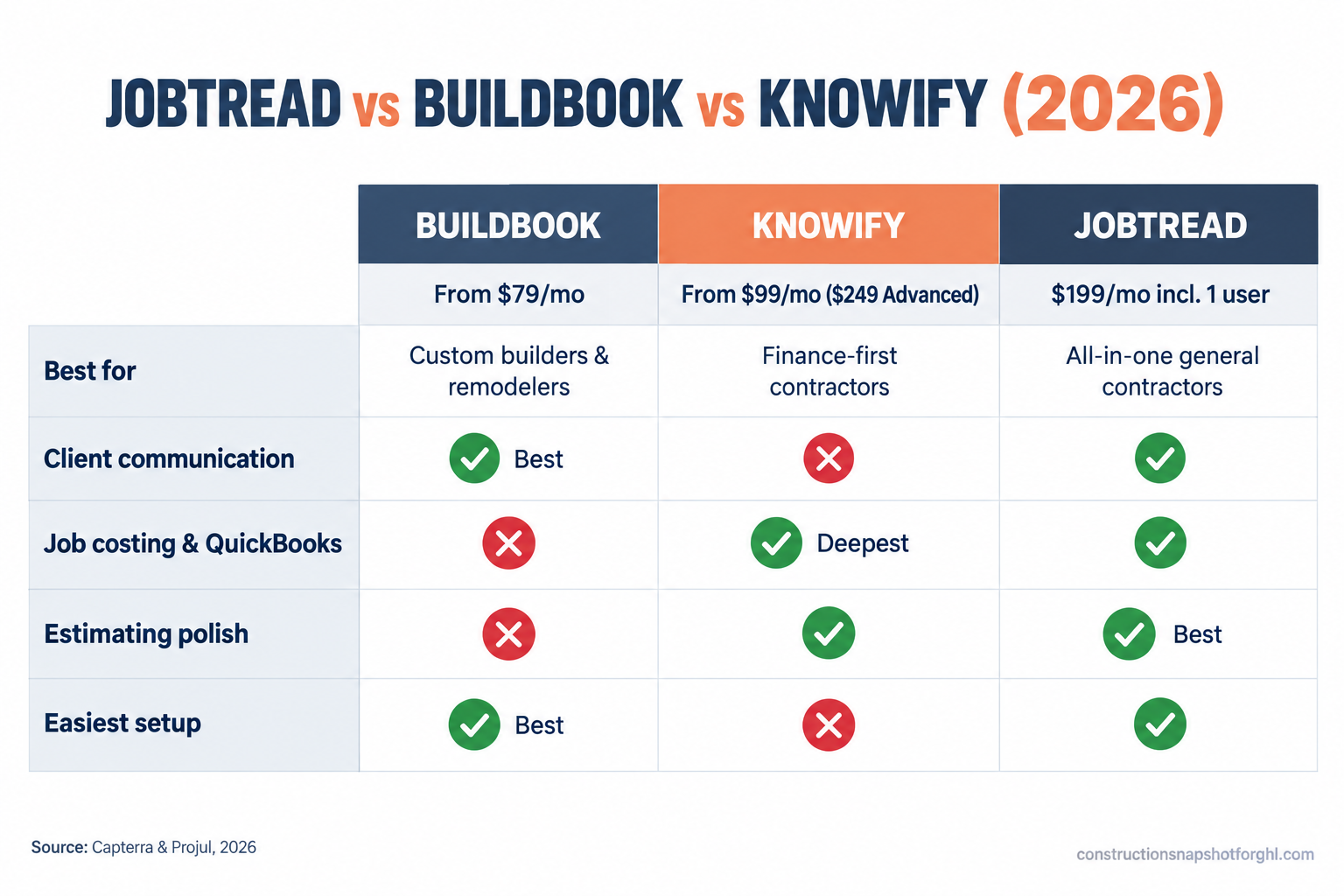
JobTread vs BuildBook vs Knowify (2026)
| Feature | What it does best | Where it breaks |
|---|---|---|
| BuildBook (from $79/mo) | Homeowner communication, simple proposals, fastest setup | Light on job costing and complex estimating |
| Knowify (from $99/mo, $249 Advanced) | Job costing, AIA billing, deepest QuickBooks sync | Steepest learning curve, least polished client portal |
| JobTread ($199/mo incl. 1 user) | All-in-one, polished proposals, free sub and client portal | Highest base, more to configure than BuildBook |
The pattern is clean once you see it. Pick the row that names your pain. If it is anxious clients and lost time, BuildBook. If it is margin and messy books, Knowify. If it is running the whole operation in one polished place, JobTread.
Three shops, three right answers
The honest answer to “which one” depends entirely on your shop, so run it three ways.
The solo remodeler or small custom builder (6 to 12 jobs, 1 to 3 users). Your pain is time and client hand-holding, not enterprise financials. BuildBook at $79 to $149 a month gets you a professional portal and simple proposals your clients will actually use, with a setup you finish in a day. Knowify Core is a fine call instead if you already run tight books and want job costing early, but be honest that its real costing sits on the $249 plan. Skip the heaviest option until you feel a wall.
The mid-size design-build or remodeling firm (15 to 25 jobs, 5 to 10 users). This is JobTread’s sweet spot. At $199 plus a handful of seats you get estimating polish, scheduling, change orders and a portal in one place, and subs and clients ride free. If margin is what keeps you up, put Knowify Advanced next to it and let the two fight on job costing versus all-in-one polish. This tier is where fit, not price, should decide.
The financials-driven or specialty contractor (any size, margin-obsessed). If your business runs on job costing, cost-plus contracts, AIA pay applications and a clean QuickBooks handoff, Knowify is the pick and the size of your shop barely changes that. The Advanced plan earns its number here in double entry you no longer do and margin you can see per phase. JobTread is the challenger worth a trial, but on pure financial depth Knowify is built to win.
Representative monthly cost by shop profile, US dollars, 2026, using published entry rates for the plan that matches each shop’s need. Sources: Capterra (JobTread), Capterra (BuildBook), Projul (Knowify).
Notice what does not change across all three shops: none of these tools decided whether the lead ever became a job. That line item is identical no matter which one you pick.
The compliance work none of them do for you
Here is the part no project-management tool handles, because it is not their job, and it costs real money when you get it wrong. Your marketing and your paperwork have to be compliant, and that lives on your website and your templates, not inside JobTread or BuildBook or Knowify.
Your license number in your advertising. In California, your CSLB license number is required by law in all advertising, including your website, business cards, truck lettering and online listings, under Business and Professions Code section 7030.5 (California BPC 7030.5). Put it in your site footer and your outbound message templates so you are covered by default. Rules vary by state, so a national template will be wrong for someone: Texas has no statewide GC license and pushes registration to the city level. Whatever tool runs your jobs, the license language is on you.
The three-day right to cancel. If you close a job in a homeowner’s home for more than $25, the FTC Cooling-Off Rule gives the buyer until midnight of the third business day to cancel, and you must hand over written notice of that right at the time of sale (FTC). If you sign at the kitchen table, build that notice into your contract template. One more state-scoped item: California and Arizona require a preliminary lien notice early in the job to preserve your lien rights, while other states require none, so scope your lien language to where you actually build. For the full rundown, see the contractor advertising and consent rules for 2026.
Common objections
“Can’t I just pick the cheapest and switch later if it doesn’t fit?” You can, but switching is not free. The cost is not the subscription, it is rebuilding every template, workflow and client record in the next tool, plus retraining your crew. Picking on fit now is cheaper than picking on price and migrating in eight months. Run the eight-question test on real work and buy the one you will keep.
“I already pay for one of these, is moving worth it?” Maybe not, if it fits your pain. But do the honest check: if you bought BuildBook and now fight it every month for job costing, or bought Knowify and your clients never touch the portal, that is a fit problem, and fit problems compound. Staying is fine. Staying because moving feels like a hassle is how you lose an hour a day for a year.
“Do I need to be technical to run one of these?” No. All three are built for owner-operators, and JobTread and BuildBook in particular are quick to adopt. Knowify asks a bit more up front because of the accounting depth. If even that feels like too much on top of running jobs, the setup and daily driving is exactly the kind of work a trained GHL VA or an ops hire handles while you stay on the tools.
“Why does a software comparison keep bringing up leads?” Because the biggest number on your P&L is not your software bill, it is the jobs you never closed. Every tool here costs a few hundred a month and runs work after it is signed. Not one of them replies to a lead in 30 seconds, texts back a missed call, or chases an estimate that went quiet. One lost project is worth more than a year of any of these subscriptions, and the front end is where a 6-to-40-job builder actually leaks money.
Where to start this week
Close two of those three tabs. Pick the tool whose origin story matches your pain: BuildBook for anxious clients and lost time, Knowify for margin and messy books, JobTread for running the whole operation in one polished place. Run it against the eight-question script on one real recent job, on the plan that has the feature you need. Then fix the front end while you are in there, because the right jobsite tool still does nothing for the leads you are not calling back. That last part is the piece we build. New to GoHighLevel? You can start an account through our partner link and drop the sales system on top. (That link is an affiliate link; we may earn a commission at no extra cost to you.)
Frequently asked questions
Is JobTread, BuildBook, or Knowify the best construction software in 2026?
There is no single best, because they are built for different shops. BuildBook is best for small custom builders and remodelers who prioritize homeowner communication and simple proposals, starting at $79/month. Knowify is best for finance-first contractors and subs who need job costing, AIA billing and a deep QuickBooks sync, from $99/month on Core (real job costing sits on the $249 Advanced plan). JobTread is best for all-in-one general contractors who want estimating polish, scheduling and a client portal in one place, at $199/month including one user. Pick the one whose strength matches your biggest pain.
How much do JobTread, BuildBook and Knowify cost?
All three publish their pricing. BuildBook starts at $79/month (Solo), with Team at $149 and Business at $299, plus about $20 per extra user. Knowify Core starts at $99/month for one user plus about $10 per additional user, with job costing on the $249 Advanced plan. JobTread is $199/month including your first user, about $20 per additional internal user, with subs and clients getting free portal access. Always price your real team size on the plan that has the feature you need.
Which one has the best QuickBooks integration?
Knowify has the deepest QuickBooks Online integration of the three, with a two-way sync that auto-assigns bills, expenses, invoices and payments to the right project, phase and cost category, so your books and job costs match without double entry. JobTread also has a solid two-way QuickBooks Online sync that eliminates most double entry. BuildBook connects to QuickBooks for basic job costing and invoice syncing but is the lightest of the three on financials.
Which is best for a small remodeler who just wants happier clients?
BuildBook. It was built around client communication and the homeowner experience, so the portal is clean, clients actually use it, and update calls drop off. It also has the fastest setup of the three, so a non-technical owner can run a project the same day. Its trade-off is lighter job costing and estimating, which a numbers-heavy custom builder will eventually outgrow.
Do I need Knowify's Advanced plan, or is Core enough?
It depends on why you are buying. Knowify Core at $99/month covers CRM, estimates, fixed-price contracts, scheduling, time tracking and AIA invoicing. But phase-level job costing and cost-plus contracts, which are the main reason most contractors choose Knowify, live on the Advanced plan at $249/month. If margin visibility is your goal, price the Advanced plan, not the Core sticker.
Will any of these tools get me more leads?
No. JobTread, BuildBook and Knowify are all project-management tools that run work after it is signed: estimating, scheduling, budgets, change orders and the client portal. None of them captures a new lead, replies within seconds, or chases an unanswered estimate. If leads go cold before you call back, that is a front-end sales problem and needs a sales system such as a GoHighLevel setup in front of your project tool, not a different project tool.
Related reading
- What construction management software actually costs in 2026: a pricing teardown
- CoConstruct is being retired: best alternatives and what migration really costs
- Best CRM for contractors: how to choose the right one
- How to follow up on a construction estimate and win more jobs
Sources
- Capterra: JobTread pricing
- TrustRadius: JobTread pricing
- Capterra: BuildBook pricing
- Capterra: Knowify pricing
- Projul: Knowify pricing breakdown (2026)
- Knowify: AIA billing
- NAHB: Three states drive over 20% of remodeling activity (Aug 2026)
- JCHS: Remodeling growth set to downshift in late 2026 (LIRA)
- California BPC 7030.5 (license number in advertising)
- FTC Cooling-Off Rule