The contract is signed. You shook hands in the client’s kitchen on Tuesday, the start date is three weeks out, and your cabinet supplier needs a deposit by Friday or the lead time slips a month. So you text the homeowner: “Can you get the deposit over before the weekend?” And then nothing. They reply Thursday asking what the deposit is for. You explain. They say they thought the first payment came after work started. Now you are floating a five-figure material order on your own credit card for a job you have not touched, and the whole thing started with a number you never pinned down and a payment you never made easy to send.
Here is the short version. There is no single right deposit for every job, but there is a right way to set it: big enough to cover your real up-front costs on that specific project (long-lead materials, permits, first mobilization) and no bigger than your state legally allows. Most states let your contract decide the number. A handful cap it hard. California and Nevada cap a home improvement deposit at the lesser of $1,000 or 10 percent of the price. Maryland, Pennsylvania, and Massachusetts cap it at roughly one third. Get the number wrong on the low side and you fund the job yourself; get it wrong on the high side in a capped state and you have broken the law before you swung a hammer. This post gives you the number, the state rules, and the six-step process that gets the deposit into your account before the job starts, including the exact messages to send.
In this post
- What a wrong deposit actually costs you
- How much deposit should you collect?
- What your state lets you legally collect
- The six-step process that gets the deposit paid
- Steal this: the exact deposit messages
- What the system looks like at three sizes
- The legal lines you cannot cross
- Common objections
- Frequently asked questions
- Sources
What a wrong deposit actually costs you
A deposit is not a formality. It is the first move in the cash game that decides whether a profitable job also leaves you with money in the bank. Slow money is not a small annoyance in this trade. Rabbet’s 2024 Construction Payments Report put the cost of slow payments to the US construction industry at around $280 billion in a single year, roughly 14 percent of all construction spending, and found that 82 percent of contractors were waiting more than 30 days to get paid, up sharply from 49 percent two years earlier (Rabbet, 2024). When the whole industry runs on late money, the builder who starts a job with no deposit is the one absorbing the delay out of pocket.
A deposit that is too small costs you in the first two weeks, before a single draw lands. Picture a $60,000 kitchen remodel. Before your crew shows up, you put money down on cabinets and the appliance package, pull permits, and cover the first week of labor and sub mobilization. That is real money leaving your account for a job that has produced zero billable progress. If your deposit does not cover it, you are lending the money to the project yourself, on a credit card or a line of credit, and paying interest to do your client a favor they did not ask for.
Illustrative week-one cash out on a $60,000 kitchen remodel, before any draw lands. The exact mix varies by job, but the shape does not: real money leaves before any money comes in. A deposit that does not cover roughly this much is a deposit that is too small. Figures are an example, not a published average.
A deposit that is too big costs you differently, and the bill can be much worse. In a handful of states, collecting more than the legal cap on a home improvement contract is not a negotiation point, it is a violation that can cost you your license and expose you to penalties. You can do everything else right on the job and still end up in front of a state board because of a number on page one of the contract. Getting the deposit wrong, in either direction, is a timing and compliance problem wearing a margin costume. The good news is that both directions are fully in your control, and setting the number correctly takes about ten minutes once you know the rules.
How much deposit should you collect?
Forget the round numbers you hear at the lumber yard. “Always get 50 percent” is wrong in most states and reckless in a few. The right deposit is the one that covers your genuine up-front exposure on that job and stays inside your state’s cap. Work it in this order.
Start from your real early costs. Open the estimate and add up everything you have to pay before your first draw is due: long-lead material deposits, the appliance or fixture package, permit fees, and your first week or two of labor and sub mobilization. That sum is the floor. Anything below it means you are financing the opening weeks yourself. On the $60,000 kitchen above, that early spend runs close to $15,000, so a deposit much under that leaves you underwater on day one.
Then check the ceiling your state sets. This is the step most builders skip, and it is the one that turns a good deposit into a legal problem. If you work in California or Nevada, your cap on a home improvement contract is brutally low (the lesser of $1,000 or 10 percent of the price) regardless of your costs. If you work in Maryland, Pennsylvania, or Massachusetts, you have room up to about one third. In most other states, your contract governs and your only real limit is what the client will accept. The next section lays out the rules state by state.
Size the number inside that window. Where the law gives you room, a common and defensible structure for a mid-size residential job is a deposit that covers your up-front costs, often landing somewhere between 10 and 30 percent of the contract, followed by milestone draws that bill slightly ahead of your spend. Where the law caps you below your real costs, as in California, you do not get to break the rule. You restructure instead: a small signing deposit, then an early, legally-collectible progress payment tied to the first delivered materials or the first completed phase. The goal is the same, which is to never fund the job out of your own pocket, but the legal path to it changes by state.
The point is that the deposit is not a vibe. It is a calculation bounded by a law. Once you have run it once for your typical job size, you can reuse the structure on every contract and only adjust the dollar figure.
What your state lets you legally collect
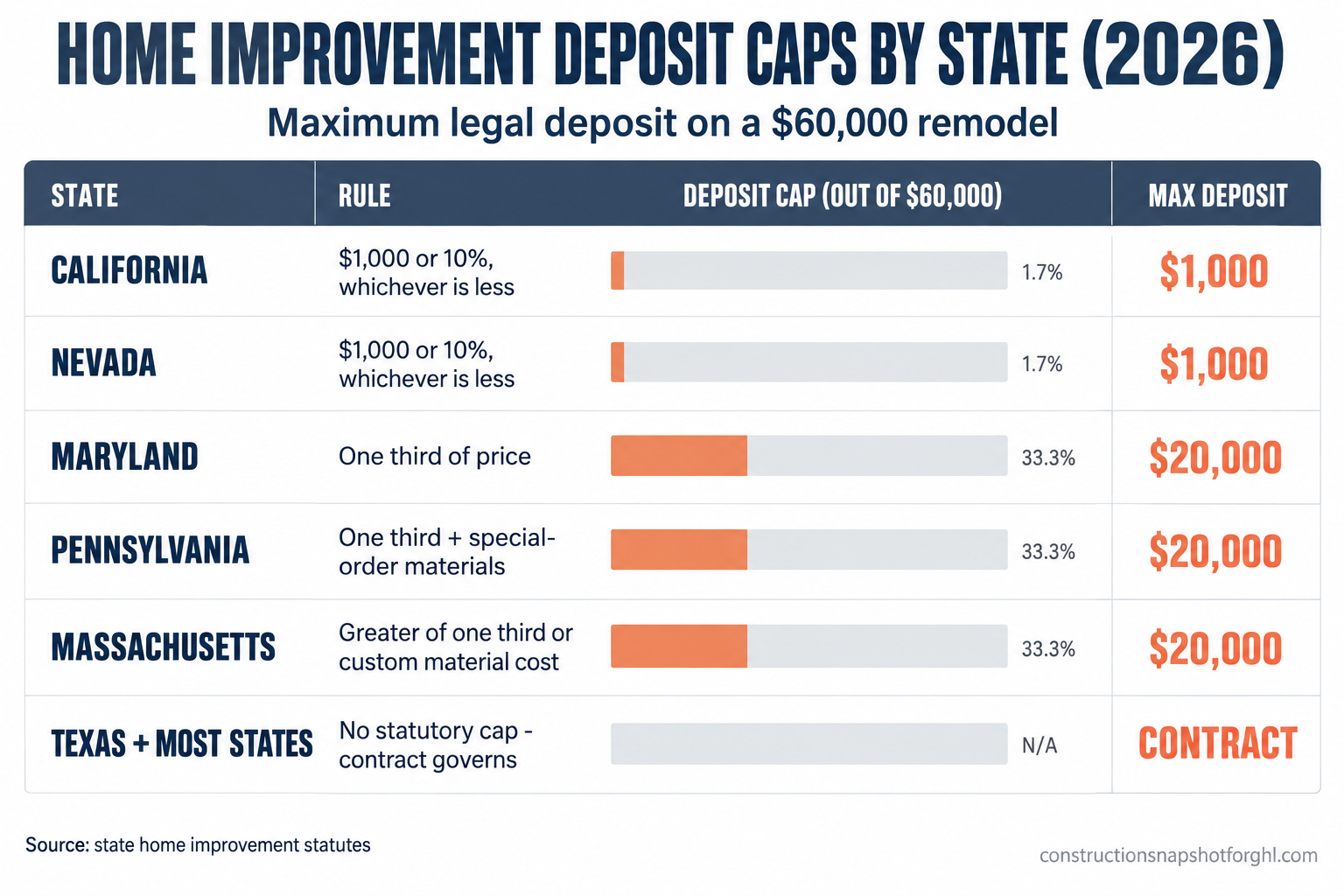
This is where a national rule of thumb falls apart. The amount you can legally collect up front genuinely changes from state to state, and the spread is enormous. On the same $60,000 remodel, a California contractor is capped at $1,000 while a Maryland contractor can collect $20,000. If you have crews or clients in more than one state, you cannot carry one number in your head.
Home improvement deposit caps on a $60,000 remodel (2026)
| Feature | What the law caps the deposit at | Max deposit on a $60,000 job |
|---|---|---|
| California (BPC 7159.5) | $1,000 or 10% of the price, whichever is less | $1,000 |
| Nevada (NRS 624.970) | $1,000 or 10% of the price, whichever is less | $1,000 |
| Maryland (Bus. Reg. 8-617) | One third of the contract price | $20,000 |
| Pennsylvania (73 P.S. 517.9) | One third, plus cost of special-order materials | $20,000 + materials |
| Massachusetts (MGL c.142A) | Greater of one third, or the cost of special-order material | $20,000 (or more if materials cost more) |
| Texas, Arizona, Connecticut, Minnesota | No statutory cap; your contract governs | Whatever the contract states |
Here is the detail behind the table, because the exceptions matter.
California is the strictest in the country. Under Business and Professions Code Section 7159.5, a home improvement contractor may not ask for or accept a down payment of more than $1,000 or 10 percent of the contract price, whichever is less, excluding finance charges (California BPC 7159.5, via Justia). On that $60,000 kitchen, 10 percent is $6,000, so the lesser figure, $1,000, is your hard ceiling. California also bars you from collecting more than the value of work performed or materials delivered as the job runs, so you cannot front-load the early draws to make up for it either. The one escape is a blanket performance and payment bond on file with the CSLB, which lifts the cap. For most small builders, the answer is not to fight the rule but to build a first phase or first delivery into the schedule so the next legal payment comes early.
Nevada mirrors California’s number. A residential improvement contract limits the deposit to the lesser of $1,000 or 10 percent of the aggregate contract price, the same language California uses (Nevada NRS 624.970, via FindLaw). As in California, a qualifying consumer protection bond on file lets a contractor and owner agree to a larger amount. Without the bond, $1,000 is the wall.
Maryland, Pennsylvania, and Massachusetts give you room, around one third. Maryland caps the deposit at one third of the contract price, collected at or before signing (Maryland Bus. Reg. 8-617, via Justia). Pennsylvania’s Home Improvement Consumer Protection Act bars a deposit above one third of the price on contracts over $5,000, plus the cost of special-order materials named in the written contract (Pennsylvania 73 P.S. 517.9, via FindLaw). Massachusetts limits the advance to the greater of one third of the total price or the actual cost of any special-order or custom material that must be bought before work starts (Massachusetts home improvement contract terms, Mass.gov). In all three, the special-order carve-out is the useful part: if a job needs expensive custom windows ordered up front, you can usually collect for them on top of the base cap, as long as you itemize them in the contract.
Most other states leave it to your contract. Texas has no state general contractor license and no statutory residential deposit cap, which pushes the question down to what your contract says and what the local market accepts. Arizona, Connecticut, and Minnesota likewise have no general home improvement deposit cap in their statutes, though regulators in some can still pursue a grossly excessive deposit as a consumer protection matter. In these states your judgment, not a number in the code, sets the ceiling.
One warning. Deposit caps live alongside other rules that also change by state, like the preliminary notice deadlines that protect your lien rights. Treat every one of these as state-scoped. A policy that is correct in Dallas can be a license violation in Sacramento. If you expand into a new state, the deposit clause in your contract template is the first thing to re-check, not the last.
The six-step process that gets the deposit paid
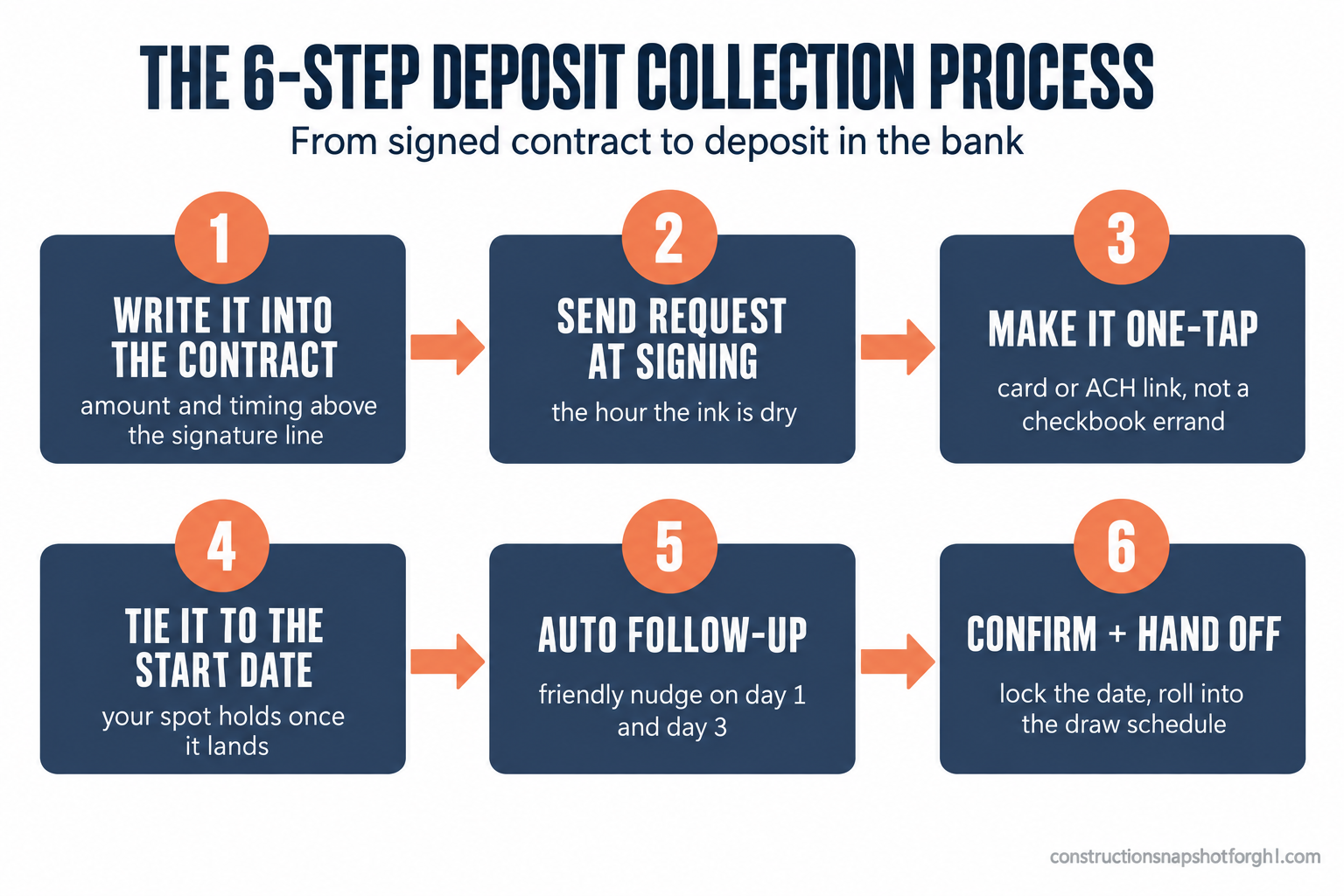
Knowing the right number does nothing if the money never shows up. The gap between “they agreed to a deposit” and “the deposit is in my account” is where most builders lose a week and start the job in the red. Here is the process that closes it, with the failure mode for each step, because the failure modes are where the real money leaks.
Step 1: Write the deposit into the contract, not the conversation
The deposit amount, what it covers, and when it is due all belong in the signed contract, in plain language, above the signature line. “A deposit of $______ is due upon signing to reserve the start date and cover initial material orders and permits.” When it is in the contract, there is no awkward follow-up ask, because the client already agreed to it when they signed.
How it breaks: The number lives only in a verbal agreement or a line in the estimate email. Then the client “doesn’t remember” the amount or the timing, and you are negotiating a payment you already closed. Fix it by making the deposit a signed term, every time.
Step 2: Send the payment request the hour the contract is signed
Momentum is everything. The moment the ink is dry, the client is as bought-in as they will ever be. Send the payment request immediately, while the handshake is still warm, not the next morning when doubt and the spouse’s opinion have crept in. Same hour, every time.
How it breaks: You wait until you are back at the office to “send the invoice.” By then the client has cooled off, a question has surfaced, and your same-day deposit becomes a next-week deposit. Automate this so the payment request fires the instant the contract is marked signed.
Step 3: Make it a one-tap payment, never a checkbook errand
The single biggest lever on deposit speed is how easy it is to pay. A card link or an ACH request the client can pay from their phone in thirty seconds collects far faster than “mail a check to the office” or “come by and drop it off.” Every step you add between “I’ll pay” and “it’s paid” is a chance for the deposit to stall for days.
How it breaks: You ask for a check. The client means to write it, forgets, the checkbook is in a drawer, and three days vanish while your cabinet deadline ticks. Offer a one-tap option and most deposits land the same day.
Step 4: Tie the deposit to the start date, out loud
The deposit is not just money, it is the thing that reserves a slot on your calendar. Say so directly: “Your start date holds once the deposit lands. I’m holding that week for you, so let’s get it locked in.” This reframes the deposit from a bill into a reservation, and a reservation is something people rush to secure.
How it breaks: You present the deposit as an administrative fee with no consequence attached. Nothing bad happens if the client pays late, so they pay late. Attach a real, honest consequence (the schedule moves) and the money moves.
Step 5: Run an automatic follow-up, not a manual chase
If the deposit has not landed within a day, a reminder should go out without you thinking about it. A short, friendly nudge at day one and day three catches the clients who simply forgot, which is most of them. The ones who have gone genuinely quiet get flagged for a phone call, not another text.
How it breaks: The follow-up depends on you remembering, in the middle of three active jobs, that a deposit is late. You don’t remember, the deposit drifts for a week, and the material order slips. A system that nudges on a schedule, the same way our estimate follow-up sequence chases quiet bids, collects the forgetful majority automatically.
Step 6: Confirm receipt and hand off into the draw schedule
When the deposit lands, send a one-line confirmation and lock the start date on the calendar in the same breath. Then connect it to the rest of the job. The deposit covered week one; from here, a milestone draw schedule has to keep the account positive so you never slide back into financing the project yourself.
How it breaks: The deposit arrives, everyone relaxes, and nobody sets up the next payment. Four weeks later you are underwater again because the deposit was treated as the finish line instead of the first mile. The deposit and the draw schedule are one system, not two.
Steal this: the exact deposit messages
Here is the actual copy. Change the names and numbers, keep the structure. These are the messages that move a deposit from “agreed” to “in the account” without you having to invent wording in the moment.
The deposit request, sent the hour the contract is signed:
Hi [First name], great to have it official. To lock your start date of [date], here’s the deposit of $[amount]. It covers your cabinet and appliance order plus permits so we can get those moving right away. You can pay by card or bank transfer in about 30 seconds here: [payment link]. Once it lands I’ll confirm your spot on the schedule. Thanks, [Your name].
The day-one reminder, friendly and short:
Hi [First name], just making sure this didn’t get buried. Here’s the deposit link again to hold your [date] start: [payment link]. Shout if any questions. Thanks.
The day-three nudge with the honest consequence:
Hi [First name], I’m holding your [date] start date, but I have to order your cabinets by [deadline] to keep that timeline, and the order kicks off once the deposit’s in. Can we get it locked today so your date doesn’t slip? Here’s the link: [payment link].
The stall-breaker, when they go quiet or hesitate:
Hi [First name], totally understand wanting to be sure before sending money. The deposit only covers materials and permits that are yours either way, and it’s fully documented in your contract. Happy to hop on a 5-minute call if that’s easier. When works for you today or tomorrow?
The receipt and schedule lock, sent the minute it lands:
Got it, thank you! Your deposit is received and your start date of [date] is officially locked in. Next you’ll hear from me about [the pre-start walkthrough / material delivery window]. We’re off and running.
Five messages. Together they are 90 percent of the deposit problem, solved. The reason they work is not clever wording, it is that they go out on time and make paying effortless. A builder who sends these by hand collects faster than one who improvises. A builder whose system sends them automatically collects faster still, and never forgets a single one.
What the system looks like at three sizes
The deposit process is the same at every scale, but who runs it and how it is enforced changes with the size of the shop.
The solo operator (6 to 12 jobs a year). You are the one in the kitchen getting the signature, so you are the one who has to send the payment request before you leave. The trap at this size is that you are also the crew, the estimator, and the bookkeeper, so the follow-up is the first thing to fall off. The single most useful move for a solo builder is a saved payment link and the five messages above in your phone, ready to paste, plus a single automation that sends the request the moment you mark a contract signed. You do not need a big system. You need the deposit ask to not depend on your memory at 7 p.m.
The mid-size team (12 to 30 jobs, an office person). Now there is a handoff, which is where deposits get dropped. The salesperson or owner closes in the field, and someone back at the office is supposed to send the request. If that handoff is a verbal “hey, send the Johnson deposit,” it will fail about a third of the time. At this size the deposit should be triggered by the signed contract itself, not by one person remembering to tell another. The office person’s job becomes watching the exceptions (the deposits that did not land in 48 hours) instead of manually sending every request.
The larger builder (30 to 40-plus jobs, multiple crews or markets). Volume plus multiple states is the danger zone. You might be legally capped at $1,000 in your California division and free to collect a third in your Texas work, and no human reliably keeps that straight across dozens of live contracts. At this scale the deposit rule has to be baked into the contract template by state and the collection has to be fully automated and tracked on a dashboard, so an owner can see at a glance which deposits are outstanding across every market. The cost of a missed or illegal deposit is highest here, and so is the payoff from systemizing it.
The legal lines you cannot cross
Three rules sit around the deposit, and crossing any one of them turns a cash-flow fix into a legal mess.
The cap is a hard limit, not a target. In the capped states, the number in the statute is the most you can collect, full stop. There is no “but the client agreed” exception without the specific bond on file. Write your contract template to the cap for each state you work in, and never let a one-off job talk you over it.
Watch the in-home close. Because the kitchen-table signing is the norm in this trade, the federal Cooling-Off Rule can apply. It gives a buyer three business days to cancel certain sales of $25 or more made at their home, and requires you to give notice of that right (FTC Cooling-Off Rule). That does not mean you cannot collect a deposit, but it does mean a client who signed in their living room may have a cancellation window, so know the rule before you order materials the same afternoon.
Document what the deposit buys. Spell out in the contract exactly what the deposit covers (materials, permits, scheduling) and that it is applied to the contract price, not an extra fee. Clear documentation is both good practice and, in the capped states, often a legal requirement for the special-order carve-out. It also kills the number-one client objection before it starts.
Common objections
“Won’t asking for a deposit up front scare clients off?” The opposite, usually. A contractor who asks for a reasonable, documented deposit reads as a real business, not a weekend operator who might vanish. The ones who refuse any deposit are often the clients who will fight every invoice later. A clear deposit term filters for serious buyers. What scares clients is a vague or oversized ask with no explanation, which is exactly what the contract clause and the receipt message prevent.
“I already use Buildertrend / JobTread for invoicing. Do I need anything else?” Those tools can take a payment, and if yours collects deposits reliably on time, keep it. The gap is almost never the payment screen, it is the trigger and the follow-up: sending the request the instant a contract is signed and nudging automatically when it is late. If your current tool leaves that to a human, that human is where deposits get dropped. The fix is automating the trigger, wherever it lives.
“My state caps me at $1,000. Doesn’t that make this pointless?” No, it makes it more important. If you cannot collect much up front, every other payment in the schedule has to be tight, early, and automatic, or you will finance the whole job. A low cap means your draw schedule and your invoice speed carry the load the deposit cannot. The process matters most precisely where the deposit is smallest.
“Do I need to be technical to set this up?” No. The whole thing is a saved contract clause, a payment link, five messages, and one automation that fires on “contract signed.” You can run the manual version today with nothing but your phone. The automated version is a one-time setup someone can install for you.
Frequently asked questions
How much deposit should a contractor collect?
Enough to cover your real up-front costs on that job (long-lead materials, permits, and the first week or two of labor and sub mobilization), and no more than your state allows. For a typical residential job in a state with no cap, that often lands between 10 and 30 percent of the contract price. Size it to the actual early spend, not a round number, then check your state's legal ceiling before you write it into the contract.
Is it legal to ask for a 50% deposit?
It depends entirely on your state. In most states with no statutory cap, a 50 percent deposit is legal if the client agrees, though it is higher than most residential clients expect. In Maryland, Pennsylvania, and Massachusetts you are capped near one third. In California and Nevada a home improvement deposit cannot exceed the lesser of $1,000 or 10 percent of the price, so 50 percent would be illegal. Always check your state before setting the number.
What is the maximum deposit a contractor can charge in California?
Under California Business and Professions Code Section 7159.5, a home improvement deposit cannot exceed $1,000 or 10 percent of the contract price, whichever is less, excluding finance charges. On a $60,000 job, 10 percent is $6,000, so the $1,000 figure is the cap. California also bars collecting more than the value of work performed as the job runs. A blanket performance and payment bond on file with the CSLB lifts the limit.
Which states limit how much deposit a contractor can collect?
California and Nevada cap home improvement deposits at the lesser of $1,000 or 10 percent of the contract price. Maryland, Pennsylvania, and Massachusetts cap them at roughly one third, with carve-outs for special-order materials in Pennsylvania and Massachusetts. Many states, including Texas, Arizona, Connecticut, and Minnesota, have no statutory cap and let the contract govern. Always verify your own state's current statute, since these change.
How do I get a client to pay the deposit faster?
Send the payment request the hour the contract is signed, make it a one-tap card or ACH link they can pay from their phone, and tie it to the start date out loud ('your spot holds once the deposit lands'). Then run an automatic reminder on day one and day three. Most late deposits are not refusals, they are requests that went out slowly or were hard to pay.
What should the deposit cover and how do I explain it?
Spell out in the contract that the deposit covers specific up-front costs (material orders, permits, and reserving the start date) and is applied to the contract price, not an added fee. Clear documentation answers the client's main objection before it starts and, in states with special-order carve-outs, is often legally required to collect for custom materials on top of the base cap.
What happens after the deposit, so I don't go broke mid-job?
The deposit only covers week one. After that, a milestone draw schedule has to bill slightly ahead of your costs so the account stays positive, and change orders have to be billed the week they are approved rather than at the end. The deposit and the draw schedule are one system. Collecting a deposit and then letting the draws lag just moves the cash-flow gap a few weeks down the job.
The deposit is the smallest part of the job and one of the most decided. Get the number right, get it in on time, and you start every project with money in the bank and a date locked on the calendar instead of a cabinet order on your credit card. Back in that kitchen on Tuesday: the version of you with a signed deposit clause, a payment link, and an automation that fires on signing does not spend Thursday explaining what a deposit is. The money is in by Wednesday morning, the cabinets are ordered, and the only thing left to do is build.
Sources
- California Business and Professions Code Section 7159.5, home improvement down payment limit (law.justia.com).
- Nevada Revised Statutes 624.970, residential improvement contract deposit limit (codes.findlaw.com).
- Maryland Business Regulation 8-617, home improvement deposit cap (law.justia.com).
- Pennsylvania Home Improvement Consumer Protection Act, 73 P.S. 517.9, deposit limits (codes.findlaw.com).
- Massachusetts, required contract terms in a home improvement contract (mass.gov).
- FTC Cooling-Off Rule, three-day right to cancel certain in-home sales (consumer.ftc.gov).
- Rabbet, 2024 Construction Payments Report, on the cost and timing of slow payments (rabbet.com).
- NAHB, three states drive over 20 percent of remodeling activity, 2026 (nahb.org).