
It is ninety days after you handed over the keys and the final $38,000 is still not in your account. The homeowner stopped replying three weeks ago. You finally call a construction attorney to put a lien on the house, and the first question out of their mouth is one you cannot answer: “Did you send a preliminary notice when you started the job?” You did not. You did not know you had to. And because of that one missing form, the strongest tool you had for getting paid is gone before you ever picked up the phone.
Here is the short version. A preliminary notice is a one-page document you send near the start of a job that preserves your right to file a mechanics lien later if you do not get paid. The deadline is the trap: in most states the clock starts the day you first show up or deliver materials, not the day payment goes bad, so by the time a client stops paying it has usually passed months ago. Whether you even need one depends on your state and your role. Direct general contractors are often exempt because they have a contract with the owner, but subcontractors, remodelers working under a builder, and suppliers almost always have to send one, and a few states make everyone do it. This post gives you the deadlines by state, who has to send one, how it breaks, and the simple office routine that keeps the form from ever being the reason you eat a bad debt.
In this post
- What a preliminary notice actually is
- Why the deadline has usually passed by the time you need it
- The part that trips up general contractors
- Preliminary notice deadlines by state
- The deadlines, side by side
- Steal this: the day-one notice routine and the messages to send
- Run it three ways: solo, mid-size, and multi-state
- What it actually costs when you get it wrong
- Common objections
- Frequently asked questions
- Sources
What a preliminary notice actually is
A preliminary notice is a short document, usually one page, that you send to the property owner and often the general contractor and the construction lender near the beginning of a job. It tells them who you are, what you are providing, and that you may have the right to file a mechanics lien on the property if you are not paid for your work. Different states call it different things. In California and Arizona it is the “20-day preliminary notice.” In Florida it is the “Notice to Owner.” In Nevada it is the “Notice of Right to Lien.” Some trades just call it a pre-lien. They all do the same job.
The key word is preserve. The notice does not place a lien, demand money, or start a fight. It keeps a door open. In the states that require it, you cannot file a valid mechanics lien later unless you sent the preliminary notice on time at the start. Skip it, and the most powerful collection tool in construction, the right to put a claim on the property itself, is not available to you no matter how clearly you are owed the money. A mechanics lien attaches to the property, so it can block a sale or a refinance until you are paid, and that is what turns a ninety-day-overdue invoice into a check. The whole thing rests on a form you sent in the first three weeks.
Why the deadline has usually passed by the time you need it
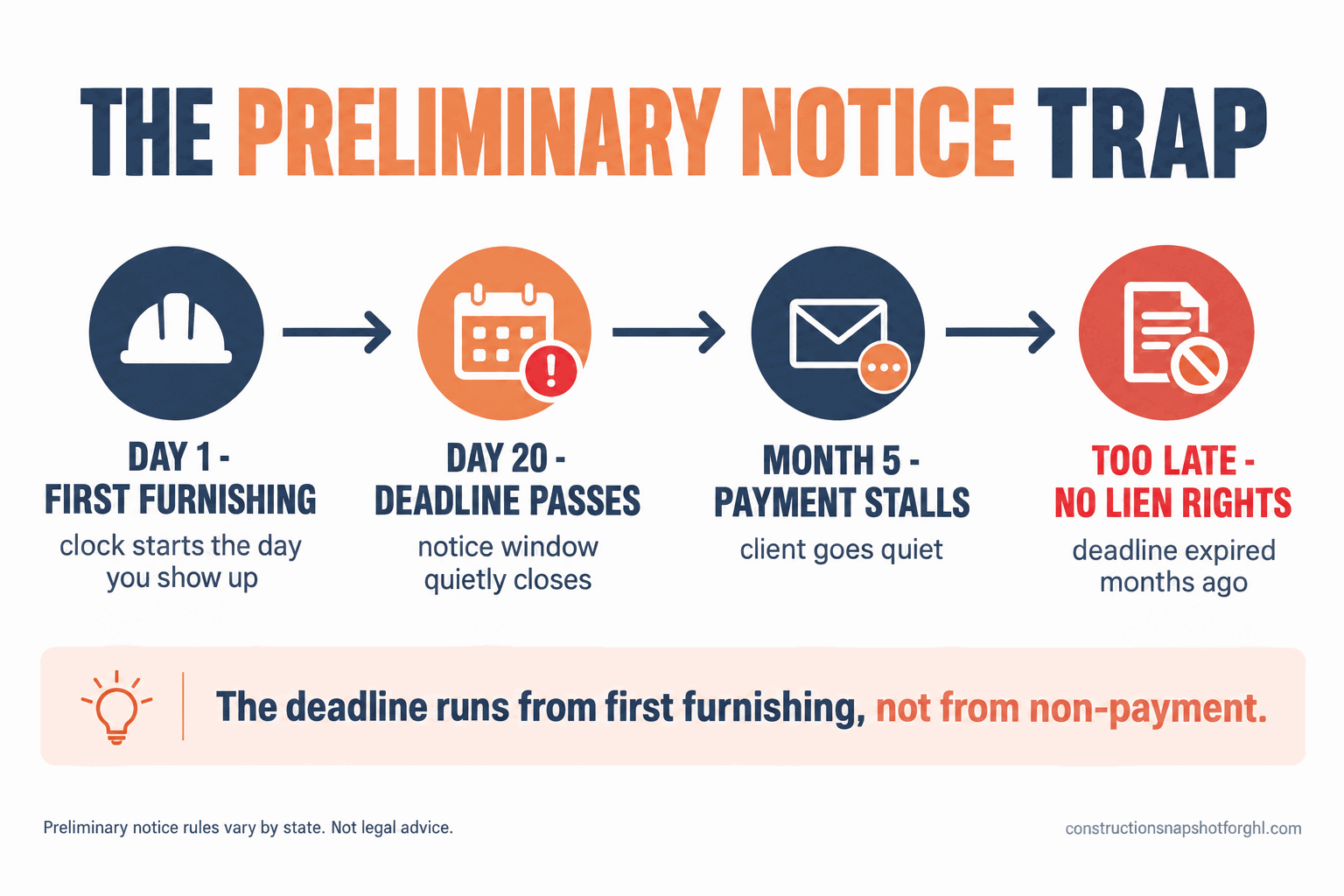
Here is the part that catches good builders every year. In almost every state, the preliminary notice deadline runs from the date you first furnish labor or materials, meaning the first day your crew shows up or your first delivery lands. It is not measured from the day the client goes quiet or an invoice goes unpaid.
Walk through the timeline and the trap is obvious. Say your deadline is 20 days from first furnishing. You start in March, so by early April the window is already closed. The job runs through summer. In September the final payment stalls. By the time you realize you have a collection problem, the deadline that mattered expired five months earlier, back when the thought of a lien never crossed your mind.
That is why the notice feels backwards to send. At day one everything is fine, and mailing a document that mentions liens feels like you are starting the relationship with a threat, so you skip it. Then the one job in twenty that goes bad goes bad, and the tool you needed was only available during the exact window when it felt least necessary. The builders who never lose this fight made the notice an automatic step on every job, sent before anyone has a reason to be upset.
A late notice is not always a total loss, but it is a big one. Several states let a late preliminary notice protect only the work performed in the days just before you sent it, not the whole job. Send it in month four of a six-month build and you may have given up your lien rights on the first three months of work. On a large project that is most of the money.
The part that trips up general contractors
If you are a general contractor with a contract directly with the homeowner, there is good news and a catch. In most states a direct contractor is exempt from the preliminary notice requirement, because you already have what the law calls privity, a direct contractual relationship with the owner. The owner knows who you are and that you can lien, so the early-warning notice is considered unnecessary for you. You still have to record the lien itself on time if it comes to that, but the preliminary step is often not yours to worry about.
Now the three catches that matter to a 6-to-40-job shop.
First, the construction lender. In California, even though a direct contractor is generally exempt from serving the owner, you must still serve a preliminary notice on the construction lender if the job has one, or you lose your rights against the lender’s funds (Levelset’s California guide). On a lender-financed custom home, that is not a small exception.
Second, Arizona does not give you the exemption. It requires nearly every party, including the direct general contractor, to serve a preliminary 20-day notice, and the statute calls it a necessary prerequisite to the validity of any claim of lien (Levelset’s Arizona guide). If you build in Arizona and you are not sending a notice on your own direct jobs, you have no lien rights, full stop. A handful of other states have their own versions, which is why “I am the GC so I am covered” is a dangerous assumption to carry across state lines.
Third, the notices that land on your desk. When you run work, your subs and suppliers send preliminary notices to your client. A nervous homeowner gets a formal document mentioning liens from a drywall supplier they have never heard of, and your phone rings. Those notices are routine and almost always mean nothing is wrong, but if you have not warned the homeowner, it reads like trouble. Worse, ignoring the paper trail from your subs is how you pay twice: you pay your sub, the sub does not pay their supplier, the supplier liens the house, and the homeowner looks at you. Tracking the notices you receive matters as much as sending your own. It is the same discipline that protects you on change orders and at punch-list and final payment.
Preliminary notice deadlines by state
Only about a dozen states require an early preliminary notice from the start of a job. Many states require no early notice at all, though most of those still require a separate “notice of intent” shortly before you actually record a lien, which is a different deadline measured from the end of the job. The table below covers the states where an early preliminary notice is a live issue for residential and private work, with the day the clock starts. Where a state is not listed, that usually means no early notice is required, but confirm it rather than assume (Levelset keeps a state-by-state breakdown).
| State | What it is called | Deadline from first furnishing | Who has to send it |
|---|---|---|---|
| Oregon | Notice of Right to a Lien | As little as 8 days | Subs and suppliers; residential rules differ |
| California | 20-day Preliminary Notice | 20 days | Subs, suppliers, equipment lessors; direct GC must serve the lender |
| Arizona | Preliminary 20-day Notice | 20 days | Nearly everyone, including the direct general contractor |
| Nevada | Notice of Right to Lien | 31 days | Subs and suppliers on private work |
| Florida | Notice to Owner | 45 days | Anyone not in privity with the owner |
| Washington | Notice to Customer / Owner | 60 days (commercial) | Subs and suppliers; residential before filing |
| Texas | Monthly notices | Monthly, by the 15th (see note) | Subs and suppliers, with a strict calendar |
| Colorado | No early notice; Notice of Intent | At least 10 days before filing | Notice of intent, not an early preliminary notice |
A few of these need a word of explanation. Texas does not use a single front-loaded deadline. It runs on a system of monthly notices tied to the calendar, where for residential work a claimant generally gives notice by the 15th day of the third month after each month of work, and the lien affidavit is due by the 15th of the third month after the job ends (Levelset’s Texas guide). It is the most unforgiving schedule in the country for a small sub. Florida’s 45-day Notice to Owner is strictly construed by the courts, so late is the same as never (Levelset’s Florida guide). Nevada’s 31-day window is longer than most, but Nevada also requires a separate notice of intent at least 15 days before you file (Levelset’s Nevada guide).
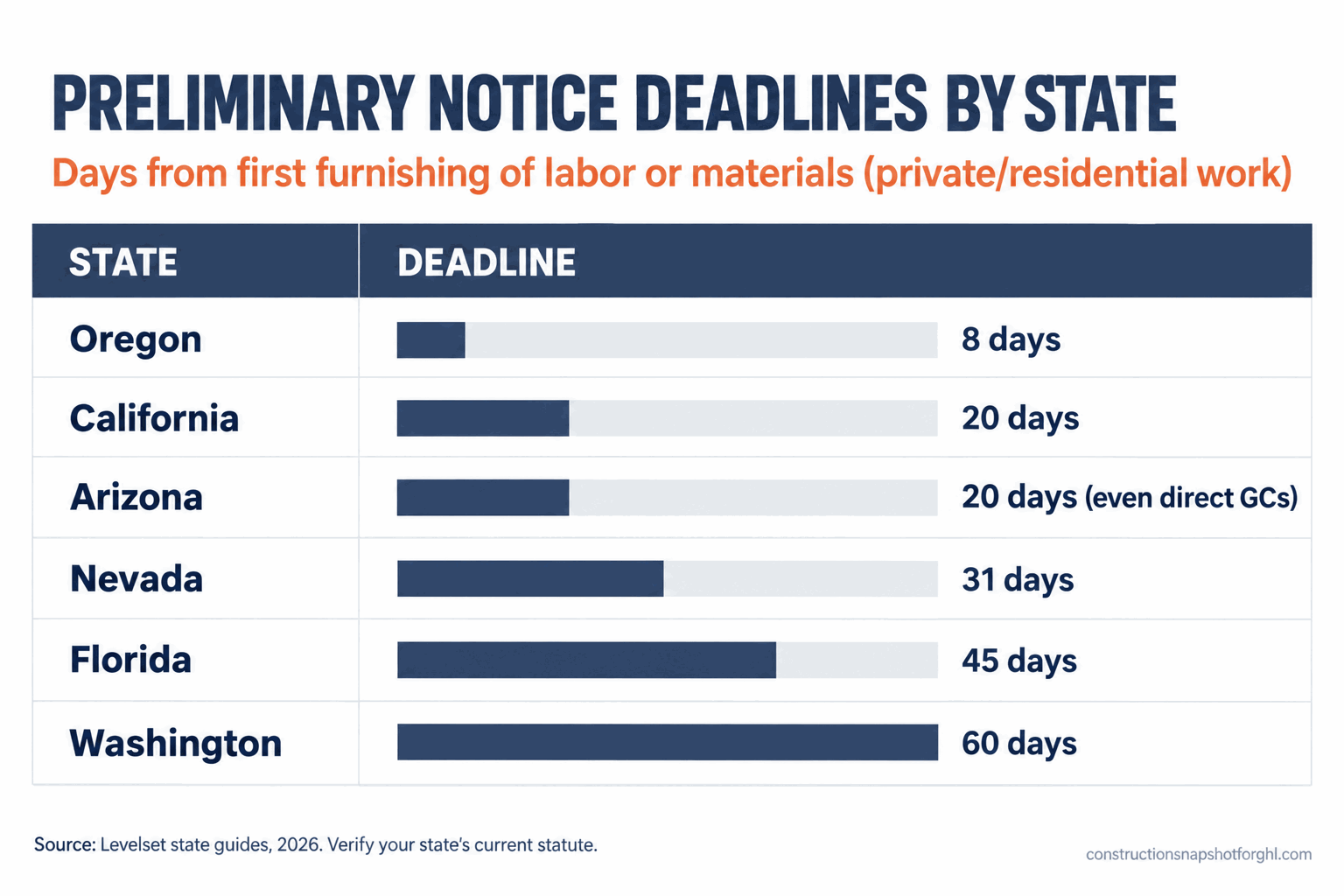
The pattern is simple. If you work in Oregon, California, Arizona, Nevada, Florida, Washington, or Texas, an early notice deadline is a real part of getting paid and you need a system for it. If you work elsewhere, you probably do not have an early deadline, but you almost certainly have a notice-of-intent step before you can file, plus a hard deadline to record the lien after the job ends. Either way the move is the same: find your state’s two or three key dates once, write them down, and build your routine around them.
The deadlines, side by side
The spread is the whole problem. The chart below is the early preliminary notice deadline, in days from first furnishing, for the states that have one. A rule that gives you 8 days in Oregon and 60 in Washington is impossible to carry in your head across a multi-state footprint, which is exactly why it has to live in a checklist instead.
Early preliminary notice deadline, in days from first furnishing of labor or materials, for private and residential work. Compiled from Levelset state guides, 2026. Deadlines vary by project type and role and change over time; confirm your state’s current statute before relying on any date.
The jobs that die on this are rarely the ones where someone forgot the law existed. They are the ones where the builder knew the rules at home and assumed the next state over matched. It does not.
Steal this: the day-one notice routine and the messages to send
The law is the easy part. The failure is always operational: the notice did not go out because nobody owned the step. Here is the whole routine, ready to run. It is built so a notice goes out on every qualifying job without anyone having to remember.
The second failure is relational: the homeowner panics when a lien-related document shows up. Get ahead of it with one short message at the start of every job, sent before any notice can land.
“Quick heads up so nothing surprises you. During the project you may receive one or two formal-looking letters from our suppliers or trade partners mentioning lien rights. These are standard paperwork on construction jobs, we send them too, and they do not mean anything is wrong. They simply record who is working on the project. You never need to do anything with them. If one ever worries you, forward it to me and I will explain it.”
And the message that goes out with your own notice, so it reads as process, not aggression:
“Attached is a preliminary notice for the work at [address]. This is a routine document our office sends on every project, the same way we send a certificate of insurance. It protects both of us by keeping a clear record of who is on the job. No action is needed on your end.”
Two messages and a four-step checklist. That is the whole difference between a shop that keeps its lien rights and one that finds out it lost them on the job where the money was on the line. If you already run follow-up sequences for estimates that go quiet, this is the same muscle pointed at the start of the job.
Run it three ways: solo, mid-size, and multi-state
The right setup depends on how many jobs and how many states you are juggling, because the way this fails changes with size.
The solo operator or small remodeler (6 to 12 jobs a year, usually one state). Your whole exposure fits on an index card. Look up your state’s three dates once, the preliminary notice deadline, the notice-of-intent rule, and the deadline to record a lien, and tape them inside your job folder template. You may be exempt as a direct contractor on cash-funded remodels, but do not assume it: in Arizona, or any time you work as a sub to a bigger builder, you are on the hook. The risk here is not complexity, it is forgetting, because you are the estimator, the PM, and the office all at once. Make the notice a line item on your job-start checklist.
The mid-size design-build or remodeling firm (15 to 25 jobs, one or two states). Volume is the enemy. With twenty active jobs you cannot carry deadlines in your head, and sub notices arrive weekly. Standardize one job-start checklist every project manager runs the same way, assign one person to own serving and logging notices, and keep a single running log of every notice sent and received with its deadline. This is the tier where the money leaking is not one job, it is a little on every job. One owner, one checklist, one log.
The larger or multi-state builder (30 to 40 jobs, several states). Your problem is different rules in every state you touch. An 8-day deadline in Oregon and a monthly calendar in Texas cannot share a process built for California’s 20 days. Build a per-state cheat card for every state you work in, confirmed against current statute, and route every new job to the right card by its location automatically, triggered by the job’s state rather than left to a PM who assumes the rest match home. Pair that with a tight draw schedule and you are protected on both fronts: paid on time during the job, and secured if a client stops paying.
What it actually costs when you get it wrong
The cost of a missed preliminary notice is not a fine. It is the quiet loss of your best collection tool, and it shows up only when you can least afford it. Construction already runs on the slowest payment terms of almost any industry: the average subcontractor waits about 56 days to be paid after billing, and the sector carries some of the highest days-sales-outstanding of any industry (DocJoist’s 2026 payment statistics). Slow and inconsistent payment is estimated to cost US construction on the order of $280 billion a year (Rabbet’s payments report). In that environment, the mechanics lien is the one piece of real bargaining power a builder has, and the preliminary notice is the key that unlocks it.
Lose that key and you are an unsecured creditor, which in plain terms means you are hoping. You can still sue for breach of contract, but that is slower, more expensive, and uncollectable if the homeowner has no assets you can reach. You cannot cloud the title, so the homeowner can sell or refinance and walk away from your invoice. A secured claim and an unsecured one are worlds apart when it is time to collect.
And the exposure is not random. It is concentrated where you do the most work. Three states, California, Texas, and Florida, together drive more than a fifth of all US remodeling activity, with California alone at roughly 8 percent and $22.2 billion (NAHB, August 2026). Two of those three have hard early-notice deadlines, and Texas has the strictest notice calendar in the country. The busiest construction markets in America are the ones where a missed notice hurts most, so if your work is concentrated there, this is a core part of how you get paid, not a technicality.
Common objections
“Sending a lien notice will make my client think I do not trust them.” Only if you present it that way. Framed as routine process, the same as a certificate of insurance, it signals that you run a real company with real systems. Use the heads-up message above and most clients never think twice. The ones who react badly to standard paperwork are often the ones most likely to create a payment problem later, which is precisely who the notice protects you from.
“I am the general contractor with a direct contract, so I am exempt.” Sometimes true, often not, and dangerous to assume. In Arizona the direct contractor must serve a notice or has no lien rights. In California you must still serve the lender on financed jobs. And the moment you take work as a sub to a larger builder, you lose the privity that exempted you. The exemption is real but narrow, and it evaporates the second you cross a state line or change your role.
“I already pay for Buildertrend or JobTread, does that not handle this?” Your project-management platform can store documents and some offer lien-tracking add-ons, but the tool does not know your job started, does not fill in the right state form, and does not make a human mail it inside the window. The failure is almost never the software’s document library. It is the gap between “job signed” and “notice served” that no tool closes unless something actively triggers the step and logs it.
“This feels like a lot of process for the one job in twenty that goes bad.” It is cheap insurance on the nineteen good jobs and decisive on the one bad one. The whole routine is a form and two short messages per job, mostly automated. Weigh a few minutes at job start against a final payment you cannot collect because the title is clean and you are standing in line with everyone else.
Where to start this week
Pull up the last three jobs you had to chase for final payment and ask the question the attorney asked at the top of this post: did a preliminary notice go out on time at the start? If you do not know, that is your answer, and it is the leak. Then do two small things. First, look up your state’s early-notice deadline, notice-of-intent rule, and lien-recording deadline, and write all three on your job-start checklist. Second, decide who serves and logs the notice on every qualifying job, and make it fire automatically the day a contract is signed.
Nail those two and the ninety-day-overdue phone call ends differently. Instead of “you did not send a notice,” the attorney says “good, you are covered, let us file.” That game is won or lost in the first week of every job. The automatic trigger, the right form by state, and the logged proof are what the Construction Snapshot for GoHighLevel builds into your pipeline, and you can hand the setup to a trained GHL VA if you would rather never touch the paperwork.
Frequently asked questions
What is a preliminary notice in construction?
A preliminary notice is a one-page document sent near the start of a job to the property owner, and often the general contractor and construction lender, stating who you are, what you are supplying, and that you may have the right to file a mechanics lien if you are not paid. It does not place a lien or demand money. In states that require it, it preserves your ability to file a lien later, so skipping it can wipe out your lien rights no matter how clearly you are owed.
When is the preliminary notice deadline?
In most states the deadline is measured from the date you first furnish labor or materials, meaning your first day of work or first delivery, not from when payment goes bad. Common deadlines are 20 days in California and Arizona, 31 days in Nevada, 45 days in Florida, and as little as 8 days in Oregon. Texas uses a monthly notice calendar instead of a single deadline. Always confirm your state's current rule, because they vary by project type and change over time.
Do general contractors have to send a preliminary notice?
Often no, because a direct contractor with a signed owner contract usually has privity and is exempt. But there are important exceptions. Arizona requires nearly everyone, including the direct general contractor, to serve a notice. California requires a direct contractor to serve the construction lender on financed jobs. And if you work as a subcontractor to a larger builder, you lose the exemption. Never assume the exemption carries across states or roles.
What happens if I miss the preliminary notice deadline?
In states that require the notice, missing it generally means you cannot file a valid mechanics lien for that work. A late notice may still protect only the work done in the short window just before you finally sent it, so on a long job you can lose your lien rights on most of the project. You would still be able to sue for breach of contract, but you lose the far stronger option of a claim against the property itself.
Is a preliminary notice the same as a mechanics lien?
No. A preliminary notice is an early, routine heads-up that keeps your lien rights alive. A mechanics lien is the actual claim you record against the property later if you are not paid. Many states also require a third document, a notice of intent to lien, shortly before you file. The preliminary notice comes first, at the start of the job, and without it the lien at the end may not be available to you.
Which states require a preliminary notice?
Only about a dozen states require an early preliminary notice from the start of a job. States where it is a live issue for private and residential work include California, Arizona, Nevada, Oregon, Washington, Florida, and Texas, which uses a monthly notice calendar. Many other states require no early notice but do require a notice of intent before you record a lien, plus a hard deadline to record it after the job ends. Confirm your specific state rather than assuming.
Sources
- Levelset: California 20-day preliminary notice guide and FAQs
- Levelset: Arizona preliminary 20-day notice guide and FAQs
- Levelset: Florida Notice to Owner guide and FAQs
- Levelset: Texas preliminary notice guide and FAQs
- Levelset: Nevada preliminary notice guide and FAQs
- Levelset: Is preliminary notice required in my state?
- NAHB: Three states drive over 20% of remodeling activity (August 2026)
- Rabbet: How slow payments are costing the construction industry billions
- DocJoist: Construction Payment Statistics 2026 (compiling Billd, CreditPulse, Rabbet data)