
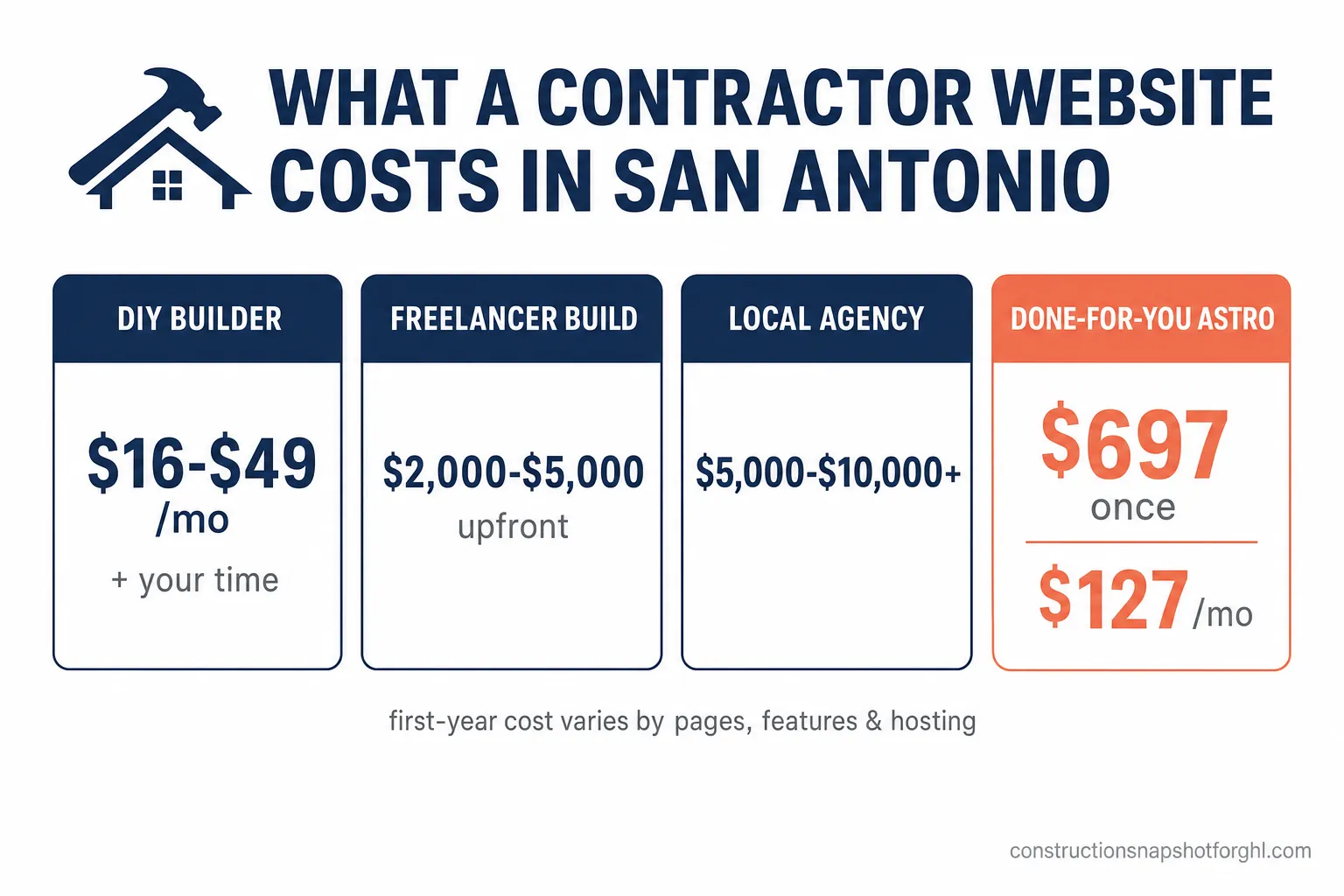
A contractor website in San Antonio costs anywhere from about $500 to $10,000+ upfront, plus $1,100–$5,000 a year to keep running (WebFX, 2026). Where you land depends on who builds it and how it’s hosted: a do-it-yourself builder like Wix runs $16–$49/month but eats your evenings, a freelancer WordPress build runs $2,000–$5,000, a local agency $5,000–$10,000+, and a done-for-you managed site like ours is $697 one-time plus $127/month with hosting and edits included.
But the sticker price is the easy part. The number that actually decides whether the site pays for itself is the one nobody quotes you: what a slow, poorly-built site costs you in leads you never see. In a market where San Antonio’s construction starts are forecast to climb from roughly $11.5 billion in 2025 to $12.6 billion in 2026 (Dodge Construction Network, via ENR), there are more contractors chasing the same homeowners than ever — and the site that loads first and reads clearly wins the estimate. This breakdown covers every real cost, what drives it, and how to spend the money so the site books jobs instead of just existing.
In this post
- What a contractor website costs in San Antonio (2026)
- The four ways to get a contractor website
- The hidden costs nobody quotes you
- Why a slow, cheap site is the most expensive one
- What actually drives the price up or down
- What San Antonio contractors should budget
- Frequently asked questions
- Sources
What a contractor website costs in San Antonio (2026)
Here is the honest range before we get into the mechanics. These figures reflect a typical contractor site: a homepage, a handful of service pages (kitchen remodels, additions, roofing, whatever you sell), location pages for the areas you serve, a project gallery, and a contact form.
Contractor website cost by build path (San Antonio, 2026)
| Feature | Upfront cost | Ongoing cost |
|---|---|---|
| DIY builder (Wix / Squarespace / GHL) | $0–$500 | $16–$49/mo + your time |
| Freelancer (WordPress) | $2,000–$5,000 | $50–$150/mo + per-edit fees |
| Local marketing agency | $5,000–$10,000+ | $100–$500/mo retainer |
| Done-for-you managed Astro (ours) | $697 one-time | $127/mo, hosting + edits in |
Two things jump out. First, the upfront number and the ongoing number are two separate decisions — and the ongoing number is where most contractors get quietly bled. Second, the cheapest upfront option (DIY) is rarely the cheapest option overall once you price in your own time and the leads a slow, generic template loses.
To make the trade-off concrete, here’s the estimated first-year total cost for each path — upfront build plus twelve months of hosting, maintenance, and typical edits:
The four ways to get a contractor website
Every contractor website in San Antonio comes from one of four places. Each has a real price and a real trade-off.
1. Do it yourself on a website builder ($0–$500 upfront)
Wix, Squarespace, GoDaddy, or GoHighLevel’s built-in site builder let you drag a template together for $16–$49/month. The upfront cash cost is near zero, which is why so many contractors start here.
The catch is twofold. First, your time isn’t free — a builder that “anyone can use” still takes a busy contractor 20–40 hours to make presentable, and every future edit is more of your time. Second, template builders are heavy: they load slowly on a jobsite phone and rarely pass Google’s page-experience checks, which costs you leads and local ranking (more on that below). DIY is fine as a stopgap; it’s rarely where a growing San Antonio contractor should stay.
2. Hire a freelancer ($2,000–$5,000 upfront)
A freelance web designer typically builds a WordPress site for $2,000–$5,000 (WebFX). You get something custom-ish and a real human to talk to. But you also inherit WordPress: hosting fees, SSL, a stack of plugins that need updating, and — critically — you pay again every time you need a change. “Update the phone number” or “add a photo of the Alamo Heights job” becomes a $50–$150 invoice or a week-long wait. The build is a one-time cost; the maintenance is forever.
3. Hire a local marketing agency ($5,000–$10,000+ upfront)
A full-service agency builds a polished, strategy-led site for $5,000–$10,000 or more, often on a monthly retainer of $100–$500 after launch. For a large builder with a marketing budget, this can be the right call — you get design, copy, SEO, and someone accountable. For most residential and remodeling contractors, it’s more money and more overhead than the job requires, and the site is still usually WordPress underneath, with the same speed and maintenance realities.
4. Get a done-for-you managed site ($697 one-time + $127/month)
This is the model we build. A done-for-you Astro website is a static-first site — the pages are built ahead of time and served from Cloudflare’s edge, so they load in under a second and are engineered to score 90+ on Google PageSpeed. You don’t touch code, hosting, or plugins. It’s $697 one-time to build, then $127/month that covers managed hosting, SSL, your domain, schema/AEO/GEO baked into every page, an AI chat widget to book estimates, and monthly change tickets — send the edit, the team ships it, no per-change invoice. Higher tiers ($267/mo adds an AI engine; $647/mo adds a content engine) exist if you want more, but the base plan is a complete, fast contractor site.
The hidden costs nobody quotes you
The build fee is the number on the quote. The costs below are the ones that show up later — and they’re where a “cheap” website gets expensive.
The recurring costs of a typical WordPress contractor site
| Feature | What it is | Typical cost |
|---|---|---|
| Hosting + SSL | Where the site lives, plus the security certificate | $20–$60/mo |
| Premium plugins | Booking, forms, page builder, SEO add-ons | $100–$500/yr |
| Maintenance / updates | Keeping WordPress + plugins patched and unbroken | $50–$150/mo |
| Per-edit fees | Every price change, photo, or new service page | $50–$150 each |
| Speed / SEO fixes | Getting a slow site to pass Core Web Vitals | $500–$2,000 one-off |
Add it up and a “$3,000 freelancer site” often carries $1,100–$5,000 a year in real running costs (WebFX). Over three years, the ongoing number quietly dwarfs the build fee. This is the single biggest reason to compare total cost, not the upfront quote — and the reason a managed model with hosting and edits folded into one monthly price is easier to budget than it looks.
Why a slow, cheap site is the most expensive one
Here’s the part that reframes the whole budget. A website’s job for a contractor is narrow: load fast, look credible, rank locally, and turn a visit into a booked estimate. Miss the first step and the rest never happens.
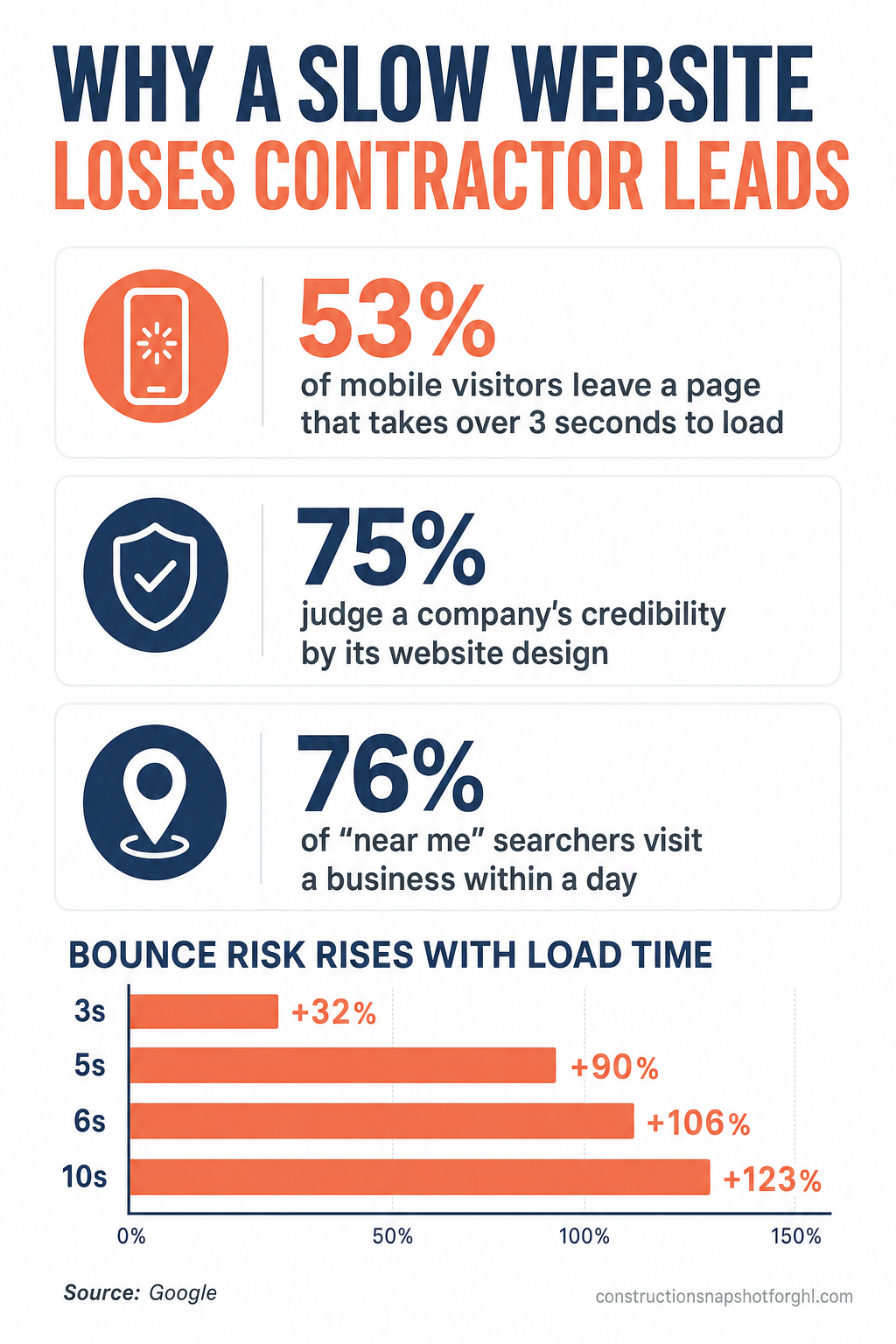
The data is blunt. 53% of mobile visitors abandon a page that takes longer than 3 seconds to load (Google). And it gets worse the slower you are — as mobile load time climbs from 1 second to 10 seconds, the probability that a visitor bounces rises 123% (Google / SOASTA):
Now connect that to San Antonio. 76% of people who search on a phone for something nearby visit a business within a day (Think with Google). When a homeowner in Stone Oak searches “kitchen remodeler near me,” they’re comparison-shopping several contractors in one sitting, on a phone, right now. A cheap template site that takes four seconds to paint loses that person before your best work is even on screen — and Google, which uses page experience as a ranking signal, buries you below the competitors whose sites are fast.
Credibility compounds it: 75% of consumers judge a company’s credibility by its website design (Stanford Web Credibility Research). A $180,000 addition is a huge trust purchase. If your site looks like a 2015 template, the homeowner assumes the workmanship matches. Speed and design aren’t vanity — they’re the first thing a lead evaluates, and the cheapest sites tend to fail both. That’s why “cheap” and “expensive” trade places once you measure in booked jobs. For the fuller argument on why fast-loading, well-structured sites win locally, see our breakdown of why San Jose contractors’ websites don’t win jobs and the Astro vs WordPress page-speed comparison.
What actually drives the price up or down
Two contractor sites can differ 10× in price. Here’s what moves the number, so you can spend where it matters:
- Number of pages. A 5-page brochure site is cheap; a site with a page per service and a page per city you serve (the setup that actually ranks in local search) is more work up front — and worth it.
- Custom design vs template. A bespoke design costs more than a proven, conversion-tested layout. For most contractors, a strong template beats a mediocre custom job at a fraction of the price.
- Copywriting. Words that sell the job — answer-first, keyworded for “San Antonio kitchen remodel” and the trades you run — are often quoted separately by agencies. Ours is included.
- Functionality. A gallery and contact form are standard. Online booking, an AI chat widget, financing calculators, and portals add cost — but the right one (instant booking) pays for itself.
- SEO, schema, and local pages. The technical layer that gets you found — clean titles, structured data, a sitemap, an
llms.txtfor AI crawlers, and real location pages — is where cheap sites cut corners and lose ranking. Pair it with the tactics in our local SEO guide for contractors and how contractors get found in AI search. - Ongoing edits. How often will prices, promotions, and project photos change? A contractor updates constantly — a plan that bills per edit will cost far more than one that includes them.
What San Antonio contractors should budget
Put the pieces together and a practical budget looks like this:
A realistic contractor website budget (San Antonio)
| Feature | If you're... | Budget guidance |
|---|---|---|
| A brand-new one-crew operation | Testing the market, thin budget | DIY builder now; move to managed within 6–12 months |
| An established GC or remodeler | Leads matter, no time for upkeep | Done-for-you managed: ~$697 + $127/mo |
| A multi-crew builder with a marketer | In-house marketing, custom needs | Managed Astro or a vetted agency retainer |
| Anyone whose site is over 3s on mobile | Losing leads right now | Rebuild fast — the speed fix pays for itself |
The through-line: don’t optimize for the lowest upfront quote. Optimize for the lowest cost per booked estimate over three years — which means a fast, credible, locally-ranked site with predictable running costs. For most San Antonio contractors, that’s a managed done-for-you site, not the cheapest template and not the priciest agency.
Frequently asked questions
How much does a contractor website cost in San Antonio in 2026?
Upfront, expect roughly $0–$500 for a DIY builder, $2,000–$5,000 for a freelancer WordPress build, and $5,000–$10,000+ for a local agency. A done-for-you managed Astro site is $697 one-time plus $127/month with hosting, SSL, a domain, and monthly edits included. On top of the build, a typical WordPress site carries $1,100–$5,000 a year in hosting, plugin, maintenance, and per-edit costs.
Is a cheap website builder like Wix good enough for a contractor?
It can work as a short-term stopgap, but it has two real costs: your time (20–40+ hours to build and maintain) and lost leads, because template builders tend to load slowly and rarely pass Google page-experience checks. Since 53% of mobile visitors abandon a page that takes over 3 seconds to load, a slow DIY site quietly costs you estimates. Most growing San Antonio contractors outgrow the builder quickly.
Why is ongoing cost more important than the build price?
Because it recurs. A one-time $3,000 freelancer build can carry $1,100–$5,000 every year in hosting, SSL, premium plugins, maintenance, and per-edit fees. Over three years the ongoing number often exceeds the build fee. Always compare total three-year cost, and favor a plan that folds hosting and edits into one predictable monthly price.
What makes a contractor website "fast," and why does it matter in San Antonio?
Fast means it loads in under a second on a phone and passes Google Core Web Vitals. It matters because 76% of people who search on a phone for something nearby visit a business within a day, and homeowners comparison-shop several contractors in one sitting. The site that loads first and reads clearly wins the estimate; a slow one loses the lead and ranks lower in local search.
How much does website maintenance cost per year?
For a typical WordPress contractor site, roughly $1,100–$5,000 per year once you add hosting and SSL ($20–$60/month), premium plugins ($100–$500/year), maintenance and updates ($50–$150/month), and per-edit fees ($50–$150 each). A managed done-for-you plan bundles hosting, SSL, and a set of monthly edits into one flat monthly fee instead.
About the author
Diego Marchetti spent twelve years running the office for a mid-size general contracting firm before moving into systems work full time. He has scoped, priced, and chased more change orders than he cares to count, and now builds the GoHighLevel workflows — and the fast websites that feed them — that keep lead-to-deposit pipelines from leaking. He writes about estimating discipline, back-office margin, and spending marketing dollars where they actually return.
Related posts
- Why San Jose Contractors’ Websites Don’t Win Jobs — and What Actually Does
- Astro vs WordPress for Austin Contractor Websites: Page Speed & Lost Leads Compared
- Local SEO for Contractors: How to Rank Your Construction Business on Google (2026)
Sources
- WebFX — How Much Does It Cost to Build a Website for a Small Business? (2026)
- Google — The need for mobile speed (53% abandonment), 2016
- Google / SOASTA — New Industry Benchmarks for Mobile Page Speed (bounce probability), 2017
- Stanford — Web Credibility Research: Guidelines (75% judge credibility by design)
- Think with Google — How mobile search connects consumers to stores (76% visit within a day)
- ENR / Dodge Construction Network — San Antonio construction remains strong (2025–2026 starts)