
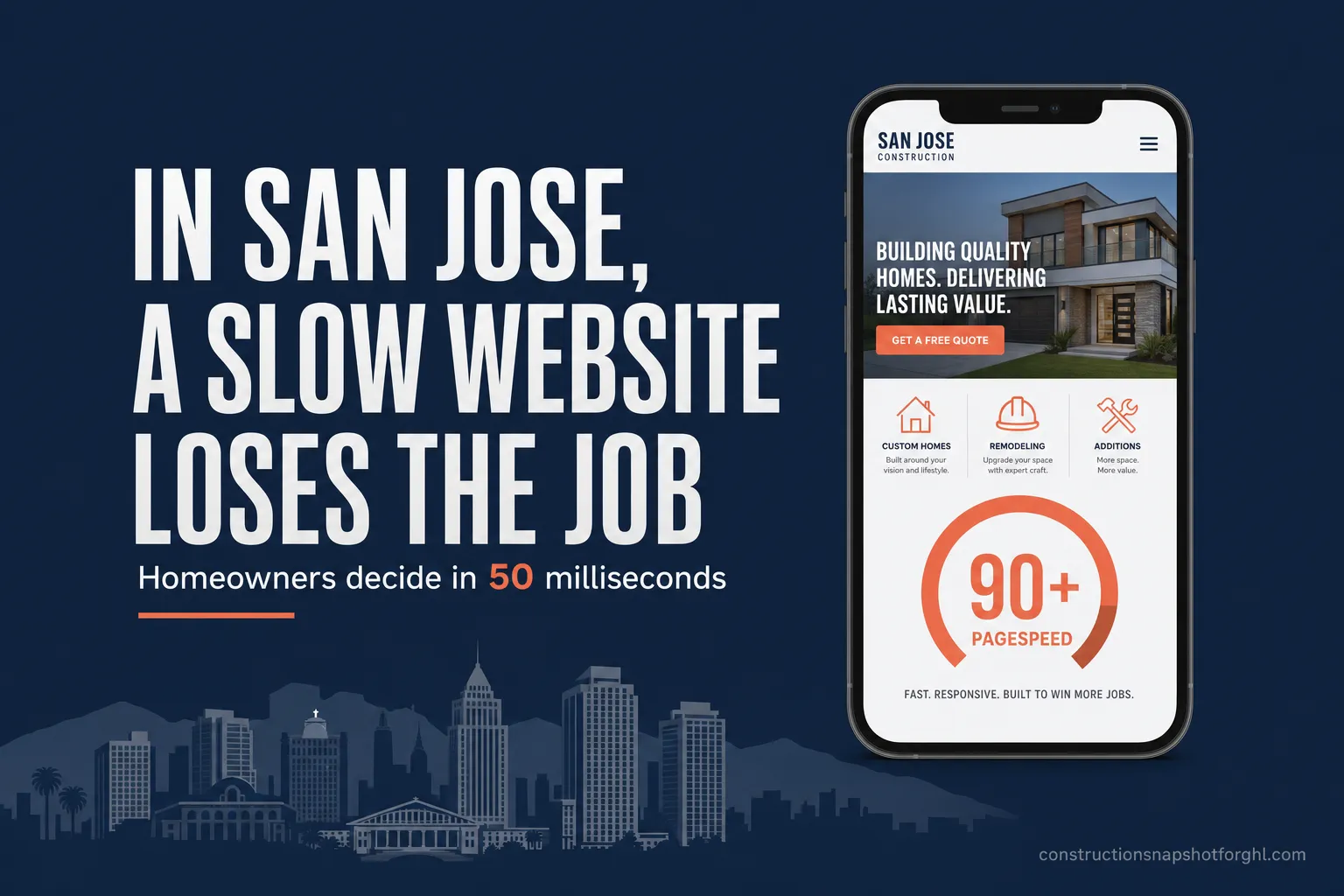
If you build in San Jose and your phone isn’t ringing from your website, the site itself is usually the problem — not your work, not your prices. A San Jose homeowner deciding who gets a $150,000 kitchen or a new ADU forms an opinion of your business in about 50 milliseconds of landing on your site, and if it loads slowly, looks dated, or never turns up in search, they’re gone before they read a word. In a market where the median home is worth roughly $1.4 million, the job you just lost to a faster-loading competitor was never a small one.
This is the uncomfortable part most contractors skip: in Santa Clara County, the homeowner is affluent, digital-first, and comparing three or four builders at once on a phone. Your website isn’t a brochure they’ll get to eventually — it’s the first (and often only) interview. And right now, the San Jose–Sunnyvale–Santa Clara metro is a tighter construction market than it was, shedding about 3,100 construction jobs, a 6% drop, in the year to November 2024 (Associated General Contractors of America). Fewer projects, same number of trucks chasing them — which means the builder whose website actually converts wins a bigger share of a smaller pie.
In this post
- The homeowner judges you in 50 milliseconds
- Where San Jose contractor websites lose the job
- What one lost lead actually costs in San Jose
- What a lead-generating website does differently
- Why this matters more in San Jose right now
- Frequently asked questions
- Sources
The homeowner judges you in 50 milliseconds
Before a homeowner reads your reviews or looks at a single project photo, their gut has already decided whether your business looks legit. Researchers at Carleton University found people form a first impression of a webpage in as little as 50 milliseconds — faster than a conscious thought (Lindgaard et al.). That snap judgment then colors everything they read next.
And it’s design that drives it. In the Stanford Web Credibility study — one of the largest ever run on how people decide whether to trust a site — 46.1% of participants cited visual design (layout, typography, color, whether it looked current and professional) as the reason they judged a site credible or not. That was the most-mentioned factor of any, ahead of the actual content (Stanford Web Credibility Project).
For a San Jose contractor, that’s the whole ballgame. A homeowner about to spend six figures is looking for a reason to trust you and a reason to rule you out. A site that loads in a spinner, stretches oddly on their iPhone, or clearly hasn’t been touched since 2019 hands them the second one for free. It doesn’t matter that your framing is flawless — they’ll never call to find out.
Where San Jose contractor websites lose the job
Most contractor sites don’t fail in one dramatic way. They leak in four quiet ones. Here are the numbers that describe the damage:
1. It’s too slow on a phone
Roughly 62% of all web traffic is on mobile (Statista / StatCounter), and a homeowner searching “kitchen remodel near me” from their couch is on a phone, on Wi-Fi that’s fighting a smart-TV. If your page makes them wait, they leave: 53% of mobile visits are abandoned when a page takes more than 3 seconds to load (Google). It gets worse the longer they wait — Google’s analysis of nearly a million mobile pages found the probability a visitor bounces rises sharply as load time grows.
Increase in the probability a mobile visitor bounces as page load time grows from 1 second. Source: Think with Google, “Mobile page speed new industry benchmarks”, 2017.
The cause is almost always bloat. The median mobile web page now weighs about 2.4 MB (HTTP Archive Web Almanac), and a typical plugin-heavy contractor site runs well past that. It’s why only ~44% of mobile sites pass all three of Google’s Core Web Vitals — the loading, interactivity, and stability metrics Google uses as a ranking signal (Web Almanac 2024). If you want the full platform breakdown of why WordPress sites end up in the failing half, we cover it in Astro vs WordPress for contractor websites.
2. Homeowners never find it
A beautiful site nobody lands on is a business card in a drawer. Two things decide whether San Jose homeowners find you, and most contractor sites are built for neither.
Local search. When someone searches “home addition contractor San Jose” or “ADU builder Willow Glen,” Google ranks on relevance, distance, and prominence — and a site with no dedicated location pages, weak schema, and thin content simply doesn’t signal that you’re the right, nearby builder. We break the full playbook down in local SEO for contractors, but the short version: one generic “Service Areas: Bay Area” line loses to a competitor with a real page for each town they build in.
AI search. This is the new front most contractors haven’t noticed. Google’s AI Overviews now serve more than 2 billion users a month (Alphabet Q2 2025 earnings, via Digiday), and homeowners increasingly ask ChatGPT or Perplexity “who builds ADUs in San Jose?” before they ever open the blue links. Those tools cite fast, structured, crawlable pages — the ones with clean schema and clear, self-contained answers. A slow, script-heavy site is invisible to them. Our guide on how contractors get found in AI search has the checklist.
3. It looks dated — and you can’t change it
Here’s the trap most builders are living in: the site was built once, at launch, and it’s been frozen ever since. Your prices moved. You added a trade. You finished a stunning Los Gatos remodel that belongs front and center. But updating any of it means emailing an agency, waiting for a quote, and getting billed by the hour for a one-line change — so you don’t bother, and the site slowly rots into a liability. To a homeowner, a site advertising last year’s promotion reads as a business that might not still be around.
4. It doesn’t capture the lead
Even when a homeowner likes what they see, most contractor sites give them exactly one way to act: a contact form that lands in an inbox you check tonight. By then they’ve messaged two other builders. There’s no instant chat to answer “do you do permitted ADUs?” at 9 p.m., no click-to-call, no booking link. The site generates interest and then lets it cool. Pairing the site with a 24/7 AI chat widget that qualifies and books is the difference between a visit and a lead.
What one lost lead actually costs in San Jose
It’s tempting to treat a slow website as a minor annoyance. The math says otherwise, because of what a single San Jose project is worth. National figures already run high — in Houzz’s 2025 study, the median kitchen renovation was $22,000, a major remodel of a large kitchen ran a median of $55,000, and the top 10% of spenders paid $180,000 or more (Houzz 2025 U.S. Houzz & Home Study).
U.S. kitchen renovation spend, 2024. Bay Area labor and material costs typically run well above these national medians. Source: Houzz 2025 U.S. Houzz & Home Study.
Now layer on Santa Clara County, where the median home is worth about $1.4 million (Zillow) and remodels routinely run above the national numbers above. Add the ADU boom — by 2022 roughly one in five new housing units permitted in California was an accessory dwelling unit (California YIMBY), and Bay Area ADUs commonly cost $250,000 or more to build. A website that bounces even one of those homeowners a year hasn’t cost you a form fill. It’s cost you the single most profitable job on your calendar.
That’s why speed pays back so fast. When Deloitte and Google studied the effect of a mere 0.1-second mobile speed improvement across dozens of brands, retail conversions rose 8.4%, average order value rose 9.2%, and lead-generation page views rose 7% (Deloitte & Google, “Milliseconds Make Millions”). A tenth of a second moved real money. A three-second site is leaving a fortune on the table.
What a lead-generating website does differently
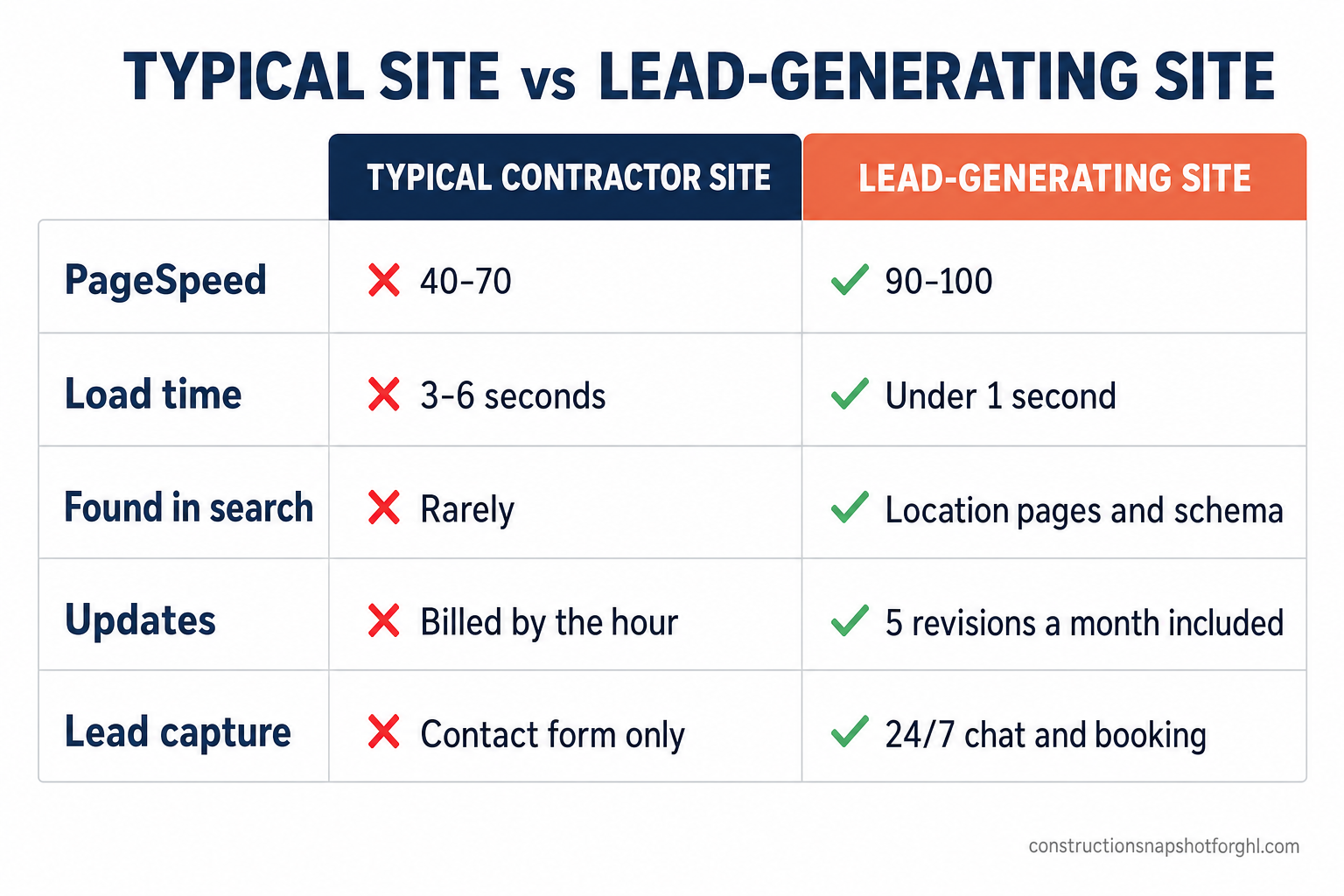
The fix isn’t a prettier brochure — it’s a different kind of website, one built to load fast, get found, stay current, and convert. Here’s the honest side-by-side.
A typical contractor site vs. a lead-generating one
| Feature | Lead-generating site (managed Astro build) | Typical contractor site |
|---|---|---|
| Google PageSpeed (mobile) | 90–100, guaranteed | 40–70 typical |
| Mobile load time | Under 1 second | 3–6 seconds |
| Found in local + AI search | Location pages, schema, llms.txt | Rarely configured |
| Keeping it current | 5 revisions/mo included, done in days | Quoted and billed by the hour |
| Capturing the lead | 24/7 chat, click-to-call, booking | A contact form you check tonight |
| Hosting, SSL, domain | Included, never itemized | $20–60/mo + surprise renewals |
Concretely, a lead-generating contractor website is:
- Fast by architecture, not by plugin. Built on the Astro framework and served from Cloudflare’s global edge, it ships static HTML with almost no JavaScript, so it lands in the passing half of Core Web Vitals with a guaranteed 90+ PageSpeed score — often a perfect 100 — on mobile and desktop.
- Built to be found. A dedicated, individually written page for every San Jose neighborhood and town you build in, plus the schema, meta, and
llms.txtthat both Google’s local pack and the AI answer engines read. - Current without the meter running. Price changes, new project photos, a new trade page — five revisions a month are included and turned around in 2–5 working days, with no hourly billing and no surprise hosting or SSL invoices.
- Wired to convert. An AI chat widget and booking flow that answers the 9 p.m. “do you do permitted ADUs?” question and drops the appointment straight onto your calendar, so interest becomes a booked walk-through instead of a cold inbox.
Why this matters more in San Jose right now
Every market rewards a good website. San Jose punishes a bad one harder, for three reasons.
The homeowner is digital-first and demanding. This is one of the most tech-literate consumer bases in the country. A site that would pass in a slower market reads as amateur here, and the credibility hit (46.1% judge you on design) lands on a homeowner who has options.
The jobs are big and the stakes are asymmetric. With the median home near $1.4 million and remodels running above national medians, one bounced visitor can be a $150,000 project. You don’t need to win more traffic — you need to stop losing the traffic you already have.
The market got tighter. The San Jose metro shed about 3,100 construction jobs (−6%) in the year to November 2024 (AGC of America). When demand softens, the builders who convert best take share from the ones who don’t. Speed-to-lead becomes the whole game — and it starts the instant a homeowner lands on your site. (The follow-up matters just as much; see speed to lead for contractors.)
None of this requires you to become a web developer. It requires a website built as a lead-generation asset instead of a digital brochure — and someone to keep it that way while you stay on the jobsite. Whether you’re a general contractor or a remodeler, the site is the cheapest salesperson you’ll ever hire, and in San Jose it’s the one working while you sleep.
Frequently asked questions
Why is my contractor website not generating leads in San Jose?
Usually one of four reasons: it loads too slowly on mobile (53% of visitors abandon a page slower than 3 seconds), it never appears in local or AI search because it lacks location pages and schema, it looks dated because updating it is expensive and slow, or it has no way to capture and book a lead beyond a contact form. In an affluent, competitive market like San Jose, any one of these hands a six-figure job to a faster-loading competitor.
How fast should a contractor website load?
Aim for a Google PageSpeed score of 90 or higher and a mobile load time under one second. 53% of mobile visitors abandon a page that takes more than 3 seconds, and bounce probability rises 106% as load time grows from 1 to 6 seconds. Only about 44% of mobile sites currently pass all three Core Web Vitals, so a fast site is a real competitive edge, not table stakes.
How much does a good contractor website cost?
Our managed contractor websites start at $97 a month plus a one-time $499 build fee, which includes fast Astro hosting on Cloudflare, a free domain, SSL, location pages, schema and AEO, an AI chat widget, five revisions a month, and two researched articles a week. That is typically far less than the value of a single San Jose remodel lead a slow or invisible site lets slip.
Do I really need location pages for San Jose neighborhoods?
Yes, if you want to rank locally. Google ranks the map pack on relevance, distance, and prominence, and a dedicated page for each town and neighborhood you serve — Willow Glen, Los Gatos, Cambrian Park, Almaden — signals relevance far better than a single "Bay Area" line. It is still the biggest on-page lever a local builder has for local search.
Will an AI chat widget replace my sales process?
No — it protects it. The AI chat widget answers common homeowner questions instantly, qualifies the project, and books a walk-through onto your calendar 24/7, so a lead that lands at 9 p.m. does not go cold before you reply in the morning. You still run the estimate and close the job; the widget just makes sure the lead survives long enough to reach you.
About the author
Danielle Shaw came up through residential remodeling sales, where she learned the hard way that the fastest responder wins the job. She now specializes in speed-to-lead systems and homeowner communication cadences for builders and remodelers, and writes about the website, follow-up, and review habits that turn online interest into signed contracts.
Related posts
- Astro vs WordPress for Austin Contractor Websites: Page Speed & Lost Leads Compared
- Local SEO for Contractors: How to Rank Your Construction Business on Google
- How Contractors Get Found in AI Search: ChatGPT, Perplexity & Google AI Overviews
Sources
- Lindgaard et al. — Attention web designers: You have 50 milliseconds to make a good first impression (Behaviour & Information Technology), 2006
- Stanford Web Credibility Project — How Do People Evaluate a Web Site’s Credibility? (46.1% cite visual design), 2002
- Google (AdSense Help) — 53% of mobile visits abandoned after 3 seconds
- Think with Google — Mobile page speed: new industry benchmarks (bounce probability by load time), 2017
- Deloitte & Google — Milliseconds Make Millions (0.1s speed → conversion lift), 2020
- HTTP Archive — Web Almanac 2024: Performance (Core Web Vitals pass rates), 2024
- HTTP Archive — Web Almanac 2024: Page Weight, 2024
- Statista / StatCounter — Share of web traffic from mobile devices, 2025
- Digiday — Google’s AI Overviews reach over 2 billion monthly users (Alphabet Q2 2025), 2025
- Houzz — 2025 U.S. Houzz & Home Study (renovation spend), 2025
- Zillow — San Jose, CA home values, 2026
- California YIMBY — California ADU Reform: A Retrospective, 2024
- Associated General Contractors of America — Metro construction employment, November 2023–November 2024 (San Jose −6%), 2024