
A $30,000 kitchen job is sitting on your estimate pad. You want 30 percent out of it, so you add 30 percent, write $39,000, and send it. The client signs, the job runs clean, no disasters. Then you reconcile at closeout and the profit is $9,000, which is not 30 percent of anything you quoted. It is 23 percent of the price. You did everything right and still came in seven points under the number you thought you priced. You did not get beaten on the job. You got beaten on one line of arithmetic before the job even started.
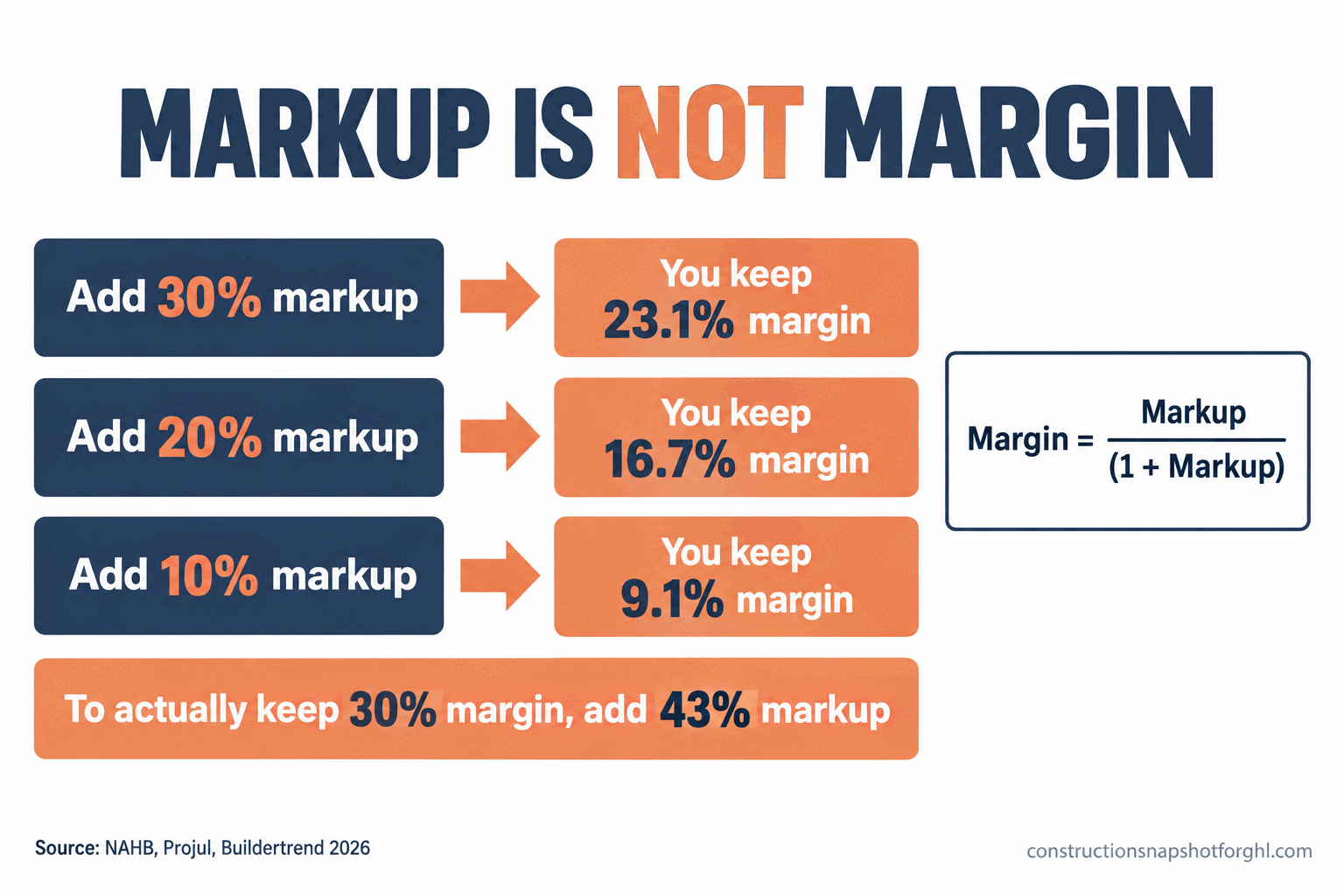
Here is the short version so you can fix it tonight. Markup and margin use the same profit dollars but divide by two different numbers, so they are never equal, and markup is always the bigger percentage. Markup is profit divided by your cost. Margin is profit divided by the price you charge. If you add 30 percent markup you keep a 23.1 percent margin, not 30. To actually keep a 30 percent margin you have to add roughly 43 percent markup. Quote with markup, judge the job by margin, and confuse the two, and you price every job several points light without touching your prices at all. The fix is not charging more. It is adding the right number. This post gives you the two conversion tables, the dollar math on a real job, the seven places the math breaks on an actual build, and the right target for a solo operator, a mid-size remodeler, and a bigger builder.
In this post
- The one-sentence difference between markup and margin
- Why one point of confusion costs you thousands
- The two tables to tape to the wall
- Markup has a second job: it pays your overhead first
- Seven ways the math breaks on a real job
- Three shops, three right numbers
- Common objections
- The change-order rule that protects the number
- Frequently asked questions
- Sources
The one-sentence difference between markup and margin
Both words describe the same pile of profit dollars. They just divide it by a different number, and that is the whole trick.
Markup is profit divided by your cost. You spent $30,000 on a job and added $9,000, so your markup is $9,000 ÷ $30,000, which is 30 percent. Markup looks at the job from the cost side, the side you build on.
Margin is profit divided by the price. That same $9,000 against the $39,000 you charged is $9,000 ÷ $39,000, which is 23.1 percent. Margin looks at the job from the money side, the side you get paid on.
Same nine grand. Two different denominators. Because the price is always bigger than the cost, the margin percentage is always smaller than the markup percentage for the same job. That is not an opinion or an accounting style. It is just where the line sits in the division. Markup divides by the smaller number, so it is always the bigger percent (Projul).
The trap is that you quote with one and get graded by the other. On the estimate you think in markup, because you build the price up from your costs. At the bank you think in margin, because the money that lands is a slice of what you charged. If you treat the two numbers as the same, you aim at 30 and hit 23 every single time, and you never see why.
Why one point of confusion costs you thousands
Run the $30,000 job both ways and watch the gap open up.
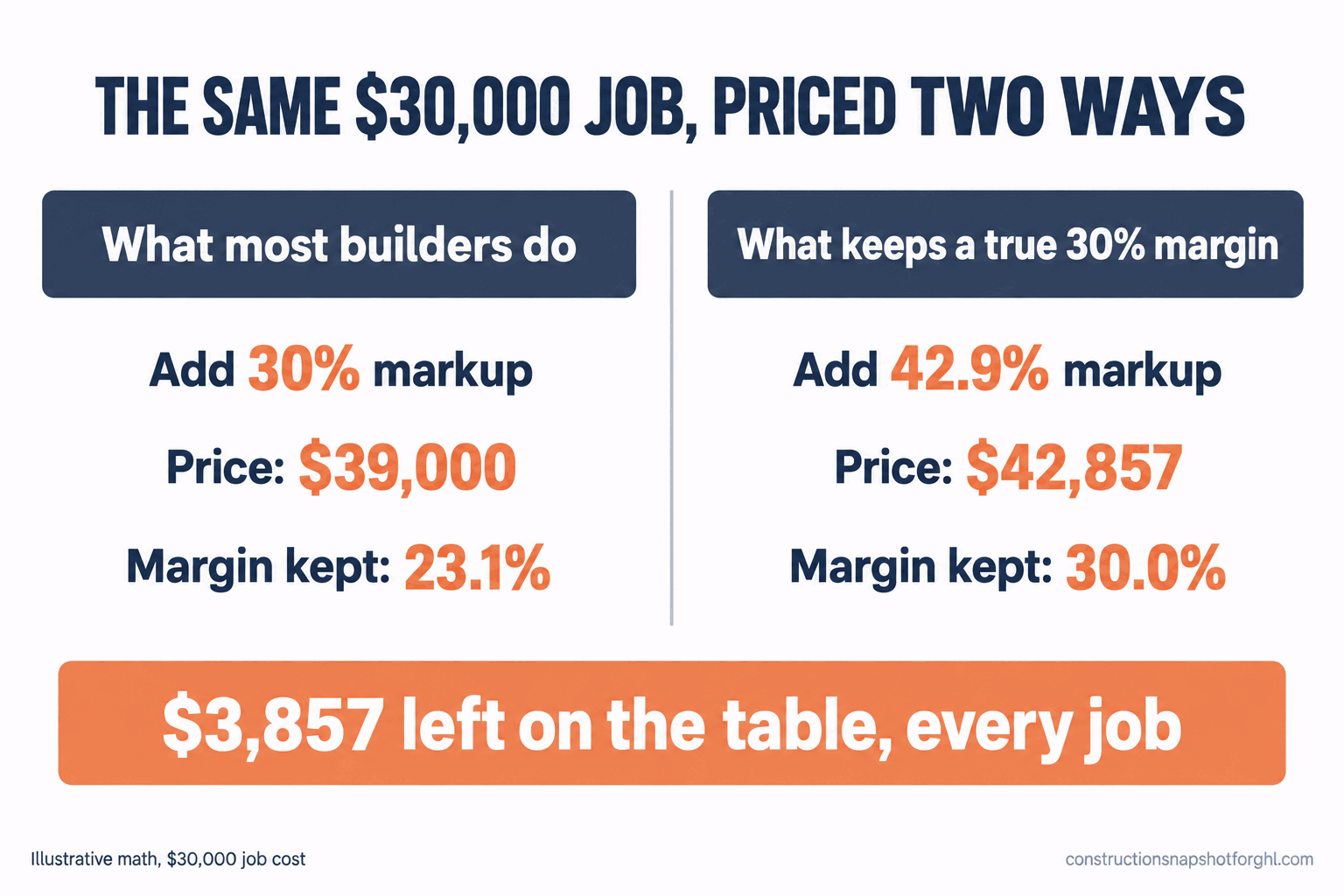
The way most builders do it. Cost is $30,000. You want 30 percent, so you add 30 percent markup: $30,000 × 1.30 = $39,000. Profit is $9,000. Margin is $9,000 ÷ $39,000 = 23.1 percent. You wanted thirty, you got twenty-three.
The way that actually keeps 30 percent margin. To keep 30 percent of the price, divide your cost by the leftover. $30,000 ÷ (1 − 0.30) = $30,000 ÷ 0.70 = $42,857. Profit is $12,857. That is a 42.9 percent markup on your cost, and it lands you a true 30 percent margin.
The difference between the two prices is $3,857 on one job. You did not raise your rates. You did not gold-plate the scope. You just added the correct number instead of the number that felt right. A shop running 20 jobs a year at that size is pricing away roughly $77,000 a year, every year, to a rounding habit.
Here is the same gap across the markup numbers builders actually use. The bar is the margin you keep, not the markup you added.
Margin kept (%) for each markup added, from Margin = Markup ÷ (1 + Markup). Source: formula per Buildertrend and Projul; arithmetic our own.
Notice the shape. Down at the low end the two numbers are close enough that nobody notices. A 20 percent markup gives a 16.7 percent margin, only a few points apart. But the bigger your markup, the wider the gap grows. By the time you are adding 100 percent markup, you are only keeping a 50 percent margin, a full fifty points of daylight. The more profit you are trying to build in, the more a careless conversion costs you.
The two tables to tape to the wall
You do not need software for this part. You need two short tables and the discipline to read the right one. Print them, tape them inside the estimate binder, and never guess again.
Table A reads the job you already priced. You added a markup; this tells you the margin you will actually keep.
You added this markup → you keep this margin
| Feature | Markup you added | Margin you actually keep |
|---|---|---|
| The quick read | Profit ÷ cost | Profit ÷ price |
| 20% | 20% | 16.7% |
| 30% | 30% | 23.1% |
| 40% | 40% | 28.6% |
| 50% | 50% | 33.3% |
| 60% | 60% | 37.5% |
| 75% | 75% | 42.9% |
| 100% | 100% | 50.0% |
Table B works backward from the margin you want. Pick your target margin, read across, and that is the markup you have to add to your cost to get there.
You want this margin → add this markup
| Feature | Margin you want | Markup you must add |
|---|---|---|
| The quick read | Profit ÷ price | Margin ÷ (1 − margin) |
| 15% | 15% | 17.6% |
| 20% | 20% | 25.0% |
| 25% | 25% | 33.3% |
| 30% | 30% | 42.9% |
| 35% | 35% | 53.8% |
| 40% | 40% | 66.7% |
| 50% | 50% | 100.0% |
If you remember nothing else, remember the two formulas behind these tables. To turn a markup into the margin it gives you: Margin = Markup ÷ (1 + Markup). To turn a margin target into the markup you need: Markup = Margin ÷ (1 − Margin) (Buildertrend). You can do both in your head on the hood of the truck. A 25 percent margin needs a third more than cost. A 40 percent margin needs two-thirds more. A 50 percent margin needs double.
Markup has a second job: it pays your overhead first
Here is the part that turns a pricing slip into an actual loss. The markup you add is not your profit. It is overhead plus profit, in that order.
Think about what comes out of the money you charge over and above job cost. Your truck payment, your insurance, the phone, the office, the estimator’s hours, your own salary, the gas spent driving to bids that never closed. None of that is in the direct cost of the kitchen. It all has to come out of the markup before a single dollar is profit. The industry calls that gap between gross and net margin the place where overhead and leaks live, and it is usually the difference between a job that looked good on paper and one that paid you.
The numbers bear it out. NAHB’s Cost of Doing Business study found residential remodelers averaged a 29.9 percent gross margin in 2024 but only a 6.3 percent net margin, because operating expenses ate about 23.6 percent of revenue (Eye on Housing). Single-family builders showed the same shape: a 20.7 percent gross margin in 2023 collapsed to an 8.7 percent net after about 12 percent of revenue went to operating costs (Eye on Housing).
So when a builder says “I add 15 percent and I am fine,” the real question is whether 15 percent markup, which is a 13 percent margin, covers both the overhead AND leaves profit. For most shops carrying a truck, insurance, and a phone that rings all day, it does not. The overhead eats the 13 and the owner works the job for free. If you have never pulled a year of expenses and divided by revenue to find your real overhead percentage, that is the first hour of homework, because it sets the floor your markup has to clear before profit even starts.
Seven ways the math breaks on a real job
Getting the conversion right on the estimate is step one. Here is where it quietly comes undone between signing and closeout, and what to do about each.
1. You quote in markup and track in margin. The original sin, covered above. Pick margin as your north star, since that is what the bank sees, and convert every markup through Table B before it hits paper. Write the target margin at the top of every estimate so you cannot forget what you aimed for.
2. You mark up only materials, not the whole cost. Plenty of builders add their percentage to the lumber and fixtures and then throw labor and subs in near cost, as if those do not carry overhead. They do. Every hour your crew works and every sub you coordinate uses your office, your scheduling, your insurance. Apply your markup to total job cost, materials plus labor plus subs plus equipment, or you are giving away the markup on the biggest line on most jobs.
3. You use one flat markup for everything. Materials, your own labor, and subcontracted work do not carry the same risk. A sub who no-shows can blow your schedule and your margin in a day, which is its own expensive problem worth solving directly. Many builders add a heavier markup to subbed work and self-performed labor than to pass-through materials, precisely because those lines carry more of the risk that eats profit. A flat number across all of it underprices your riskiest work.
4. You price change orders at cost or a friendly markup. The job is signed at a real margin, then the client asks for a change and you quote it loose because you are already there and do not want friction. Every change order should carry the same markup as the base contract, run through the same table. Changes are where margin leaks fastest, and the discipline of pricing and signing each one is a whole system on its own, which we cover in how to get change orders signed.
5. You eat the allowance overage. The client picks the $9,000 range when the allowance was $4,500 and you absorb the difference to keep the peace. That overage is not just the $4,500 in cost, it is the markup you never added to it. A clean selections process that prices every upgrade against its allowance at your job markup, in writing, before it gets ordered, stops this cold.
6. You use last year’s markup on this year’s costs. Material and labor costs move. If your overhead crept up and your markup did not, your margin eroded while you felt busy and fine. Recheck your overhead percentage at least once a year and reset the markup floor so the math still clears it.
7. You never cost your own time. On a solo or small shop, the owner’s hours vanish into the job and never land on a cost line. If your labor is not in the cost you marked up, your markup is not covering it, and you are literally working for the margin instead of being paid for the work. Put a real hourly rate on your own time and run it through the cost like any other labor.
Every one of these is the same disease in a different spot: the right markup applied to the wrong base, or at the wrong moment. Fix the conversion and you have fixed only the first one. The other six are discipline, and they are where the profit on your last job actually leaked.
Three shops, three right numbers
There is no single correct markup, because overhead is different at every size. Run the framework for three shops and the right answer changes each time.
The solo operator, 6 to 10 jobs a year. You are the estimator, the PM, and half the crew. Your overhead percentage looks low on paper because you do not carry an office team, but that is a lie if you are not costing your own time. Put a real wage on your hours, fold it into job cost, and you will usually find your true overhead is 15 to 20 percent of revenue once your salary is in it. That means a markup that only clears 20 percent margin barely feeds you. Aim your margin target high enough that it pays your wage as a cost AND leaves profit on top, or you have bought yourself a job, not a business.
The mid-size remodeler, 15 to 25 jobs a year. This is the NAHB benchmark zone: 29.9 percent gross, 6.3 percent net (NAHB). You now carry real overhead, an office person, maybe a project manager, a yard. Your markup has to cover a 20-plus percent overhead load before profit, so a 50 percent markup, which is only a 33 percent margin, is often the realistic floor, not the ceiling. At this size the danger is volume hiding the leak: you are busy enough that a two-point margin slip across twenty jobs disappears into the churn and you only feel it at tax time.
The bigger builder, 30 to 40 jobs a year. Single-family builders averaged 20.7 percent gross and 8.7 percent net in 2023, and the top quartile kept a 17.7 percent net while the bottom quartile ran at a 1.4 percent loss (Eye on Housing). The spread between the top and bottom is almost entirely discipline, not luck. At your volume the markup conversion has to be systematized, because you are no longer the one pricing every job, and a green estimator who quotes 30 markup thinking it is 30 margin will bleed you across dozens of contracts before anyone notices.
Here is where those net numbers land side by side. Note how thin even the good ones are.
Average net profit margin (%). Source: NAHB Cost of Doing Business via Eye on Housing.
Common objections
“I have always used 1.5 times my cost and done fine.” A 1.5x multiplier is a 50 percent markup, which is a 33.3 percent margin. That is a genuinely healthy number IF your overhead is comfortably under it. The point is not that 1.5x is wrong. It is that you should know it buys you a 33 percent margin, not a 50 percent one, and you should check that 33 clears your actual overhead with profit left over. Most shops that “do fine” on 1.5x are fine. Some are quietly working for their overhead and calling it fine because the bank account never goes negative.
“My market will not bear higher prices.” This is the most common objection and it misses the point entirely. Fixing the markup-to-margin conversion is not about charging more. It is about not accidentally charging seven points less than you meant to. If your market genuinely caps what you can charge, that is even more reason to know your exact margin, because you cannot afford to give any of it away to a math slip. Pricing correctly and pricing higher are two different decisions.
“Is this not just accounting hair-splitting?” On a single small job the gap is a few hundred dollars and feels like splitting hairs. Across a year it is the $77,000 we ran earlier on a 20-job shop, and at a 6 percent industry net margin it can be most of your profit. It is the best-paying hour of math you will do all year, and it costs nothing to fix.
“Do I need software to get this right?” No. A printed table and a calculator get the conversion right on every estimate. Where software earns its keep is consistency at volume: making sure the junior estimator, the change order written at 7pm, and the selection upgrade all carry your real margin automatically, instead of relying on everyone remembering the table. If you are still pricing off a spreadsheet that nobody trusts, the math being right in your head does not help when it is wrong on the document that gets signed.
The change-order rule that protects the number
The base contract is the easy part to get right because you have time to think. Change orders are where a correct base margin quietly bleeds out, because they happen fast and under pressure. Steal this rule and the message that enforces it.
The same principle runs through the rest of the back office: the number you planned only survives if the system makes everyone honor it, from the draw schedule to the follow-up on bids that went quiet. Get the markup conversion right on the estimate, then build the discipline that keeps it right all the way to the final payment.
Frequently asked questions
What is the difference between markup and margin in construction?
Markup is profit divided by cost; margin is profit divided by the price you charge. Same profit dollars, different denominator, so they are never equal and markup is always the larger percentage. A $30,000 job with $9,000 added is a 30 percent markup but only a 23.1 percent margin. Trouble starts when you quote with markup but judge the job by margin.
How do I convert markup to margin?
Use Margin = Markup ÷ (1 + Markup). A 30 percent markup is 0.30 ÷ 1.30 = 23.1 percent margin. To go the other way and find the markup for a target margin, use Markup = Margin ÷ (1 − Margin): a 30 percent margin needs 0.30 ÷ 0.70 = 42.9 percent markup. In your head: a 25 percent margin needs a third more than cost, a 40 percent margin needs two-thirds more, a 50 percent margin needs double.
What markup should a contractor charge?
There is no single number because it depends on your overhead, which the markup has to cover before any profit. Pull a year of expenses, divide by revenue to find your overhead percentage, then set your markup so the resulting margin clears it with profit on top. Many small-to-mid shops find a 50 percent markup, which is a 33.3 percent margin, is a realistic floor once a truck, insurance, an office, and the owner's wage are costed.
What is a good profit margin for a construction or remodeling business?
NAHB found residential remodelers averaged a 29.9 percent gross and 6.3 percent net margin in 2024, the highest net since 1996, and single-family builders averaged 20.7 percent gross and 8.7 percent net in 2023. Those are averages, so half the field did worse and the bottom quartile of builders ran at a loss. A mid-single-digit net is normal; a double-digit net is top tier. The gap between gross and net is where your overhead lives.
Why did my job make less profit than my estimate said it would?
Usually because you added markup and then measured the result as margin, which lands several points lower: 30 percent markup keeps only 23.1 percent. Other causes are marking up materials but not labor or subs, pricing change orders at a discount instead of your real markup, eating allowance overages, and never costing your own time. Each one leaves part of the markup off the signed number.
Do I need software to price jobs at the right margin?
No. A printed conversion table and a calculator get the math right on every estimate. Software earns its keep at volume, when more than one person prices work, because it keeps every estimate, change order, and selection upgrade at your real margin automatically instead of relying on memory. The math is free; the value of a system is consistency on the fast, high-pressure changes where margin leaks most.
Sources
- Builders’ Profit Margins Improved in 2023 (NAHB Eye on Housing): single-family builders 20.7% gross, 8.7% net, plus the quartile spread.
- Remodelers Saw Profit Margin Gains in 2024 (NAHB Eye on Housing): remodelers 29.9% gross, 6.3% net, highest since 1996.
- Home Remodeling Profit Margin (NAHB): the 2026 Remodelers’ Cost of Doing Business Study.
- Construction Markup vs Margin Guide (Projul): definitions and why markup is always the larger percentage.
- Margin vs. Markup in Construction (Buildertrend): conversion formulas and worked example.