Contractors get found in AI search the same way they earn a referral: by being fast to load, easy to crawl, clearly structured, and trusted around the web. AI answer engines — Google AI Overviews, ChatGPT, and Perplexity — don’t invent contractors. They pull from pages they can index, understand, and verify, then quote the ones that answer a homeowner’s question most directly. If your site is slow, thin on schema, and missing location pages, the AI simply skips you and cites a competitor who did the work.
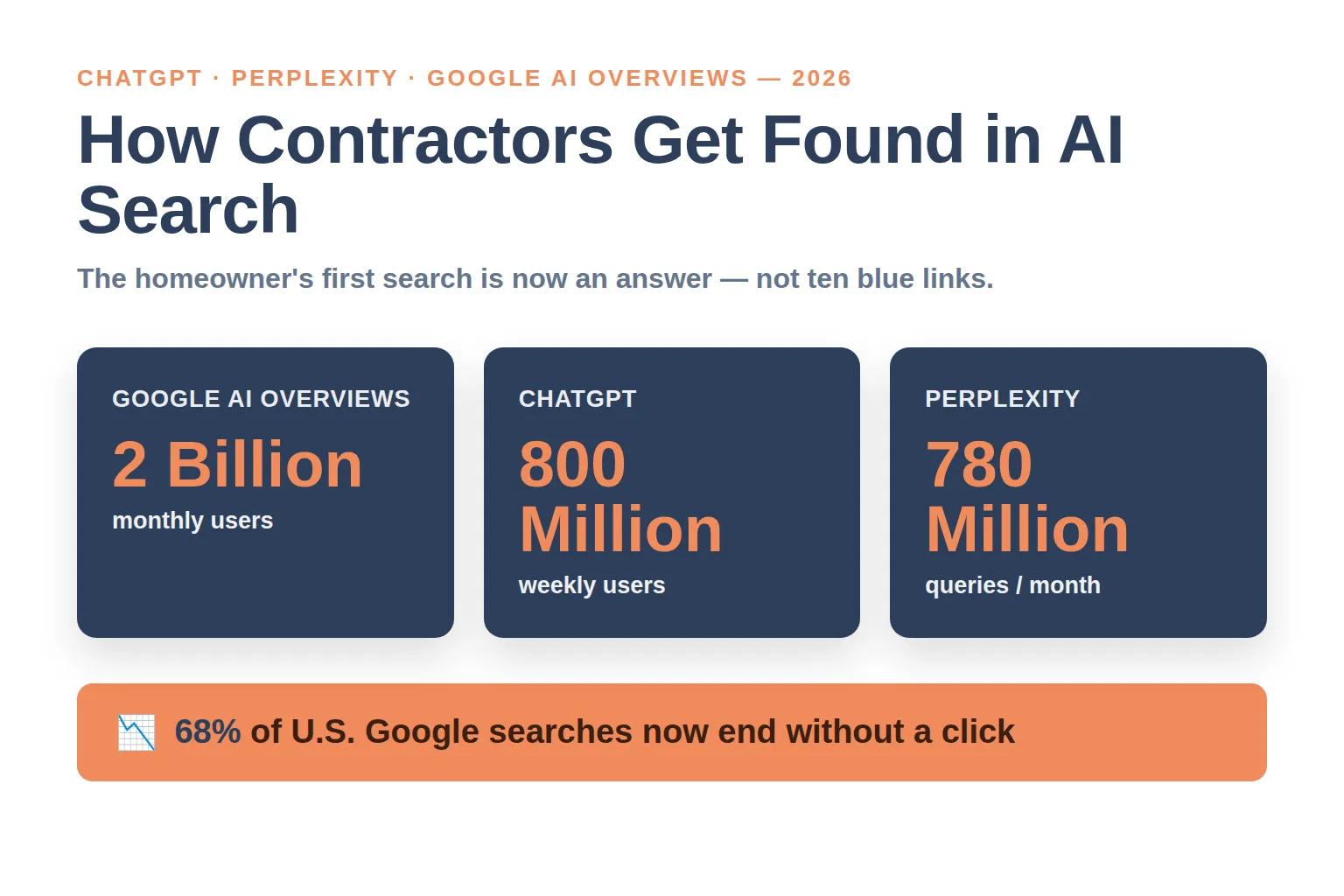
This matters now because the homeowner’s first “search” increasingly isn’t a list of ten blue links — it’s an answer. Google’s AI Overviews reached 2 billion monthly users across 200+ countries by mid-2025 (Google, via TechCrunch), ChatGPT passed 800 million weekly active users (OpenAI), and 68% of U.S. Google searches now end without a single click (SparkToro, 2026). For a general contractor, remodeler, or home builder, the practical question has changed from “where do I rank?” to “when a homeowner asks the AI who to hire, does my business show up in the answer?”
In this post
- What “AI search” actually means for contractors
- The new homeowner search journey
- How AI answer engines decide which contractor to cite
- The 6-step AEO/GEO playbook for contractors
- Why most contractor sites are invisible in AI search
- How to measure your AI search visibility
- Frequently asked questions
- Sources
What “AI search” actually means for contractors
“AI search” is the shift from a page of links to a generated answer. Three surfaces matter for a U.S. contractor:
- Google AI Overviews — the AI-written summary that now sits above the normal results for many queries, with a handful of cited sources. It appears on roughly 16% of all Google queries as of late 2025 (Semrush), and SparkToro puts it above 20% of searches (SparkToro, 2026).
- ChatGPT (with search) — homeowners increasingly type “who’s a good deck builder in my area” straight into ChatGPT. A consumer survey found 77% of Americans have used ChatGPT for search-style tasks (Adobe Express, via Search Engine Journal).
- Perplexity — a citation-first answer engine that lists its sources prominently. It reported 780 million queries in May 2025 alone, growing 20%+ month over month (TechCrunch).
The umbrella disciplines are AEO (Answer Engine Optimization) — structuring content so an AI can lift a clean, correct answer from it — and GEO (Generative Engine Optimization) — earning citations inside those generated answers. For contractors, both come down to the same field-level work: a fast site, honest structured data, answer-first pages, real location pages, and a strong local reputation.
The new homeowner search journey
For a decade, a homeowner searching “kitchen remodeler near me” got a map pack and ten links, and clicked two or three. That journey is quietly collapsing. In early 2026, 68.01% of U.S. Google searches ended without a click, up from 60.45% two years earlier (SparkToro, 2026). When an AI Overview appears, the click-through rate on the results below it drops by nearly 60% (SparkToro).
Share of U.S. Google searches that end without a click, 2024 vs. 2026 (%). Source: SparkToro / Datos, 2026.
That doesn’t mean the internet stopped sending contractors work — it means the shape of the win changed. Instead of a click to your homepage, the payoff is increasingly your business getting named inside the answer: “Based on reviews and service area, three well-rated remodelers near you are…”. The homeowner then searches your name, taps your Google Business Profile, or calls. AI search referral traffic is still small — averaging roughly 0.1–1% of total sessions for most sites — but it grew about 66% over 2025, with ChatGPT referrals up 206% year over year (Semrush). More importantly, it converts: Semrush found AI-search visitors convert at 4.4× the rate of standard organic visitors (Semrush), because someone who arrives after an AI already vetted you is far down the decision funnel.
How AI answer engines decide which contractor to cite
AI engines don’t have a secret “best contractor” database. They assemble an answer from pages they can read, then cite the ones that most directly and credibly answer the query. Here’s what that rewards — and one reassuring surprise.
You don’t need to be #1. Ahrefs analyzed 863,000 keywords and roughly 4 million AI Overview citation URLs and found that only 38% of AI Overview citations come from a page ranking in the top 10 for that query; about 31% come from positions 11–100, and 31% from beyond page 100 (Ahrefs, 2025). BrightEdge, tracking the same surface, found roughly 54% of AI Overview citations overlap with organic-ranking pages (BrightEdge, 2025). Read together: strong rankings help, but a clearly written, well-structured page can be quoted even if it isn’t dominating traditional search yet.
Where Google AI Overview citations come from, by the source page’s organic ranking position (% of citations). Source: Ahrefs, 2025.
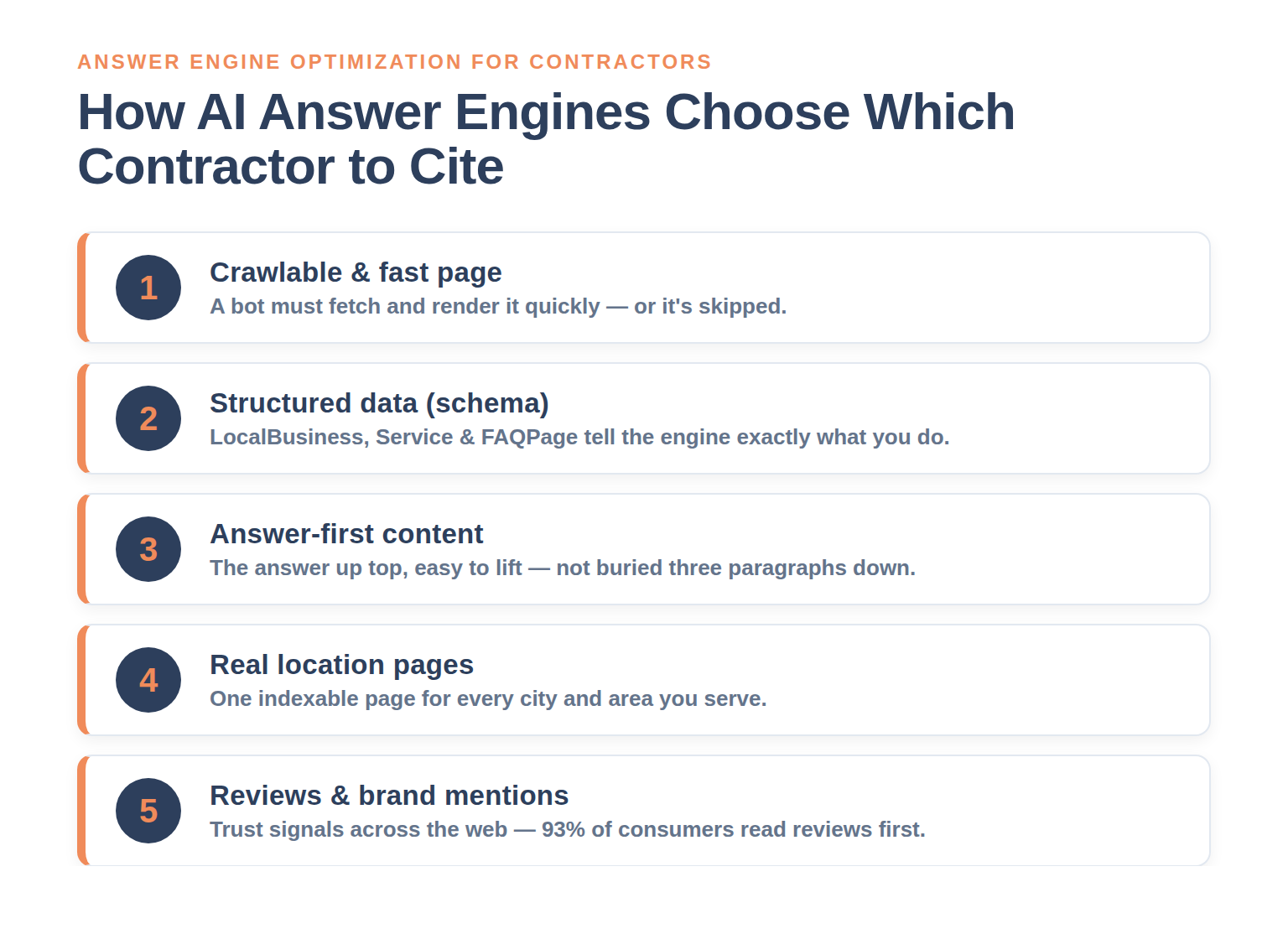
Across the studies and Google’s own guidance, five factors decide whether an AI names your contracting business:
- Crawlability and speed. If a bot can’t fetch and render your page quickly, it can’t cite it. A fast, static-first site is a prerequisite — and only 48% of mobile sites pass Core Web Vitals (HTTP Archive, 2025).
- Structured data (schema).
LocalBusiness,Service,FAQPage, and review schema tell the engine exactly what you do, where, and how well-rated you are — no guessing. - Answer-first content. Pages that open with a direct, self-contained answer (then support it) are easy for an AI to lift verbatim. Buried answers get skipped.
- Real location pages. A dedicated page for each city and neighborhood you serve gives the engine the geographic evidence it needs to name you for “near me” queries.
- Off-site trust. Reviews, directory citations, and brand mentions across the web. 93% of consumers read reviews before choosing a local business (BrightLocal, 2025) — and the AI weighs the same reputation signals.
The 6-step AEO/GEO playbook for contractors
Here’s the practical build order. None of it is exotic; it’s the same site-and-reputation work that wins local SEO, tuned so an AI can quote you.
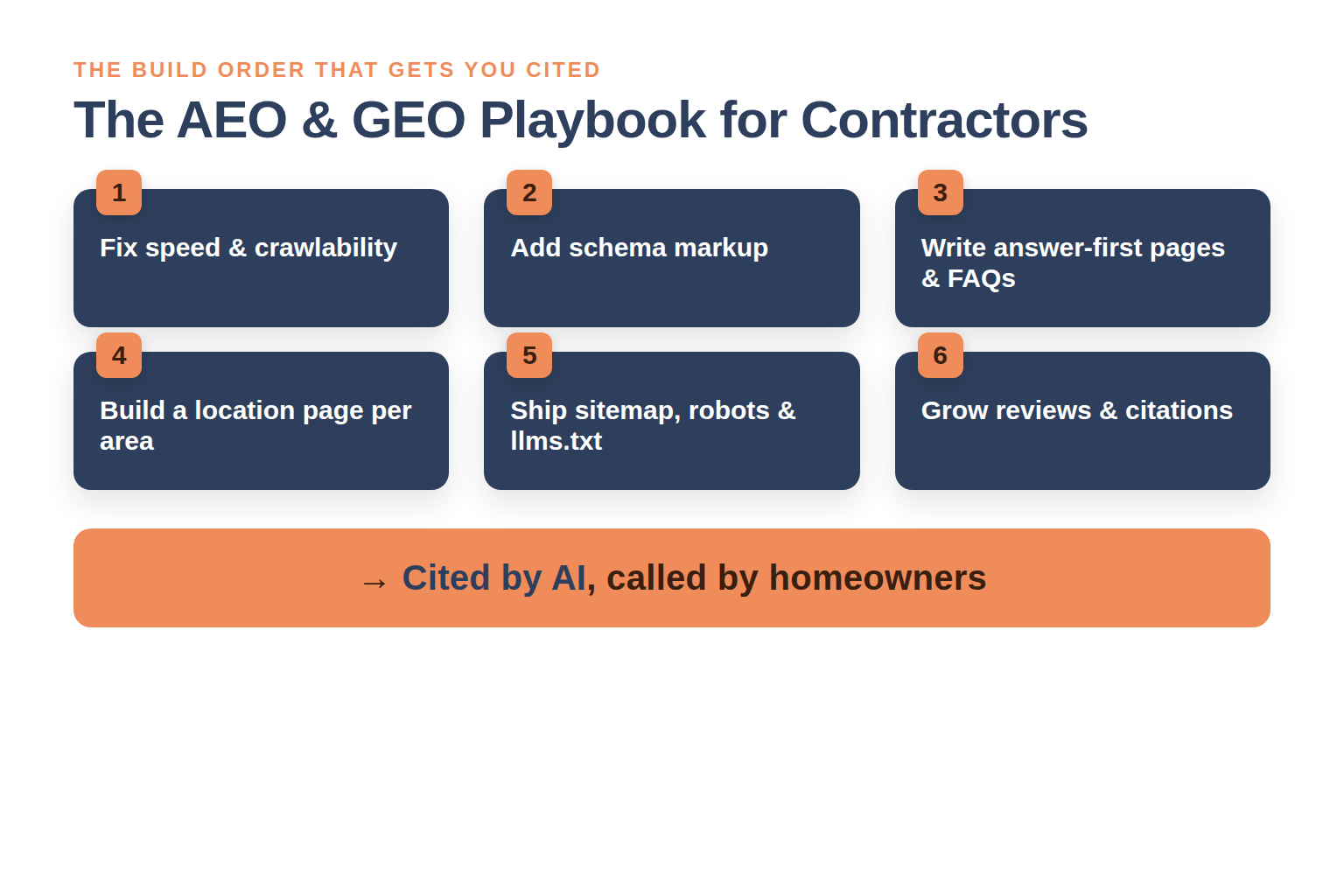
- Fix speed and crawlability first. Get to a 90+ Google PageSpeed score and pass Core Web Vitals. On a bloated WordPress or page-builder site, that’s ongoing work; on a static-first Astro build it’s the default. If a bot times out, nothing else matters.
- Mark up every page with schema.
LocalBusinesswith your service area,Servicefor each trade,FAQPageon pages that answer questions, andReview/AggregateRatingwhere you show ratings. This is the single highest-leverage AEO move because it removes ambiguity. - Write answer-first pages and FAQs. Lead each service and location page with a one-paragraph, self-contained answer to the obvious homeowner question (“How much does a kitchen remodel cost in Phoenix?”), then support it. Add a real FAQ block to every important page.
- Build a location page for every service area. One indexable page per city and neighborhood you actually serve, with local specifics — not a spun template. This is the evidence AI needs for “near me” answers, and it maps directly to how homeowners search: 68% use Google to find local businesses (BrightLocal, 2025).
- Ship a clean sitemap, robots.txt, and llms.txt. Tell both search crawlers and AI crawlers what to index and how your content is organized. An
llms.txtfile is the emerging convention for guiding AI models to your key pages — most contractor site platforms don’t generate one automatically. - Grow reviews and off-site citations. A steady flow of fresh Google reviews and consistent listings across directories is the reputation layer AI engines pull from. Automate the ask so it’s reliable — see how to get more Google reviews for your construction business.
This sequence is deliberately front-loaded on the technical foundation, because steps 3–6 can’t help you if a crawler can’t get past step 1. It’s the same reason local SEO for contractors starts with the site and the Google Business Profile before anything clever.
Why most contractor sites are invisible in AI search
Walk through the checklist above against a typical contractor site — a WordPress theme with a page builder, or a site thrown together inside a CRM — and the gaps are obvious. It loads in 4–6 seconds on mobile, has no schema beyond whatever a plugin bolted on, buries the answer three paragraphs down, serves one generic “Areas We Serve” page instead of real location pages, and has no llms.txt at all. To an AI crawler, that site is hard to read and easy to skip.
AI-search readiness: typical contractor site vs. an AEO-built site
| Feature | AEO-built Astro site | Typical WordPress / CRM site |
|---|---|---|
| Google PageSpeed (mobile) | 90–100 | 40–70 |
| Schema (LocalBusiness, Service, FAQ) | Built into every page | Rarely configured |
| Answer-first content + FAQ blocks | Standard | Inconsistent |
| Location pages per service area | One page per city/area | One generic page |
| Sitemap + robots + llms.txt | Shipped and correct | Often missing llms.txt |
| Passes Core Web Vitals | By default (static) | A monthly maintenance fight |
The fix isn’t a plugin or a one-time “AI SEO” service — it’s building the site correctly in the first place. That’s exactly what our Get-a-Website service does: static-first Astro pages with a guaranteed 90+ PageSpeed score, schema/AEO/GEO on every page, real location pages, a correct sitemap/robots/llms.txt, and an AI chat widget to catch the homeowner the moment they arrive — for $497 one-time plus $97/month, hosting and edits included. It’s the same speed argument as Astro vs. WordPress for contractor sites, extended to the AI era: the front door has to open instantly and be readable by the engine deciding who to recommend.
How to measure your AI search visibility
You can’t improve what you don’t watch. Three practical checks, no expensive tooling required:
- Ask the engines directly. Type your highest-intent queries — “best [your trade] in [your city],” “how much does [your service] cost in [your city]” — into Google (watch for the AI Overview), ChatGPT with search on, and Perplexity. Note whether you’re named and which of your pages, if any, gets cited.
- Watch referral sources. In your analytics, track referrals from
chatgpt.com,perplexity.ai, andgemini.google.com. They’ll be small but growing; a rising trend means your pages are getting surfaced. - Audit the fundamentals monthly. Run PageSpeed Insights, confirm your schema validates, and verify your sitemap and
llms.txtare live. If those slip, your AI visibility slips with them.
Treat it like any other lead channel: measure it, fix the weakest link, repeat. The contractors who show up in AI answers over the next two years won’t be the ones who chased a trick — they’ll be the ones whose sites were fast, structured, and trustworthy enough that the AI had no reason to leave them out.
Frequently asked questions
How do contractors get found in AI search like ChatGPT and Google AI Overviews?
By making their site fast and crawlable, adding structured data (LocalBusiness, Service, and FAQPage schema), writing answer-first pages with real FAQs, building a location page for every service area, shipping a clean sitemap/robots/llms.txt, and maintaining strong Google reviews and directory citations. AI engines assemble answers from pages they can read and trust, then cite the ones that answer the homeowner’s question most directly.
Do I need to rank #1 on Google to be cited by AI Overviews?
No. Ahrefs found only 38% of AI Overview citations come from pages ranking in the top 10 — the rest come from positions 11–100 and beyond. Strong rankings help, but a clearly structured, answer-first page can be quoted even before it dominates traditional search results.
What is the difference between SEO, AEO, and GEO?
SEO (Search Engine Optimization) is about ranking in traditional search results. AEO (Answer Engine Optimization) is structuring content so an AI can extract a clean, correct answer from it. GEO (Generative Engine Optimization) is earning citations inside AI-generated answers. For contractors they overlap heavily: fast site, schema, answer-first content, location pages, and reputation serve all three.
Is AI search traffic even worth it for a construction business?
Yes, despite low volume today. AI referral traffic averages roughly 0.1–1% of sessions but grew about 66% in 2025, and AI-search visitors convert at roughly 4.4× the rate of standard organic visitors (Semrush), because they arrive after the AI has already vetted you. It is a small, fast-growing, high-intent channel worth building for now.
What is an llms.txt file and does my contractor website need one?
llms.txt is a plain-text file at the root of your site that guides AI models to your most important pages, similar to how robots.txt guides search crawlers. It is an emerging convention for AI discoverability. Most contractor site platforms do not generate one automatically, so having a correct llms.txt is a simple edge in AI search.
About the author
Danielle Shaw is Lead Generation & Client Communication Lead at Construction Snapshot for GHL. She came up through residential remodeling sales, where she learned the hard way that the fastest, clearest responder wins the job. She writes about speed-to-lead systems, homeowner communication cadences, and — increasingly — how contractors stay visible as search shifts from blue links to AI answers.
Related posts
- Local SEO for Contractors: How to Rank Your Construction Business on Google (2026)
- Astro vs WordPress for Contractor Websites: Page Speed & Lost Leads Compared
- How to Get More Google Reviews for Your Construction Business
Sources
- Google (via TechCrunch) — AI Overviews reach 2B monthly users, 200+ countries, 2025
- SparkToro / Datos — In 2026, less than one-third of Google searches still send a click, 2026
- Semrush — AI Overviews study (~16% of queries), 2025
- OpenAI (reported) — ChatGPT reaches 800M weekly active users, 2025
- Adobe Express (via Search Engine Journal) — 77% of Americans have used ChatGPT for search, 2025
- TechCrunch — Perplexity: 780M queries in May 2025, 2025
- Ahrefs — Only 38% of AI Overview citations come from top-10 pages, 2025
- BrightEdge — 54% AI Overview / organic rank overlap, 2025
- Semrush — Traffic channel mix study (AI referrals +66%, ChatGPT +206% YoY), 2025–2026
- Semrush — AI-search visitors convert at 4.4× organic, 2025
- BrightLocal — Local Consumer Review Survey 2025, 2025
- HTTP Archive — Web Almanac 2025: Performance (Core Web Vitals pass rate), 2025