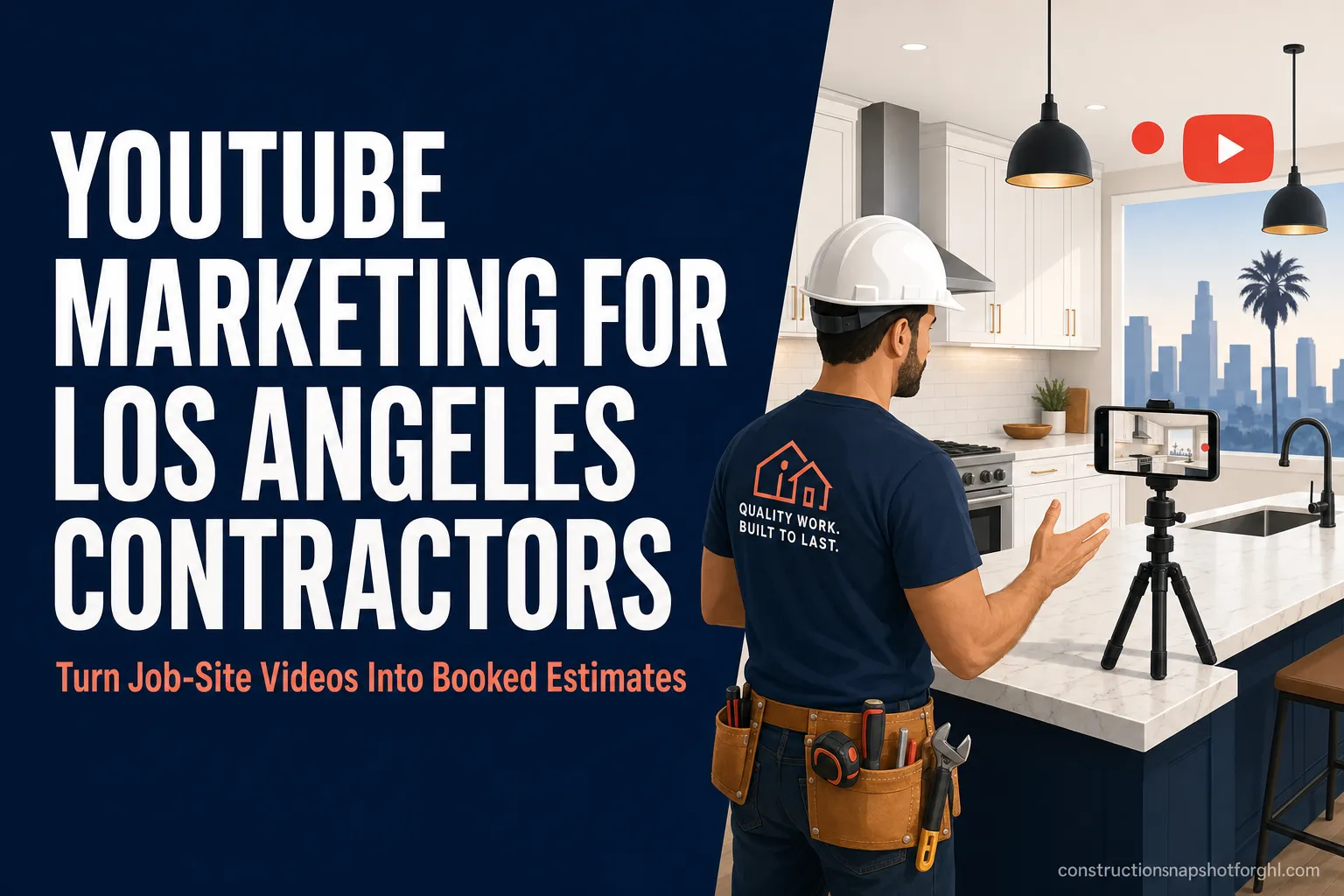
For a Los Angeles contractor, YouTube is the highest-leverage marketing channel you’re probably ignoring — and the fix is a six-step system that turns the jobs you’re already on into video homeowners find, watch, and book from. You don’t need a studio, a scriptwriter, or an on-camera personality. You need to film the demo, the framing, and the finished kitchen you’re standing in anyway, cut it into a short vertical clip, name it for what an LA homeowner actually searches, and put a booking link under it. That’s the whole loop.
Here’s why it works: 84% of U.S. adults use YouTube — more than any other online platform (Pew Research Center, 2025), and it’s the second most-visited website in the world (Statista, 2025). Homeowners in Sherman Oaks and Pasadena are already on it watching “kitchen remodel cost” and “ADU walk-through” videos before they ever fill out a form. This playbook shows you exactly how to be the contractor they find.
In this post
- Why YouTube matters for Los Angeles contractors
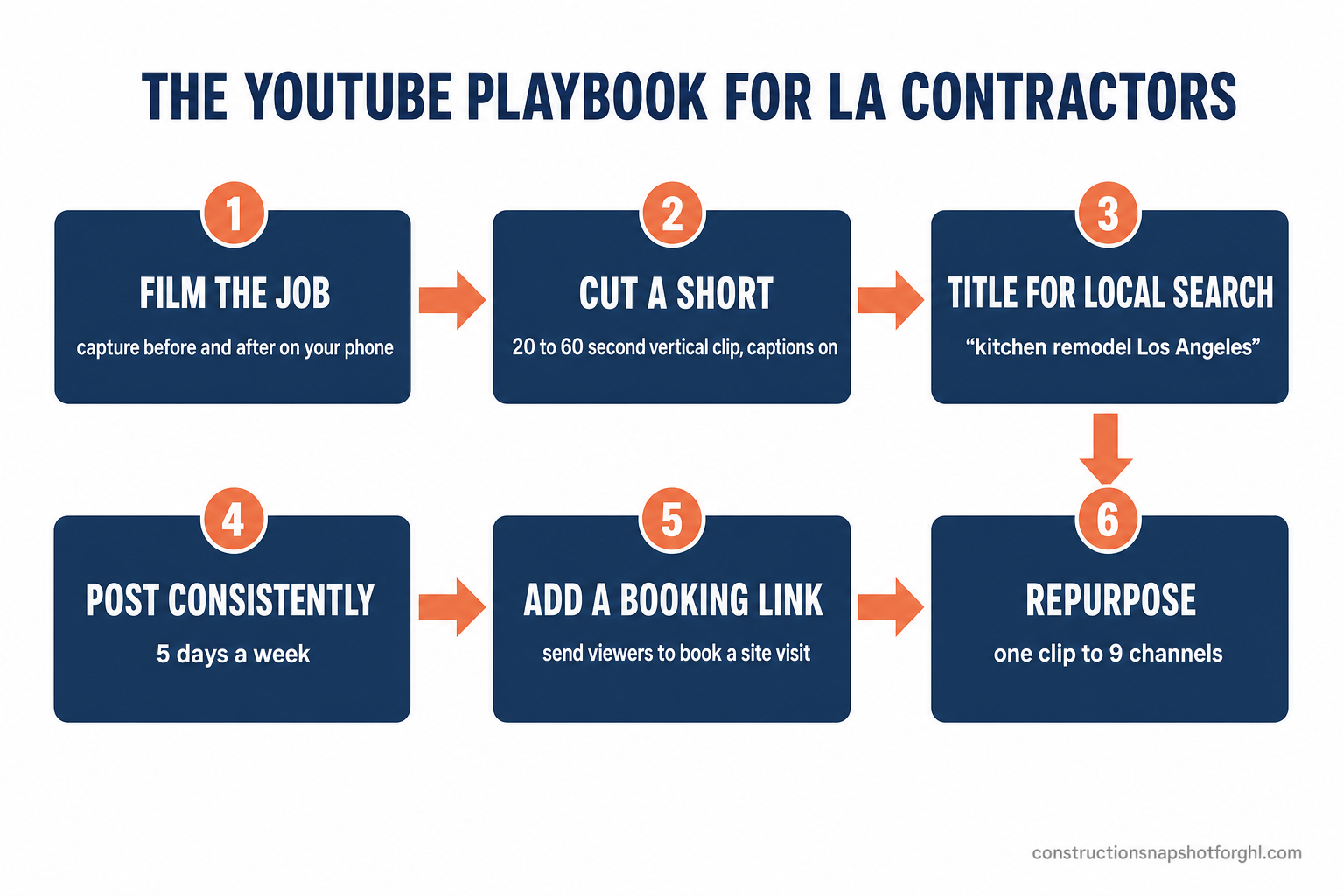
- The 6-step YouTube playbook
- What to film: LA-specific content that books jobs
- What results actually look like (and when)
- DIY vs. done-for-you
- Frequently asked questions
- Sources
Why YouTube matters for Los Angeles contractors
Los Angeles is one of the largest — and most competitive — construction markets in the country. California employs roughly 895,800 construction workers (AGC of America, 2025), a large share of them in the LA basin, and the metro has been tightening: the Los Angeles–Long Beach–Glendale division shed 8,200 construction jobs, a 5% decline, in the year to February 2025 (AGC of America, 2025). When the pipeline tightens, the contractors who stay booked are the ones homeowners already trust before the first call — and video is the fastest way to earn that trust at scale.
That trust is built where homeowners already spend their attention. YouTube isn’t a niche channel; it’s the default one:
Share of U.S. adults who say they use each platform (%). Source: Pew Research Center, “Americans’ Social Media Use 2025”.
Reach is only half the story. The reason video converts is that it does the pre-selling a homeowner needs before spending five or six figures on their house. Watching you demo a clean tile cut or explain why a permit inspection matters answers the quiet question every homeowner has — can I trust this person in my home? — in a way a text testimonial never will. That’s why roughly 89% of people say a video has convinced them to buy a product or service (Wyzowl), and why 89% of businesses now use video as a marketing tool with the vast majority reporting positive ROI.
And short-form is where the free reach lives right now. YouTube Shorts — vertical clips under a few minutes — went from 70 billion to over 200 billion daily views in about fifteen months:
YouTube Shorts, average daily views (billions). Source: YouTube CEO Neal Mohan (70B, Feb 2024) and YouTube at Cannes Lions 2025 (200B+, June 2025).
The 6-step YouTube playbook
You already have the raw material — you’re on job sites every day. The system below turns that footage into found, watched, booked. Do it in order.
Step 1 — Film the job you’re already on
The best contractor content isn’t staged; it’s the work. Keep your phone horizontal for a full walk-through and vertical for a quick Short, and capture three things on every job: the before (the tear-out, the dated kitchen, the cracked slab), the process (a satisfying tile cut, a beam going in, a rough-in), and the after (the reveal). Ten to fifteen seconds of clean footage per visit is plenty. Shoot in good light, keep the lens clean, and get a few seconds of steady b-roll. You are not making a movie — you’re making proof.
Step 2 — Cut a vertical Short (and the occasional long-form walk-through)
Most of your reach will come from Shorts, so lead with them: a 20–60 second vertical clip with a strong first frame (“This Encino kitchen hadn’t been touched since 1988”), captions burned in (most people watch muted), and a satisfying before/after payoff. Then, once or twice a month, publish a longer 3–8 minute walk-through — a full ADU tour, a “what a $90k kitchen actually includes” breakdown — for the homeowners who are deep in research mode and ready to talk. Shorts win attention; long-form earns the appointment.
Step 3 — Title and tag it for local search
This is the step most contractors skip, and it’s where the leads are. YouTube is a search engine, so name your video the way a homeowner searches: “Kitchen Remodel in Los Angeles — Before & After (2026)” beats “Project #47.” Put the service and the city in the title, the description, and the spoken intro. Add a plain-English description with your service area (Glendale, Burbank, the Valley, the Westside) and a link. Because about 80% of the videos Google surfaces in search come from YouTube (Search Engine Land), one well-titled video can show up both on YouTube and on the Google results page for “kitchen remodel Los Angeles.” This is the same local SEO discipline that wins the map pack, applied to video.
Step 4 — Publish on a consistent calendar
The algorithm rewards consistency, not perfection. A homeowner’s remodel search can happen any week of the year, so you want a steady drip of content — ideally posting five days a week — rather than four videos in one burst and then silence for two months. Batch your filming (you’re already on site) and schedule ahead. Consistency is also what compounds: every video you publish keeps working, so a channel that posts weekly for a year has 50+ assets pulling in searches, not one.
Step 5 — Route every viewer to a booking link
Views don’t pay for the truck; booked estimates do. End every video with a clear spoken call to action (“Want a quote on your kitchen? Link’s below”) and put a real booking URL in the description and pinned comment. The faster a curious viewer can go from “I like this” to a scheduled site visit, the more of them convert — the same speed-to-lead logic that governs phone leads. Better still, send them to a page with an AI chat widget that answers questions and books the visit 24/7, so a homeowner watching your Short at 11 p.m. doesn’t cool off by morning.
Step 6 — Repurpose to every channel you own
A single vertical clip isn’t one post — it’s five. The same Short belongs on YouTube, Instagram Reels, TikTok, Facebook, and your Google Business Profile, cropped and captioned for each. This is where a real content engine pulls ahead of a solo phone-and-forget approach: one film day feeds a week of posts across nine channels. Homeowners who DM you from those clips can be handled the same automated way you’d handle any Instagram and Facebook DM — captured, answered, and booked without you touching your phone.
What to film: LA-specific content that books jobs
Generic “we do great work” videos get generic results. In the Los Angeles market specifically, these topics map to what homeowners are actively searching and hiring for:
- ADU tours and cost breakdowns. ADUs are one of the hottest categories in LA thanks to statewide rules that make them easier to permit. A “detached ADU in the San Fernando Valley — full walk-through and what it cost” video is pure high-intent gold.
- Permit and process explainers. LA homeowners are (rightly) anxious about permits, timelines, and inspections. A calm two-minute “how a kitchen permit actually works in the City of LA” video positions you as the pro who won’t cut corners.
- Before/after reveals by neighborhood. Name the area — Silver Lake, Manhattan Beach, Pasadena — so the video matches local searches and signals you actually work there.
- Cost-and-timeline honesty. “What a $120k remodel really includes” videos build enormous trust because almost no contractor makes them. Honesty is a differentiator.
- Earthquake retrofits and older-home issues. LA’s housing stock is old; soft-story retrofits, foundation work, and 1920s re-pipes are real, searched, high-ticket problems you can own on video.
The point is to answer the questions a homeowner is already typing into YouTube and Google. Every honest, specific, local video is a salesperson that works while you’re on the job — and increasingly, it’s what gets you cited in AI search answers too, because clear, question-shaped content is exactly what AI assistants pull from.
What results actually look like (and when)
Set expectations honestly, because anyone promising overnight virality is selling you something. Organic video is a compounding asset, not a switch. Realistically:
- Months 1–2: You’re building the habit and the library. Your existing followers and past homeowners re-engage. Views are modest; you’re planting.
- Months 3–5: The algorithm starts pushing your best Shorts to homeowners who don’t follow you yet. This is the window where a single reveal can genuinely take off and flood you with inquiries.
- Month 6 and beyond: You now have a back catalog of 50–100 searchable assets, each one still pulling in “remodel near me” traffic. This is the point where YouTube stops feeling like a chore and starts feeling like a lead source.
The math is why it’s worth it. Homeowners are searching before they call — 84% of consumers looked up a local business online in the last three months, and 52% start that search on Google (BrightLocal) — and video is what shows up and does the convincing when they do. You’re not chasing a trend; you’re putting proof of your work where buyers are already looking. For a deeper look at running this across every platform at once, see our Phoenix social media playbook, which covers the nine-channel content engine in detail.
DIY vs. done-for-you
There are two honest ways to run this. Here’s the trade-off, plainly:
Running YouTube yourself vs. a done-for-you team
| Feature | DIY (you + your crew) | Done-for-you social |
|---|---|---|
| Filming | You capture clips on site | You capture clips on site (or we use AI footage) |
| Editing & captions | You or a freelancer, per video | Done for you, on-brand, per platform |
| Titling for local SEO | You learn it | Handled — service + city, every post |
| Posting cadence | Whenever you have time | 5 days a week, 9 channels, on a calendar |
| Comments & DMs | You, eventually | AI agents reply and book 24/7 |
| Typical monthly cost | $0 + your hours (or $4k–8k for staff) | From $397/month, white-label |
DIY is genuinely viable if you (or someone on your crew) will actually do it every week — the tools are free and the reach is real. Where most contractors fall down is consistency: the filming happens, the posting doesn’t, and three weeks later the channel is dead. A done-for-you team exists to remove that failure point. A designer, video editor, social manager, and community manager run $4,000–$8,000 a month combined; our done-for-you social service bundles the content and the AI agents from $397/month, white-label, cancel with 15 days’ notice — so the videos actually ship whether or not you had a slow week.
Whichever path you choose, the standard is the same: film the work, name it for local search, post consistently, and route every viewer to a booking link. Do that in Los Angeles for six months and you won’t be the contractor hoping to be found — you’ll be the one homeowners already watched before they called.
Frequently asked questions
Do I need expensive equipment to do YouTube marketing as a contractor?
No. A recent smartphone shoots more than good enough video for YouTube and Shorts. Focus on good light, a clean lens, steady footage, and burned-in captions (most people watch muted). The content — a real before/after, an honest cost breakdown — matters far more than the camera. You can add a $30 clip-on mic and a small tripod later if you want.
Should Los Angeles contractors post Shorts or long-form videos?
Both, but lead with Shorts. Vertical Shorts under 60 seconds get the most reach right now — YouTube Shorts crossed 200 billion daily views in 2025 — so they are how new homeowners discover you. Then publish a longer 3–8 minute walk-through once or twice a month for homeowners who are deep in research and closer to booking. Shorts win attention; long-form earns the appointment.
How do I get leads from YouTube instead of just views?
End every video with a clear call to action and put a booking link in the description and pinned comment. Title videos for local search ("kitchen remodel Los Angeles") so the right homeowners find them, and send viewers to a page with a fast booking form or an AI chat widget that can answer questions and schedule a site visit 24/7. Views are the top of the funnel; the booking link is what turns them into estimates.
How long until YouTube produces real inquiries for my construction business?
Expect meaningful, compounding results in roughly 3–5 months of consistent posting, with a back catalog of searchable videos paying off from month six onward. Because Shorts can be pushed to new audiences quickly, a single strong before/after can take off much sooner — but consistency over months is what builds a reliable lead source. Anyone promising overnight results is not being honest.
Can I outsource contractor YouTube marketing?
Yes. You still capture short clips on the job (or a service can use AI-generated footage), and a done-for-you social team handles editing, captions, local-SEO titling, and posting across YouTube and other channels five days a week — plus AI agents that reply to comments and DMs and book site visits. In Los Angeles, our done-for-you social service starts at $397/month, white-label, so the content ships even during your busy weeks.
About the author
Danielle Shaw is the Lead Generation & Client Communication Lead at Construction Snapshot for GHL. She came up through residential remodeling sales, where she learned the hard way that the fastest, most visible contractor wins the job. She writes about speed-to-lead systems, social and video content that reaches new homeowners, and the follow-up cadences that turn attention into booked estimates.
Related posts
- Social Media Marketing for Contractors in Phoenix: What Actually Books Jobs
- Instagram & Facebook DM Automation for Charlotte Contractors
- Local SEO for Contractors: How to Own Your Service Area
- Speed to Lead for Contractors: Why the First Responder Wins
Sources
- Pew Research Center — Americans’ Social Media Use 2025, Nov 2025
- Statista — Most visited websites worldwide, 2025
- YouTube / Neal Mohan — Letter from the YouTube CEO (Shorts 70B daily views), Feb 2024
- YouTube at Cannes Lions — Shorts averages 200B+ daily views, June 2025
- Wyzowl — State of Video Marketing / Video Marketing Statistics
- Search Engine Land — YouTube dominant source of video in Google results
- BrightLocal — Consumer Search Behavior
- AGC of America — California construction fact sheet 2025
- AGC of America — Construction jobs by metro, Feb 2024–Feb 2025 (LA job losses)