The bank is holding your $62,000 draw, and the only thing between you and the money is a stack of paper. The draw package wants a signed lien waiver from you and one from every sub and supplier who touched the job this period. Your framer faxed his over last week. Your plumbing supplier swears they sent one but cannot find it. Your electrician wants to be paid first and sign after. So the draw sits, your payroll is Friday, and you are chasing signatures instead of running the job. That is lien waivers on a normal week. On a bad week, it is worse: you sign the wrong version of the form, hand it over before the check clears, and quietly give up your right to collect on work you have not been paid for.
Here is the short version. A lien waiver is a document that says you give up your right to file a mechanics lien in exchange for payment. There are four of them, and the split that matters is conditional versus unconditional. A conditional waiver only takes effect once you actually get paid, so it is safe to sign up front. An unconditional waiver takes effect the second you sign it, paid or not, so signing one before the money lands means you have released your lien rights on nothing but a promise. On top of that, twelve states will throw out any waiver that does not match their exact statutory form, which means a generic template you pulled off the internet can be worthless in those states. This post walks the four types, the conditional-versus-unconditional trap, the twelve mandatory-form states, and the draw-day routine that keeps you from ever signing away money you have not received.
In this post
- What a lien waiver actually is
- The conditional vs unconditional trap that hands back your money
- Your two jobs on every draw: sign smart, collect everything
- The twelve states where a generic waiver form is worthless
- Steal this: the draw-day waiver routine and the messages to send
- Run it three ways: solo, mid-size, and multi-state
- What it costs when the waiver is wrong
- Common objections
- Frequently asked questions
- Sources
What a lien waiver actually is
A mechanics lien is the strongest collection tool a builder has. It attaches a claim to the property itself, so an unpaid contractor can block a sale or a refinance until the bill is settled. A lien waiver is the other side of that coin. It is a signed document in which you, or your sub, or your supplier agree to give up that lien right for a specific chunk of work, usually in exchange for a payment. Owners and construction lenders collect them on every draw because they are what proves nobody can come back later and lien a house that has already been paid for.
There are four lien waivers, and the names tell you exactly what each one does once you learn the two dimensions. The first dimension is timing: a progress waiver covers one payment along the way, and a final waiver covers the last payment and closes out your claim on the whole job. The second dimension is the one that matters: a conditional waiver only becomes effective once you have actually been paid, while an unconditional waiver becomes effective the instant it is signed, whether the money shows up or not (Levelset’s lien waiver guide).
The four lien waivers, and which is safe to sign when
| Feature | Conditional (safe to sign up front) | Unconditional (sign only after payment clears) |
|---|---|---|
| Progress payment (mid-job draw) | Sign WITH your invoice to request a draw. It does nothing until the check clears. | Sign ONLY after that draw's check has actually cleared your bank. |
| Final payment (job closeout) | Sign to request final payment. Your lien rights survive until you are paid. | Sign ONLY after the final check clears. This releases your rights for the entire job. |
| When it takes effect | Only on proof of payment (a cleared check or written acknowledgment). | The moment you sign it, paid or not. |
| The risk if you get it wrong | Low. If the check bounces, your lien rights are intact. | High. If the check never comes, you have waived your rights for free. |
So the safe default is simple. When you are asking to be paid, you send a conditional waiver with the invoice. When you have been paid and the money has cleared, you sign an unconditional one to confirm it. The trouble starts when someone asks you to flip that order.
The conditional vs unconditional trap that hands back your money
This is the whole ballgame, so it gets its own section. The most expensive mistake in lien waivers is signing an unconditional waiver before the payment has actually hit your account.
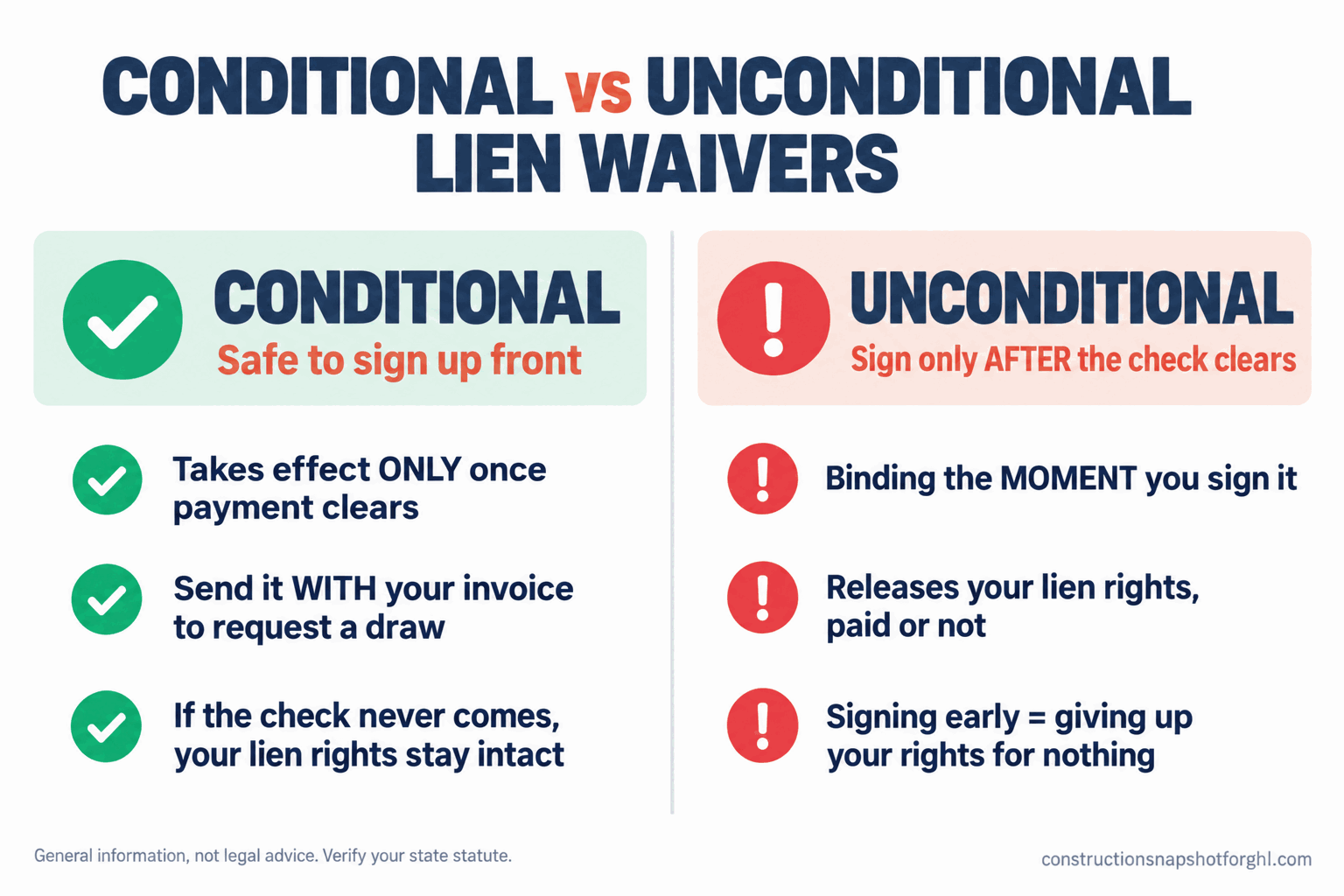
Picture how it happens, because it never looks like a trap in the moment. A general contractor or an owner’s lender tells your office, “We cannot cut the check until we have the signed unconditional waiver in the draw package.” It sounds like a formality. Your bookkeeper, wanting the money to move, signs the unconditional form and sends it over. Now the law treats your lien rights for that work as gone, immediately, because that is exactly what an unconditional waiver does. If the check then gets delayed, shorted, or never comes, you are an unsecured creditor holding a release you signed for nothing.
The fix is one sentence you never break: you only ever sign an unconditional waiver after the money for that payment has cleared your bank. Until then, you send the conditional version, which releases nothing until payment is real. California’s statutory conditional form spells the mechanism out: it is only binding once there is evidence of payment, which the state defines as the claimant’s endorsement on a check that the bank has actually paid, or a written acknowledgment that payment was received (California Contractors State License Board). That built-in safety is the entire reason the conditional form exists.
It runs the other direction too. When you are the general contractor paying a sub, do not accept a conditional waiver as proof the sub has been paid, because a conditional waiver proves nothing until the payment clears. And never let a sub hand you an unconditional waiver before you have actually paid them, or you are asking them to take the same bad deal you would refuse yourself. The paperwork only works when the type of waiver matches the real state of the money.
Your two jobs on every draw: sign smart, collect everything
Here is the part that separates a builder who gets paid cleanly from one who pays twice. On most financed jobs you are not just signing waivers, you are also collecting them. You have two jobs at every draw, and they pull in opposite directions.
Job one: sign to get paid. To release your draw, the owner or lender needs your waiver and usually a waiver from each of your subs and suppliers for that period. You send a conditional progress waiver with your pay application, and you flip to the unconditional version once the draw clears.
Job two: collect before you release. Before you pay a sub or a supplier out of that draw, you collect a signed lien waiver from them first. This is the step that protects the homeowner, and therefore you. If you pay your framer and he does not pay his lumber supplier, that supplier can file a lien on your client’s house for material you already paid for. Now the homeowner is staring at a lien, and they are not looking at the framer they never met. They are looking at you. Collecting a waiver at each payment is how you prove the chain is clean all the way down.
The builders who do this well do not have better lawyers. They have a repeatable routine that makes the waiver part of cutting the check, not a scramble after the fact. It is the same operational discipline that protects you on getting change orders signed and at punch-list and final payment: the money only moves when the paper is in hand.
The twelve states where a generic waiver form is worthless
Most states let you write your own waiver language. Twelve do not. In these states the law prescribes the exact form, and a waiver that does not substantially match it can be thrown out, which cuts both ways: the waiver you sign to get paid, and the ones you collect from your subs to protect the house.
The twelve are Arizona, California, Florida, Georgia, Massachusetts, Michigan, Mississippi, Missouri, Nevada, Texas, Utah, and Wyoming (Siteline’s 50-state breakdown). They are not all strict in the same way. Some only regulate the wording. Georgia goes further and even controls formatting details, and in Georgia a conditional waiver automatically converts to unconditional after a set period if you do not act, which is its own trap. If you work in any of these states, a template that does not match the statute is not a shortcut, it is a liability.
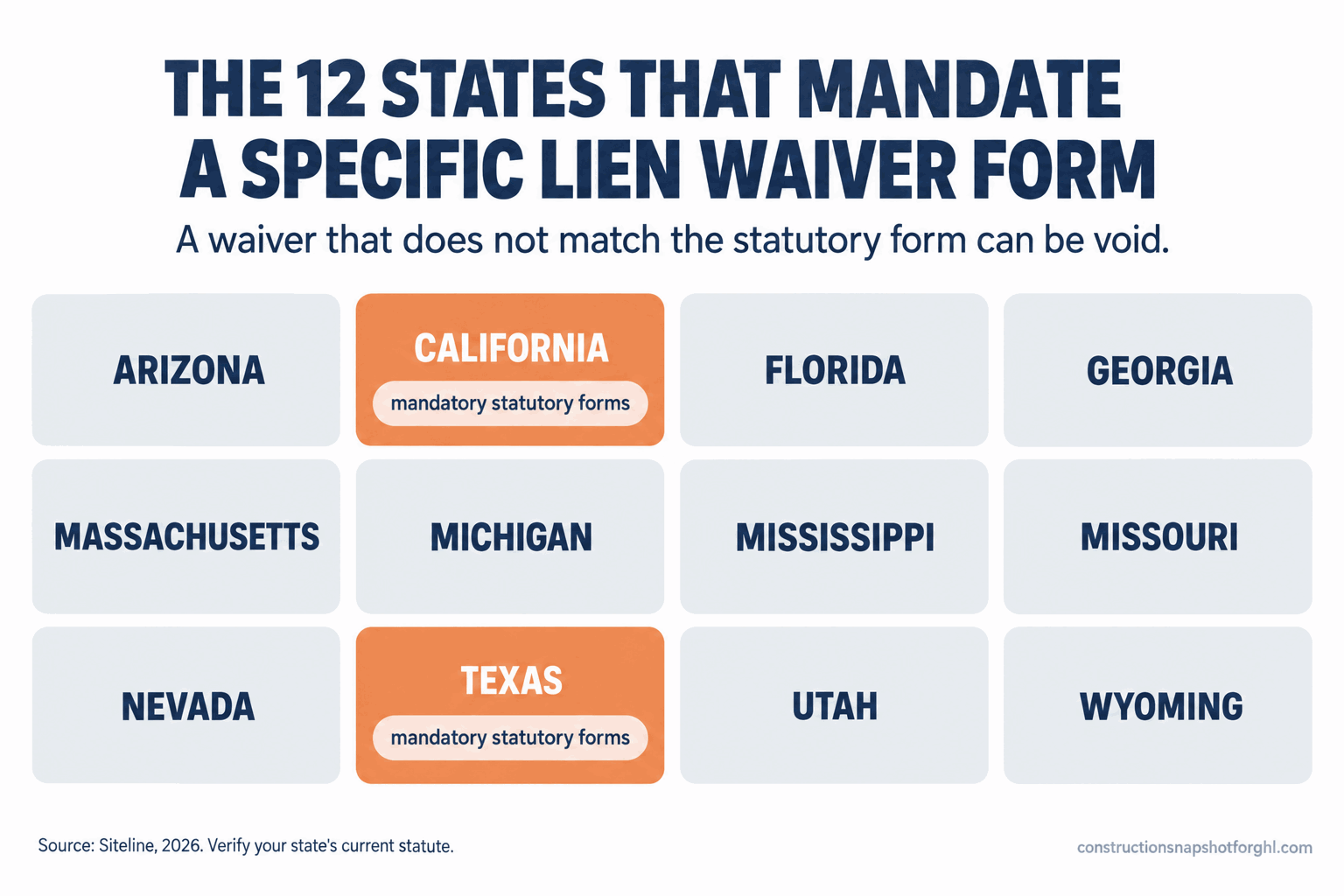
The two biggest construction markets in the country are both on the list, which is why this is not a technicality for most builders. California publishes four statutory forms in its Civil Code: section 8132 for a conditional waiver on progress payment, 8134 for unconditional on progress, 8136 for conditional on final, and 8138 for unconditional on final. The state is blunt that your form must follow one of these substantially or it is not effective, so a homemade waiver in California can be void (California CSLB).
Texas does the same thing in Property Code section 53.284, which sets out four forms covering the same four situations. Under section 53.281 a waiver and release is simply unenforceable in Texas unless it substantially complies with one of those statutory forms and is signed by the claimant (Texas Property Code 53.284). Texas also dropped its notarization requirement for waivers on contracts signed after January 1, 2022, so if you are still paying a notary on every one, you may be able to stop. The lesson across both states is the same: in a mandatory-form state, do not invent the paperwork, pull the state’s form.
The spread of pain from slow payment is what makes the whole exercise worth the minutes it takes. Rabbet’s 2025 report puts hard numbers on the environment these waivers live in.
Share, in percent, from industry payment research. The 14% “hidden tax,” the 91% who factor an owner’s payment reputation into bids, and the 88% who declined a bid over slow-pay reputations are from Rabbet’s 2025 Construction Payments Report. The 64% of subcontractors who report slow pay from general contractors is from Billd’s 2025 subcontractor research. Figures vary by survey year; confirm the current report before relying on any single number.
Steal this: the draw-day waiver routine and the messages to send
The law is the easy part. The failure is always operational: the draw stalls because nobody owns the step, or someone signs the wrong form to make the money move. Here is the whole routine, ready to run, built so the right waiver goes out and the right waivers come in on every single draw.
The second failure is relational. Subs drag their feet on waivers because it feels like paperwork that only helps you. Get ahead of it by making the ask routine and tying it to their money. Here is the message that goes out with every sub payment request, so the waiver arrives before you are chasing it:
“Payment for [job name], draw [number] is going through this week. Before we release your check, we need your signed lien waiver for this payment. I have attached the correct form for the state, already filled in with the amount and the through date, so all you need to do is sign and send it back. As soon as it is in, your payment goes out. If anything on the form looks off, reply and I will fix it.”
And the message that sets the expectation at the very start of the job, so no sub is surprised by the ask on draw one:
“Quick note on how we handle payments. We pay on a draw schedule, and every payment comes with a lien waiver for that amount. This is standard on our jobs, it protects you, the owner, and us, and it keeps the whole payment chain clean. We will always send you the right form, filled in, ready to sign. Sign it, send it back, and your check goes out. No waiver, no surprises, just a clean paper trail on every dollar.”
Two messages and a five-step checklist. That is the entire difference between a shop that funds payroll on time and one that is chasing four signatures on a Thursday afternoon. If you already run follow-up sequences for estimates that go quiet, this is the same muscle pointed at your draws.
Run it three ways: solo, mid-size, and multi-state
The right setup depends on how many jobs and how many states you juggle, because the way this fails changes with size.
The solo operator or small remodeler (6 to 12 jobs a year, usually one state). Your exposure is small but your margin for error is zero, because you are the estimator, the project manager, and the bookkeeper all at once, and you are the one who will sign the wrong form at 9pm to get a check moving. Do two things. Download your state’s statutory waiver forms once (or the four California or Texas forms if you are there) and save them filled with your company details, so you never pull a random template again. Then write the one rule on the inside of your folder: conditional to ask, unconditional only after it clears. On cash-funded remodels you may rarely need waivers at all, but the moment a job has a construction loan, the draw package will demand them.
The mid-size design-build or remodeling firm (15 to 25 jobs, one or two states). Volume is the enemy. With twenty active jobs and a dozen subs each, waivers arrive and leave weekly, and the failure is a missing signature that freezes a draw. Standardize one draw-day checklist that every project manager runs identically, assign one person to own collecting and logging waivers, and keep a single running log of every waiver sent and received, tied to the draw it covers. This is the tier where the money leaking is not one disaster, it is a little friction on every draw that adds up to weeks of delayed cash across the year. One owner, one checklist, one log.
The larger or multi-state builder (30 to 40 jobs, several states). Your problem is different forms in every state you touch. California’s four statutory forms do not work in a state that lets you write your own, and a generic form you use happily in one state is void in the twelve that mandate their own. Build a per-state form kit for every state you work in, confirmed against current statute, and route every job to the right kit by its location automatically rather than leaving a PM to guess that the next state matches home. Pair that with a tight draw schedule by phase and you are protected on both ends: the right waiver on every draw, and no state surprise waiting at closeout.
What it costs when the waiver is wrong
The cost of a waiver mistake is not a fine. It is the quiet loss of your bargaining power, and it shows up at the worst moment. Construction already runs on the slowest payment terms of almost any industry. Rabbet’s 2025 report estimates slow and inconsistent payment costs US construction roughly $299 billion a year and behaves like a 14 percent tax on the whole industry, while the average general contractor burns about 65 hours a month just administering payments (Rabbet 2025 Construction Payments Report). In that environment, every mistake below makes a slow situation worse.
You signed unconditional before you were paid. The single most expensive error. You released your lien rights for that payment, the check never fully came, and now you cannot lien the property for the gap. You are unsecured, which means you are hoping.
You used a generic form in a mandatory-form state. In the twelve statutory-form states, a waiver that does not match the law can be void. If it was the waiver you signed, you may have less protection than you think or a dispute over what you actually released. If it was the waiver you collected from a sub, it may not protect the homeowner at all, which puts the lien risk back on you.
You paid a sub without collecting a waiver. The framer did not pay his supplier, the supplier liens the house, and the owner looks at you for money you already spent. Without a signed waiver in the file, you have nothing to show the chain was clean.
You lost the paper at closeout. The final draw and the release of retainage usually require a complete set of unconditional final waivers from everyone. One missing signature can hold up the last and largest payment on the job, sometimes for weeks, over a form a sub never returned.
None of these are exotic. They are ordinary office slip-ups, and two of them, California and Texas, happen to be the busiest remodeling markets in the country and both mandate exact forms. The states where you are most likely to be working are the states where a sloppy waiver hurts most.
Common objections
“My sub is honest, I do not need a waiver from him.” The waiver is not about his honesty, it is about the link below him. You can trust your framer completely and still get burned when his lumber supplier, who you have never met, does not get paid and liens your client’s house. The waiver proves the money reached the people who could file a claim. It protects you from a stranger two levels down, not from your framer.
“Signing a waiver to request payment feels like giving up rights before I get paid.” That is exactly what the conditional form prevents, and why it exists. A conditional waiver releases nothing until the payment actually clears. You can send it with your invoice with zero risk, because if the check never comes, your lien rights are fully intact. The mistake is only ever signing the unconditional version early. Match the form to the money and the fear goes away.
“I already pay for Buildertrend or JobTread, does that not handle this?” Your project-management platform can store the documents and some offer waiver-tracking add-ons, but the tool does not know your draw went out, does not pull the right state form, and does not stop a check from leaving before the waiver is back. The failure is almost never the document library. It is the gap between “payment approved” and “waiver in hand” that nothing closes unless a step actively holds the money until the release arrives.
“This is a lot of process for paperwork most clients never ask about.” Owners with construction loans ask about it on every draw, because their lender requires it. And on the one job in twenty that turns into a payment fight, the waiver file is the difference between a secured claim and a lawsuit you may never collect on. It is a few minutes per draw against the entire value of your lien rights. That is cheap insurance.
Where to start this week
Open your last financed job and pull the waiver file. Can you produce a signed waiver for every payment you made to every sub, matched to the draw it covered? If you cannot, that is the leak, and it is the exact gap a supplier lien or a stalled final draw drives through. Then do two small things. First, download your state’s correct waiver forms, the statutory ones if you are in a mandatory-form state, and save them prefilled so nobody pulls a random template again. Second, write the one rule where your office can see it: conditional to request payment, unconditional only after it clears, and never release a sub’s check without his waiver in hand.
Nail those and the draw that used to stall on a Thursday goes out clean, and the ninety-day payment fight ends with “you are secured, let us file” instead of “you signed that away in March.” The automatic request down the chain, the right form by state, and the logged proof at closeout are what the Construction Snapshot for GoHighLevel builds into your pipeline, and you can hand the setup to a trained GHL VA if you would rather never touch the paperwork yourself.
Frequently asked questions
Lien waivers, answered
What are the four types of lien waivers?
Conditional waiver on progress payment, unconditional waiver on progress payment, conditional waiver on final payment, and unconditional waiver on final payment. 'Progress' covers one mid-job draw, 'final' covers the last payment and closes out the whole job. 'Conditional' means the waiver only takes effect once you are actually paid; 'unconditional' means it takes effect the moment you sign it, paid or not.
What is the difference between a conditional and an unconditional lien waiver?
A conditional waiver only becomes binding once payment clears, so it is safe to sign when you are requesting a draw. An unconditional waiver is binding the instant you sign it, whether the money arrives or not. The rule that keeps builders out of trouble: send a conditional waiver to ask for payment, and sign an unconditional one only after that payment has cleared your bank.
Should I ever sign an unconditional lien waiver before I get paid?
No. Signing an unconditional waiver before the payment clears means you have released your lien rights for that work in exchange for nothing but a promise. If anyone asks you to sign one 'so we can release the funds,' give them the conditional version instead. It does the same job for them and keeps you protected until the check actually clears.
Which states require a specific lien waiver form?
Twelve states regulate the exact waiver language: Arizona, California, Florida, Georgia, Massachusetts, Michigan, Mississippi, Missouri, Nevada, Texas, Utah, and Wyoming. In these states a waiver that does not substantially match the statutory form can be void. California publishes its four forms in Civil Code sections 8132, 8134, 8136, and 8138; Texas publishes its four in Property Code section 53.284. Confirm your state's current statute before relying on any form.
Why do I need to collect lien waivers from my subcontractors?
Because anyone in the payment chain who is not paid can lien the property, even someone you never hired directly. If you pay your framer and he does not pay his lumber supplier, that supplier can file a lien on your client's house for material you already paid for, and the homeowner will look to you. Collecting a signed waiver from each sub and supplier at each payment proves the chain is clean down to the bottom.
Do lien waivers have to be notarized?
It depends on the state. Some states require notarization and some do not, and the rules change. Texas, for example, no longer requires waivers to be notarized on contracts signed after January 1, 2022. Several mandatory-form states have their own notarization or witness rules. Check your state's current statute rather than assuming, since a missing notarization can invalidate the waiver where it is required.
Sources
- Rabbet, 2025 Construction Payments Report (slow payment cost of $299B, the 14% “hidden tax,” 65 hours a month on payment administration, 91% who weigh owner payment reputation, 88% who declined a bid over slow pay).
- Billd, 2025 subcontractor payment research (share of subcontractors reporting slow pay from general contractors).
- Siteline, Lien Waiver Requirements for All 50 States (the states that mandate statutory waiver forms and how strictness varies).
- California Contractors State License Board, Conditional and Unconditional Waiver and Release Forms (the four statutory forms and the proof-of-payment rule).
- Texas Legislature, Property Code Section 53.284 and Section 53.281 (the four Texas statutory forms and the enforceability requirement).
- Levelset, Lien Waiver Form guide (the four waiver types and how conditional and unconditional releases work).
This article is general information for construction business owners, not legal advice. Lien and waiver law varies by state and project type and changes over time. Confirm your state’s current statute and consult a construction attorney before relying on any form or deadline described here.