If you run a construction business in Tampa, the problem usually isn’t leads — it’s that you’re the bottleneck. You’re on a roof in Seminole Heights at 2pm, so the call from a Westchase homeowner goes to voicemail. You’re driving to a walk-through in Brandon, so the Angi lead sits for six hours. And at 10pm, instead of sleeping, you’re inside GoHighLevel trying to figure out why a follow-up workflow didn’t fire. A virtual assistant for contractors — specifically a trained GoHighLevel VA — fixes this by taking the CRM, the follow-up, and the lead response off your plate so you can stay on the jobsite where the money is made.
This matters more in Tampa than almost anywhere. The Tampa Bay metro added more than 270,000 residents between 2020 and 2025, a 7% jump, and construction was one of the region’s top job-gaining sectors through 2025 (Construction Owners Association / FloridaCommerce). More homeowners, more competitors, more inbound — and the contractor who answers first and follows up fastest wins. If you’re buried in admin, you’re handing those jobs to the guy across town who isn’t.
In this post
- The real problem: you’re the CRM admin now
- What admin overload actually costs a Tampa contractor
- The speed-to-lead trap
- What a GoHighLevel virtual assistant actually does
- DIY vs. a hire vs. a dedicated GHL VA
- Why this hits harder in Tampa
- How to hand off GoHighLevel without losing control
- Frequently asked questions
- Sources
The real problem: you’re the CRM admin now
Nobody starts a contracting business to become a software administrator. But somewhere between buying GoHighLevel because a competitor told you to and actually running it, you became the person who builds the funnels, tags the leads, writes the SMS templates, and debugs the workflows. That work is real, and it’s necessary — but it’s not your work. Every hour you spend inside a CRM is an hour you’re not estimating, closing, or running a crew.
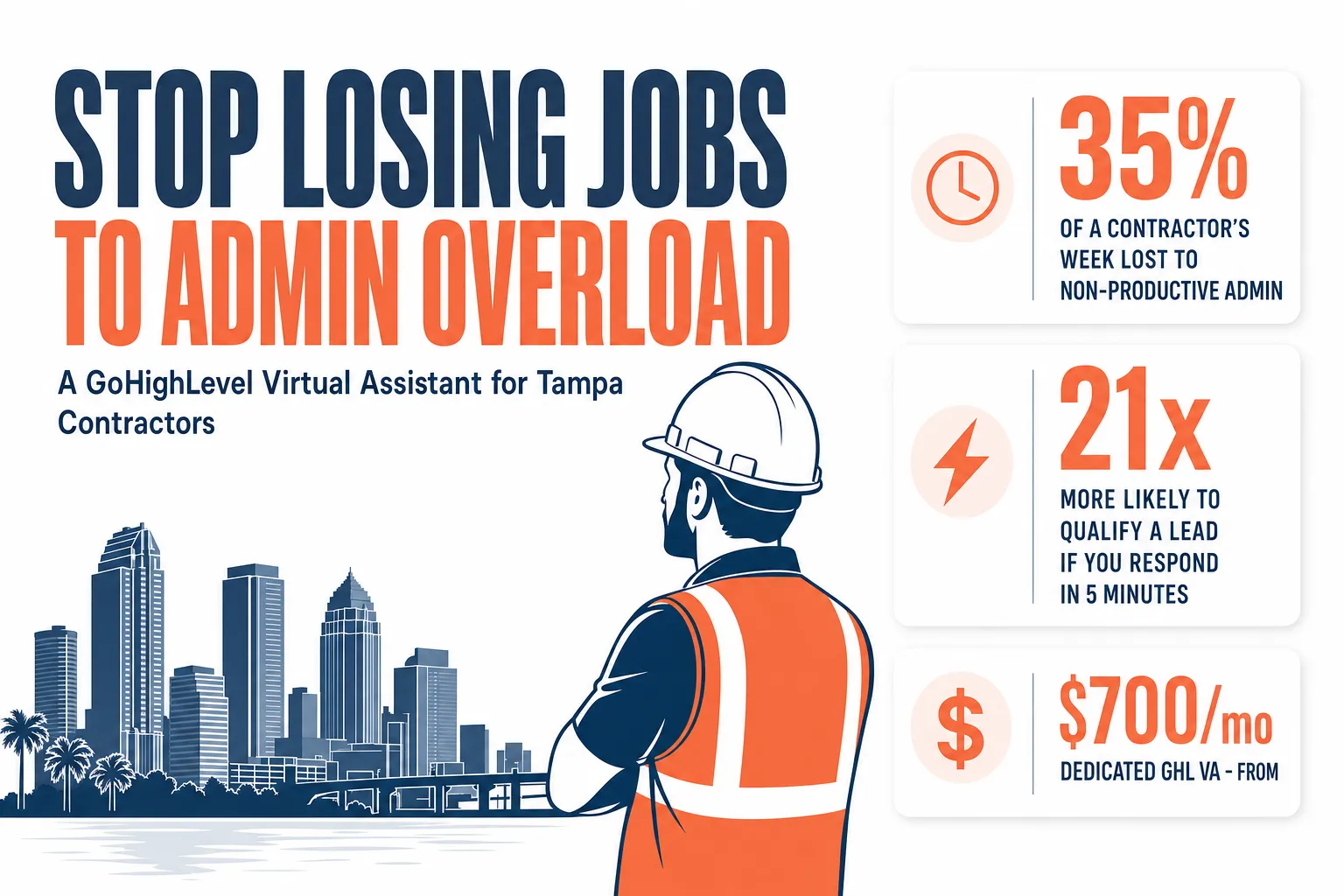
The data on this is blunt. In the industry-wide Construction Disconnected study, respondents reported spending 35% of their working time — more than 14 hours a week — on non-productive activities: looking for project information, resolving conflicts, and dealing with mistakes and rework (FMI / PlanGrid). That’s before you add CRM administration on top. Field foremen alone lose about six hours a week just to paperwork (Rhumbix).
Here’s where those 14 non-productive hours go, on average:
Average hours per week construction professionals lose to non-productive activities. Source: FMI / PlanGrid, “Construction Disconnected”, 2018.
Add the CRM to that pile and the math gets ugly fast. Fourteen non-productive hours a week is roughly 700 hours a year — the equivalent of a full 40-hour workweek every single month spent on work that doesn’t pour concrete, sign a contract, or make a homeowner happy.
What admin overload actually costs a Tampa contractor
The cost of doing your own GoHighLevel admin isn’t the software fee. It’s three compounding leaks:
Leak one: opportunity cost. Every hour on CRM cleanup is an hour not spent on the $30k kitchen remodel estimate sitting in your inbox. For an owner whose time is worth hundreds of dollars an hour on the sales side, spending it tagging contacts is the most expensive labor arrangement in your whole company.
Leak two: cold leads. When you’re on-site, nobody is responding to the Houzz inquiry, the “request a quote” form, or the missed call. Those leads don’t wait — they go to whoever answers first (more on that below).
Leak three: no follow-up. The estimate you sent Tuesday needs a nudge Friday and again next week. When you’re doing everything yourself, that estimate follow-up simply doesn’t happen, and your pipeline slowly fills with “maybes” that quietly die. The same goes for reactivating old leads — a goldmine that stays buried because nobody has time to dig.
The speed-to-lead trap
This is the leak that costs the most and hurts the worst, because the lead was already yours. In the landmark Lead Response Management research published by Harvard Business Review, firms that contacted a new online lead within five minutes were 21 times more likely to qualify that lead than firms that waited just 30 minutes (HBR).
Relative likelihood of qualifying an online lead by response speed (30-minute response = 1x baseline). Source: Harvard Business Review / Lead Response Management Study.
Now overlay that on a jobsite reality: you physically cannot answer a form fill within five minutes when you’re 30 feet up framing a second story. And the phone is worse — roughly 85% of callers who hit your voicemail never call back (AnswerConnect data). They just call the next Tampa contractor on the Google map pack.
A GoHighLevel VA closes this gap two ways. First, they configure the automations that respond instantly — missed-call text-back, an AI receptionist that answers 24/7, and an AI chat widget that qualifies homeowners while you’re on the roof. Second, they’re a human watching the pipeline during business hours, so a hot lead that needs a real reply gets one fast. This is the entire premise of speed-to-lead for contractors: the first responder wins, and automation plus a dedicated VA is how you become the first responder without chaining yourself to a desk.
What a GoHighLevel virtual assistant actually does
“Virtual assistant” undersells it. A trained construction GHL VA isn’t an inbox-checker — they’re the person who runs your entire lead-to-signed-contract system inside GoHighLevel. On a typical engagement, that includes:
- Estimator intake funnels and landing pages that route homeowner project requests straight into your pipeline.
- Email and SMS follow-up workflows — the nurture that turns a quote into a signed contract, running automatically instead of “when you remember.”
- CRM and pipeline management — keeping stages clean so you always know which jobs are close and which are stalling.
- Voice AI and conversational AI setup (VAPI, Retell, Closebot) for after-hours call capture and homeowner qualification.
- Review harvesting so every finished job turns into the 5-star reviews that win the next one.
- Integrations with the tools you already run — Buildertrend, JobNimbus, QuickBooks, Procore — plus A2P/10DLC registration so your texts actually deliver.
In other words, the VA does the work that’s currently keeping you up at night, and they do it faster because they build GoHighLevel systems every day. If you’ve been shopping for the best CRM for contractors, the honest answer is that the platform matters less than whether someone competent is actually running it. A great CRM nobody has time to operate is just an expensive contact list.
DIY vs. a hire vs. a dedicated GHL VA
Most Tampa contractors weigh three options for handling GoHighLevel. Here’s how they compare on the things that actually matter:
Three ways to run your contractor CRM
| Feature | Dedicated GHL VA | Do it yourself / office admin |
|---|---|---|
| GoHighLevel expertise | Builds GHL systems daily | Learning on the job, at night |
| Monthly cost | From $700 (~80 hrs) | Your billable time + a salary |
| Time to productive | 5–7 business days | Weeks to months of ramp-up |
| Lead response during work hours | Actively monitored | Whenever you get off the site |
| Automations built correctly | Yes — it's their trade | Trial, error, and broken workflows |
| Commitment | No contract, cancel anytime | W-2 hire, benefits, overhead |
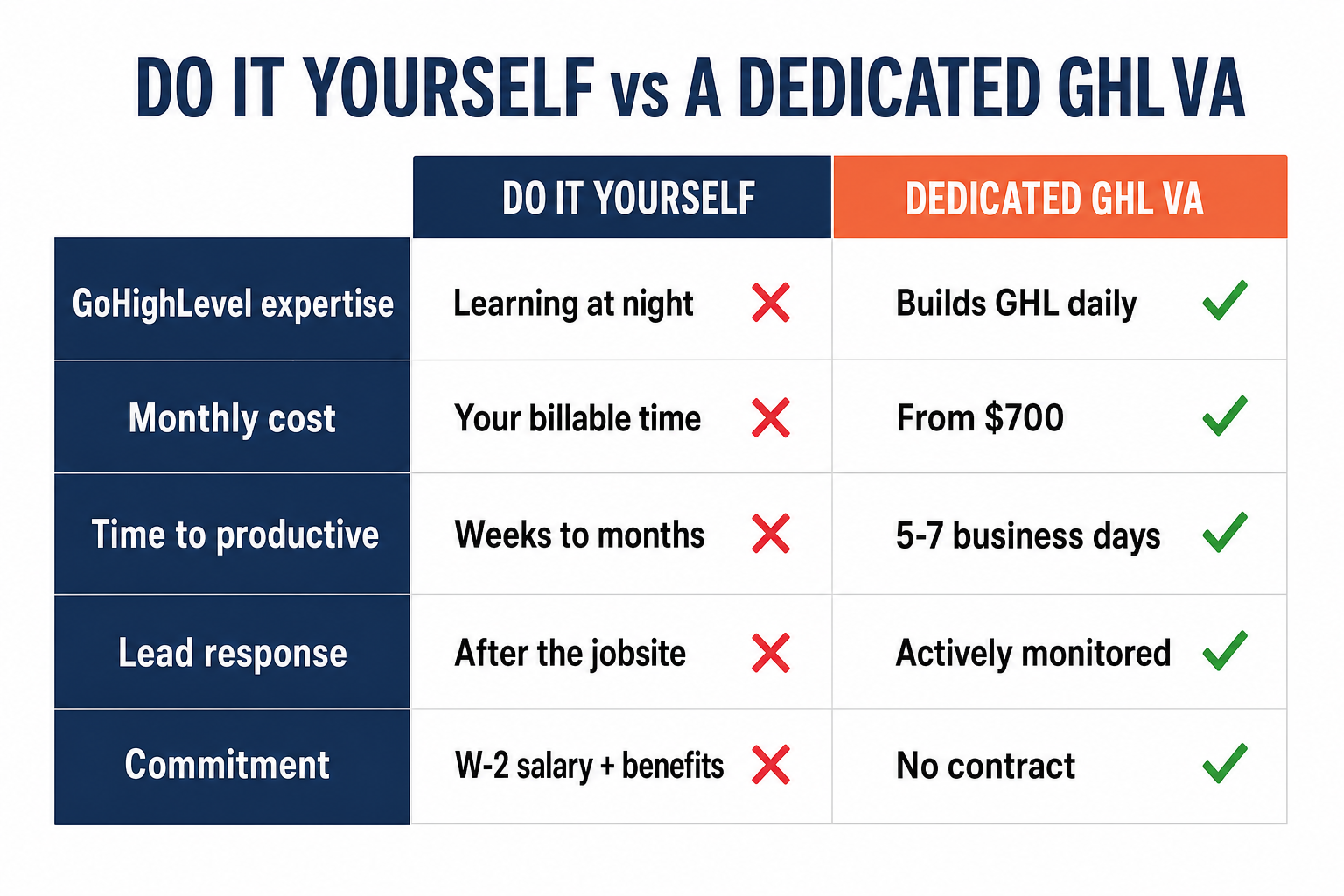
Doing it yourself feels free, but it’s the most expensive option once you price your own hours honestly. Hiring a full-time office admin can work, but you’re paying a Tampa salary plus payroll taxes and benefits for someone who still has to learn GoHighLevel — and if they leave, your system leaves with them. A dedicated GHL VA gives you the expertise without the overhead: a trained specialist for $700/month (Growth, ~80 hours) or $1,250/month (Power, ~160 hours), matched to construction, with a project manager overseeing the work.
Why this hits harder in Tampa
Tampa is exactly the kind of market where the speed gap decides who eats. The metro’s population surge and steady permitting mean demand is strong — Tampa authorized building permits ranging from 1,356 in March 2025 to 2,436 in June 2025 (Construction Owners Association) — but strong demand pulls in strong competition. When a Riverview homeowner searches “kitchen remodel near me,” you’re one of a dozen results, and the homeowner is messaging three of you at once.
In that environment, admin overload isn’t a back-office annoyance — it’s a competitive disadvantage. The contractor whose CRM answers instantly, follows up on schedule, and never drops a lead will out-book the more skilled builder whose leads rot in a voicemail box. Pair a dedicated GHL VA with proper local SEO for your Tampa service area and you get both halves of the equation: more inbound, and a system that actually converts it. If you want the deeper build-out, our general contractor snapshot installs the full pipeline the VA then runs day to day.
How to hand off GoHighLevel without losing control
The fear that stops most owners from delegating is losing visibility. A good VA engagement is built to prevent exactly that:
- Start with a call, not a login. Map what’s leaking first — slow response, no follow-up, a messy pipeline — so the VA fixes the highest-value problem in week one, not busywork.
- Keep a project manager in the loop. The right setup puts a PM in your Slack (or ClickUp/Asana/Trello) watching every task and conversation, the way a site super reviews a crew — so quality is tracked and nothing slips.
- Automate the instant stuff, delegate the judgment stuff. Missed-call text-back, AI receptionist, and CRM workflows handle the reflexes; the VA handles the pipeline decisions that need a human.
- Review weekly, adjust monthly. You get a weekly account of hours and outcomes, so you always know what was built and what it moved.
You stay the owner and the decision-maker. You just stop being the unpaid, overqualified, exhausted CRM admin. The point isn’t to care less about your GoHighLevel — it’s to finally have someone who cares about it full-time, so you can go back to caring about the build.
Frequently asked questions
What does a virtual assistant for contractors actually do?
A construction-focused GoHighLevel VA runs your CRM and lead system: they build estimator intake funnels, set up email and SMS follow-up workflows, manage your pipeline, configure your AI receptionist and chat widget, register your texting (A2P/10DLC), harvest reviews, and connect GHL to tools like Buildertrend, JobNimbus, and QuickBooks. In short, they do the software and follow-up work that would otherwise keep you inside a CRM at night instead of on the jobsite.
How much does a GoHighLevel VA cost in Tampa?
A dedicated construction GHL VA starts at $700/month for the Growth plan (about 4 hours a day, ~80 hours a month) and $1,250/month for the Power plan (about 8 hours a day, ~160 hours a month). There are no contracts and you can cancel anytime. That is typically far less than the value of the jobs a slow, unmanaged CRM lets slip — and cheaper than a full-time office hire once you add salary, payroll taxes, and benefits.
Is a VA better than just hiring an office admin?
For most Tampa contractors, yes. A dedicated GHL VA already builds GoHighLevel systems every day, so they are productive in about a week instead of ramping up for months. You avoid the salary, benefits, and payroll overhead of a W-2 hire, and because the VA comes with a project manager, the knowledge does not walk out the door if one person leaves.
How fast can a GHL VA start?
A trained, construction-matched GoHighLevel specialist is usually live within 5 to 7 business days of you picking a plan. The engagement typically starts with a call to identify your biggest leak — slow lead response, no follow-up, or a messy pipeline — so the first week is spent fixing something that actually moves booked jobs.
Will I lose visibility into my own CRM if I delegate it?
No. A well-run engagement adds a project manager to your Slack, ClickUp, Asana, or Trello who monitors every task and conversation, and you get a weekly account of hours and outcomes. You remain the owner and decision-maker — you just stop doing the hands-on admin yourself while keeping full oversight of what gets built and changed.
About the author
Diego Marchetti spent twelve years running the office for a mid-size general contracting firm before moving into systems work full time. He has scoped, priced, and chased more change orders than he cares to count, and now builds the GoHighLevel workflows that keep lead-to-deposit pipelines from leaking. He writes about estimating discipline, sub coordination, and the unglamorous back-office habits that protect a builder’s margin.
Related posts
- Speed to Lead for Contractors: Why the First 5 Minutes Decide the Job
- Missed-Call Text-Back for Contractors: Never Lose a Lead to Voicemail
- Best CRM for Contractors (2026): How to Choose the Right One
Sources
- FMI / PlanGrid — Construction Disconnected: 35% of time / 14+ hours a week on non-productive work, 2018
- Construction Dive — Industry could be overspending $177B per year, study finds, 2018
- Rhumbix — Field foremen spend ~6 hours a week on paperwork
- Harvard Business Review — The Short Life of Online Sales Leads (Lead Response Management Study), 2011
- Aira / AnswerConnect — Missed business call statistics (~85% won’t call back), 2026
- Construction Owners Association / FloridaCommerce — Tampa–St. Pete growth drives building boom (population + permits), 2025
- Tampa Bay Business & Wealth — Tampa Bay leads Florida job growth, 2026