
If you run a construction business in Seattle, you are probably losing jobs you never hear about — and the reason is your Google reviews. A Seattle homeowner choosing between three remodelers rarely calls all three. They open Google, glance at the star rating and the date of your most recent review, and quietly cross you off the list before the phone ever rings. You do great work in Ballard and Bellevue, but a profile with 14 reviews and nothing since last spring reads as “smaller, slower, maybe out of business” next to the builder down the road with 180 reviews and a fresh one every week. That is the whole loss, and it happens in silence.
This is not a “you should care about reputation” pep talk. It is a margin problem with real numbers behind it, and it is worse in Seattle than in a sleepy market. Seattle added 11,572 residents between mid-2024 and mid-2025 to reach 784,777 — the fifth-largest numeric gain of any U.S. city, and the only West Coast city in the national top ten (U.S. Census Bureau, via KOMO News). More homeowners means more projects — and more contractors fighting for each one. When a dozen builders can do the job, the review profile is the tiebreaker.
In this post
- Seattle homeowners decide on your reviews before they call
- The three ways a thin review profile loses you jobs
- The revenue hiding in your review gap
- Why “just ask” fails on a jobsite
- What automated review harvesting actually does
- The five-step review engine for Seattle contractors
- Frequently asked questions
Seattle homeowners decide on your reviews before they call
The buying journey for a $60k kitchen remodel or a $400k custom build no longer starts with a phone call. It starts with a search — “general contractor near me,” “kitchen remodel Ballard,” “Bellevue home addition” — and the homeowner makes a first cut from what Google shows them: the map pack, the star ratings, the review counts, and the date of the newest review. By the time they dial anyone, they have already eliminated most of the field. You were either on the shortlist or you were invisible, and reviews are what put you on one side of that line.
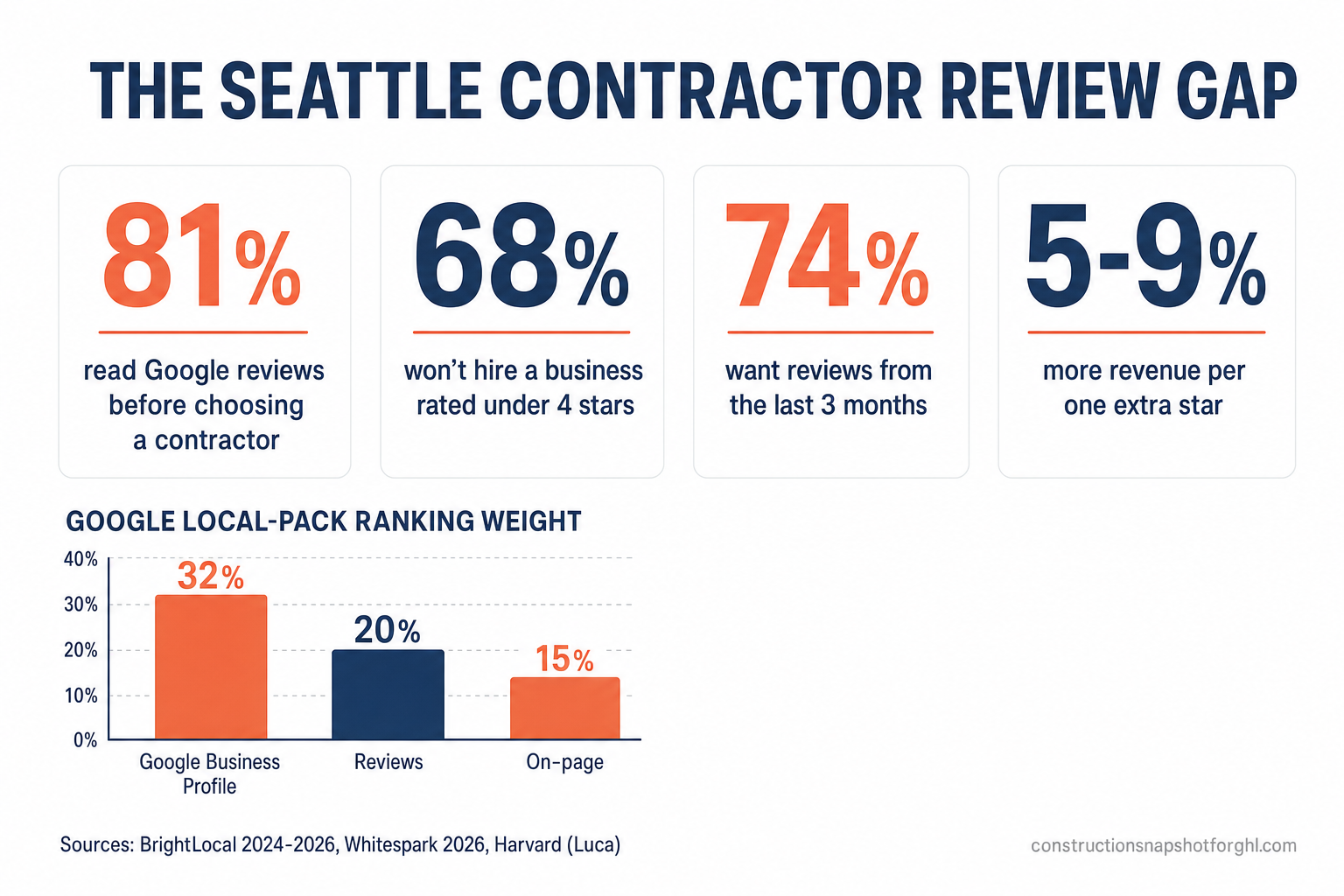
The numbers are blunt. About 81% of consumers read Google reviews when checking out a local business (BrightLocal, LCRS 2024). This is not a soft “reputation matters” signal — it is the single most-consulted piece of information a homeowner sees before choosing who to trust in their house for three months.
And there is a uniquely Seattle footnote to the research. The most-cited academic study on reviews and revenue — Harvard Business School economist Michael Luca’s Reviews, Reputation, and Revenue — was built on Seattle restaurant data matched against Washington State Department of Revenue records. Luca found that a one-star increase in Yelp rating drove a 5–9% increase in revenue, with the effect concentrated among independent businesses rather than big chains (HBS). If you are an independent Seattle contractor, that study is describing your exact situation: the star rating is not vanity, it is turnover.
The three ways a thin review profile loses you jobs
“Bad reviews” is not usually the problem for a good contractor. The problem is a profile that is too small, too old, or too far down the map to get you considered at all. Here are the three leaks, each with the data behind it.
1. Homeowners filter you out below four stars
Consumers now set a hard floor. 68% of people say they will only use a business rated 4 stars or higher (BrightLocal LCRS 2026). That cutoff is unforgiving math for a small profile: one unhappy homeowner and a couple of blank three-star ratings can drag a contractor with only 15 reviews below 4.0 — and two-thirds of prospects never look further. A builder with 150 reviews absorbs the same complaint without moving the needle. Volume is not vanity; it is the shock absorber that keeps you above the line homeowners actually screen on.
2. Old reviews read as “out of business”
A five-star review from two years ago barely counts anymore. 74% of consumers look specifically for reviews written within the last three months, and Whitespark’s local-search experts now rank review recency among the top five factors in the entire local algorithm (Whitespark, Local Search Ranking Factors 2026). To a Seattle homeowner scrolling your profile, a stale review date is a quiet red flag — it suggests you are slow, small, or no longer taking work. Steady, recent reviews are the signal that you are busy, trusted, and safe to hire. That is precisely why a once-a-quarter review push does not cut it: recency decays every single week.
3. You fall out of the map pack
Even homeowners who never read a word of your reviews are affected by them, because reviews decide whether Google shows you at all. In Whitespark’s 2026 analysis, review signals account for roughly 20% of what ranks a business in the Google local pack — up from 16% in 2023 — second only to your Google Business Profile itself.
Share of Google local-pack / Maps ranking weight by signal group. Source: Whitespark, Local Search Ranking Factors 2026.
Quantity, star average, recency, and whether you respond all feed that 20%. A contractor with few, old, unanswered reviews doesn’t just lose the shortlist — they lose the top three map spots where most local clicks go, before a homeowner has read anything at all. The review gap compounds: fewer reviews → lower ranking → fewer people see you → fewer new reviews.
The revenue hiding in your review gap
Reviews are one of the rare marketing levers with hard revenue research behind it, across hundreds of thousands of businesses. Womply’s analysis of transaction and review data from more than 200,000 U.S. small businesses found the pattern below.
Two things jump out for a contractor. First, review count moves revenue as much as the rating — businesses with 200+ reviews earn roughly double the average (Womply, via Search Engine Land). Second, simply replying to reviews is worth ~35% more revenue, and three out of four businesses don’t bother — which means responding is a nearly free competitive edge most of your Seattle competitors are ignoring. (It shows on the consumer side too: 89% of people read businesses’ responses to reviews, per BrightLocal 2024.)
Consumer review behavior, % of respondents. Sources: BrightLocal LCRS 2024 and BrightLocal LCRS 2026.
Put the two studies together and the “review gap” stops being abstract. If your competitor sits at 4.8 stars with 180 recent reviews and you sit at 4.2 with 30 stale ones, you are not losing by a nose — you are being filtered out of consideration and out of the map pack, on projects worth tens of thousands of dollars each. Across a Seattle year, that is a six-figure leak you never see on any invoice.
Why “just ask” fails on a jobsite
Here is the frustrating part: the fix is not hard, and homeowners are willing. 69% of consumers said they left a review after a business asked them to in the past year — up from 60% the year before (BrightLocal 2024). People say yes when you ask. The problem is that contractors almost never ask, and it is not a discipline failure — it is a jobsite reality.
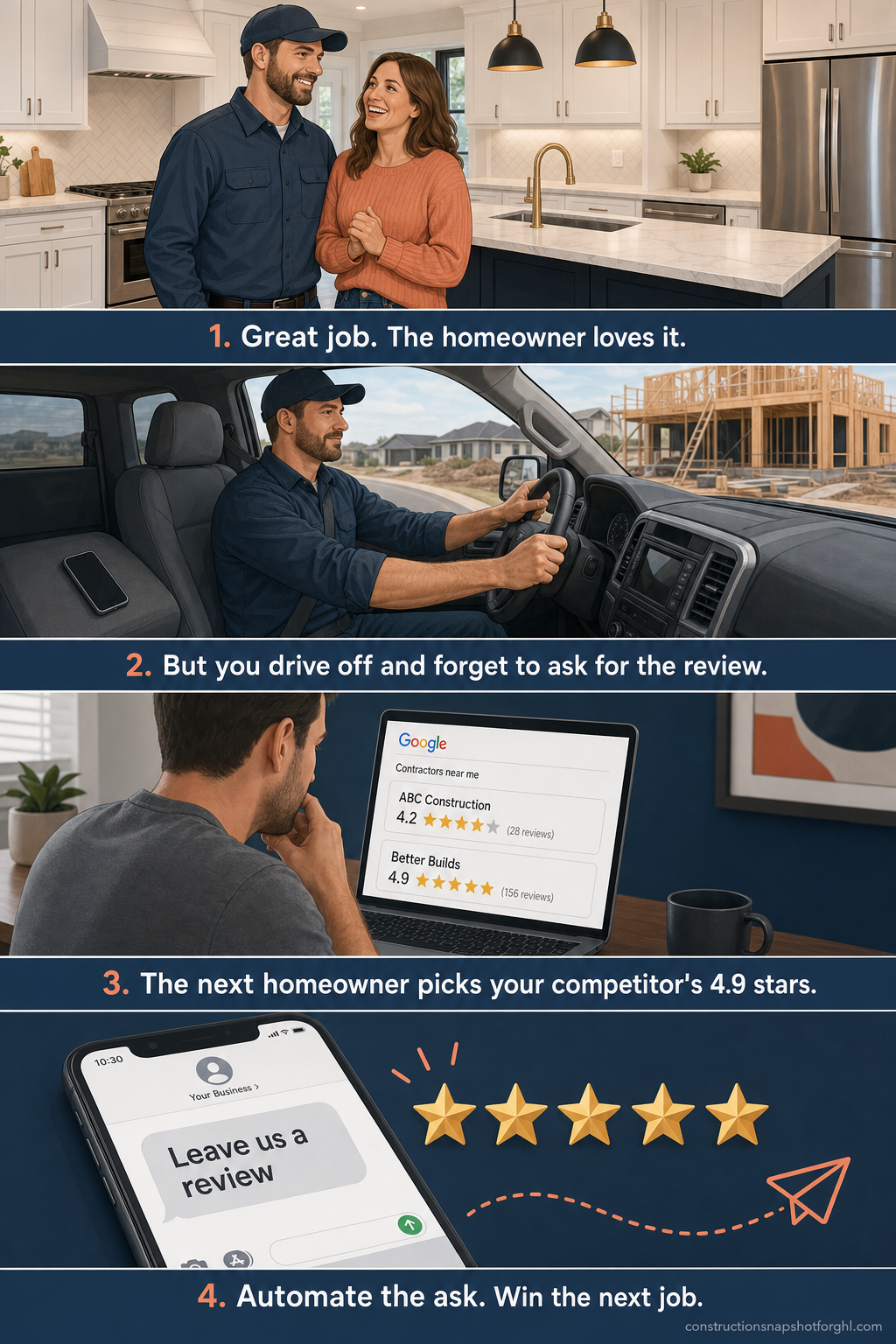
The moment a homeowner is happiest is the final walk-through, when the punch-list is done and the space looks incredible. That is the golden window to ask. But that is also the exact moment you are loading the truck, chasing the next deposit, and driving to a bid across town. By the time you are back at a desk, three days have passed, the glow has faded, and asking now feels awkward. Multiply that across every job and you get the profile most good contractors have: excellent work, and a thin, stale review count that doesn’t show it.
You cannot solve a timing problem with willpower. A busy builder will always be on a roof when the window opens. The only reliable fix is to take the ask off your plate entirely and let a system fire it at the right moment, every time — which is exactly what review harvesting automation does.
What automated review harvesting actually does
Review harvesting automation is a workflow that lives in your CRM and runs the entire ask-and-respond loop for you. When a job is marked complete, it waits for the peak-satisfaction moment, sends the homeowner a one-tap review request by text (where it actually gets seen), routes happy customers straight to your Google profile, and privately catches an unhappy one before it becomes a public one-star. It is the difference between hoping you remember and knowing it happens.
| Feature | Automated review harvesting | Chasing reviews by hand |
|---|---|---|
| When the ask goes out | Automatically, timed to job completion | Whenever you remember — usually days late or never |
| How it's sent | One-tap SMS + email, straight to your Google link | A verbal 'could you leave us a review?' that gets forgotten |
| Consistency | Every completed job, every time | The one or two jobs a month you catch |
| Unhappy customers | Routed to you privately first, so you fix it | Land publicly as a 1-star before you hear about it |
| Responding to reviews | Prompted and templated — the +35% revenue lever | Rarely happens; 75% of businesses skip it |
| Result over 6 months | A steady stream of fresh, recent 5-star reviews | A stale profile that quietly loses the shortlist |
The key design detail is the private catch. A good review automation asks the homeowner how the project went before pointing them at Google. Five-star sentiment gets routed to your public profile; anything lukewarm gets routed privately to you, so you hear the complaint, fix the punch-list item, and keep it from becoming the one-star that drags you under the 4.0 line 68% of homeowners screen on. You get more public reviews and fewer public disasters.
This is one of the automations built into the Construction Snapshot review harvesting system, which installs the post-job sequence, the SMS/email templates, the 5-star routing, and the private-feedback catch into your GoHighLevel account — so the loop runs on every job without you touching it.
The five-step review engine for Seattle contractors
If you want to build the loop yourself, here is the sequence the automation runs. (For the full playbook on wording and timing, see our guide on how to get more Google reviews for your construction business.)
- Trigger on job completion. The moment a project is marked complete in your pipeline, start the review sequence automatically — no sticky notes, no memory required.
- Ask at peak satisfaction. Fire the first request within 24 hours of the final walk-through, while the homeowner still loves the result. Waiting a week costs you the emotion that writes five-star reviews.
- Send it by text, with one tap. Most review requests die in email. A short SMS with a direct link to your Google review page — one tap, pre-filled — is what actually converts a “yes” into a posted review.
- Route by sentiment. Ask how it went first. Happy homeowners go public to Google; unhappy ones come to you privately so you can fix the issue before it becomes a public rating.
- Respond to every review. Reply to all of them, good and bad. It is the ~35% revenue lever, it is read by 89% of prospects, and three-quarters of your competitors skip it.
Run that on every job and the compounding flips in your favor: more recent reviews → a higher, fresher rating → better map-pack ranking → more homeowners see you → more reviews. That is how the Bellevue builder with 180 reviews got there — not better work than you, just a system that never forgot to ask.
Reviews are a speed-to-lead problem in disguise: the fastest, most consistent asker wins, exactly like the fastest responder wins the call. If chasing reviews is one of a dozen follow-ups slipping through the cracks, a trained GoHighLevel virtual assistant can own the whole reputation loop for you — or the snapshot can automate it outright. Either way, the goal is the same: never let a finished job go un-asked again.
Frequently asked questions
How many Google reviews does a Seattle contractor actually need?
There is no magic number, but the research points to "as many recent ones as you can steadily earn." Womply found businesses with 200+ reviews earn roughly twice the average revenue, and 68% of consumers only use businesses rated 4 stars or higher. More practically: you want enough volume that one bad review can't drag you below 4.0, and enough recency that your newest review is from this month — 74% of consumers look for reviews written in the last three months. A steady stream beats a big one-time push.
Why do recent reviews matter more than my total count?
Because consumers and Google both weight freshness. 74% of people look for reviews from the last three months, and review recency is now a top-five local search ranking factor per Whitespark's 2026 analysis. A profile with 90 reviews but nothing in a year reads as "slower or out of business" next to a competitor posting a fresh review every week. Automation matters here specifically because recency decays every week — a quarterly manual push can't keep up.
Is it against Google's policy to filter unhappy customers to a private form?
Asking every customer for feedback and then responding to what they say is fine. What violates Google's policies is "review gating" — selectively soliciting only positive public reviews while blocking negative ones. A compliant review automation still lets any customer post a public review; it simply asks about their experience first and gives an unhappy homeowner an easy private channel to reach you, so you can resolve the issue. You are speeding up service recovery, not suppressing reviews. Configure it to route, not to block.
Does an SMS review request really beat email?
For contractors, yes — mostly because of open rates and friction. A homeowner is far more likely to see and tap a text than dig a review link out of an email the day after their project wraps. The winning format is a short SMS sent within 24 hours of the final walk-through with a one-tap link straight to your Google review page. Email is a fine backup, but SMS should be the primary channel.
How fast can review automation be running on my jobs?
The Construction Snapshot installs the full review harvesting workflow — post-job trigger, SMS and email templates, 5-star routing, and the private-feedback catch — into your GoHighLevel account within 24 hours. From there it runs on every completed job automatically. If you'd rather not manage it at all, a dedicated GoHighLevel VA can own your reputation loop end to end.
About the author
Travis Okafor is a GoHighLevel consultant who deploys snapshots for construction and trades businesses across the West. He has installed hundreds of workflows for general contractors, home builders, and design-build firms, and is opinionated about what should be automated versus left to a human on the jobsite. He writes the comparison and implementation pieces: snapshot versus DIY, tool migrations, and what to configure first.
Related posts
- How to Get More Google Reviews for Your Construction Business (2026 Playbook)
- Local SEO for Contractors: How to Win the Google Map Pack
- Speed to Lead for Contractors: Why the First 5 Minutes Decide the Job
Sources
- BrightLocal — Local Consumer Review Survey 2024 (81% read reviews; 69% left a review when asked; 89% read responses), 2024
- BrightLocal — Local Consumer Review Survey 2026 (68% won’t use a business under 4 stars), 2026
- Whitespark — Local Search Ranking Factors 2026 (review signals ≈20%; recency a top-5 factor; 74% want reviews under 3 months), 2026
- Michael Luca, Harvard Business School — Reviews, Reputation, and Revenue: The Case of Yelp.com (one star = 5–9% revenue, Seattle + WA Dept. of Revenue data), 2011/2016
- Womply, via Search Engine Land — Review counts matter more to local business revenue than star ratings (200,000+ businesses; 200+ reviews = 2× revenue; replies to 25%+ = +35%), 2019
- U.S. Census Bureau, via KOMO News — Seattle 5th in U.S. population growth, +11,572 to 784,777, 2025