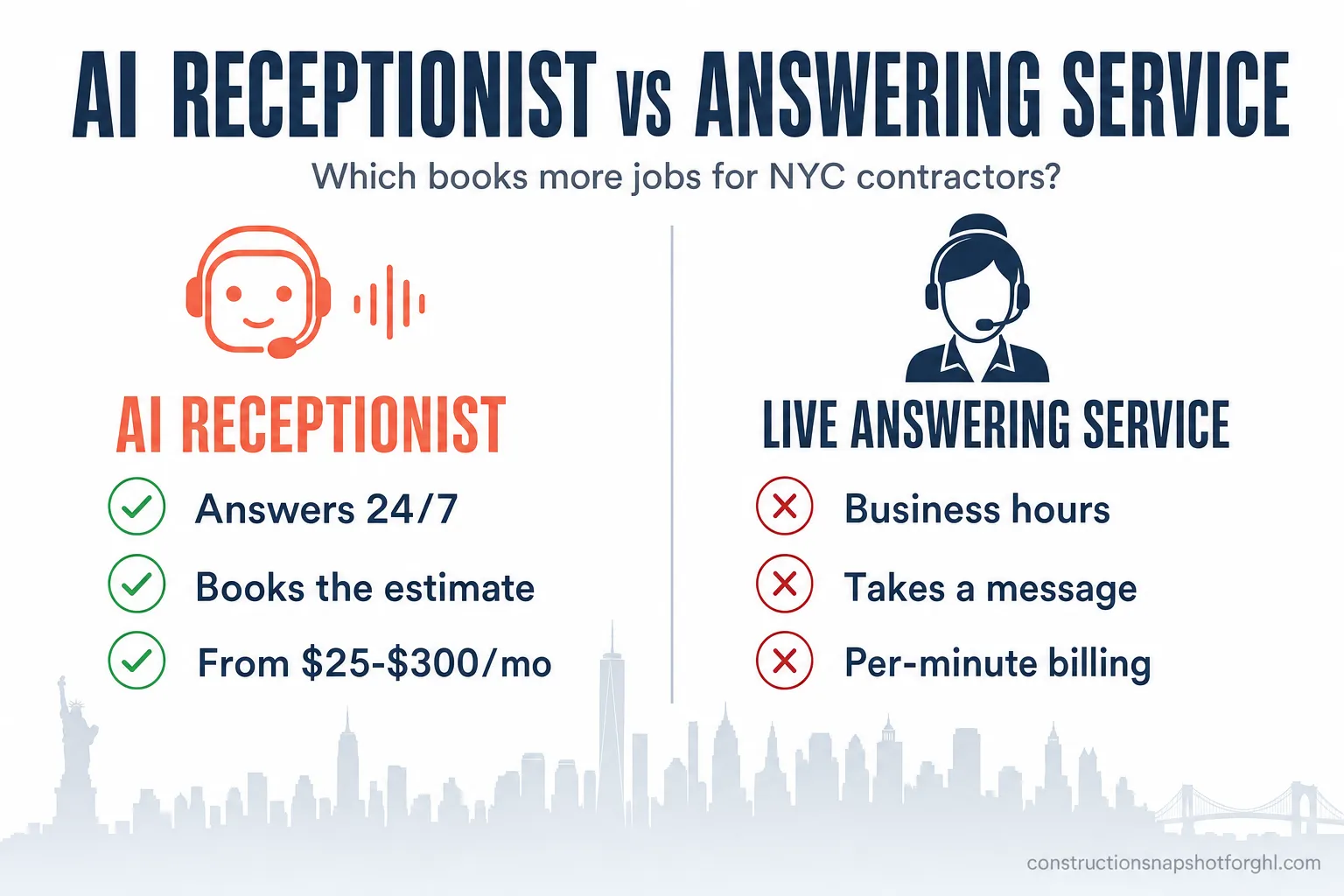
For a New York City contractor, the phone rings while you’re on a scaffold in Astoria or elbow-deep in a Park Slope kitchen demo — and the question is who picks it up. Between an AI receptionist and a live answering service, the AI receptionist wins for most NYC contractors on the three things that decide whether a call becomes a booked estimate: it answers every call 24/7, it books the site visit into your calendar instead of just taking a message, and it costs a fraction of a human answering plan. A live answering service still has its place — genuine emergency dispatch, complex nuance, callers who insist on a person — but for the everyday job of catching leads you’d otherwise lose, AI now does the heavier lifting.
That matters more in New York than almost anywhere else. The New York Building Congress forecasts roughly $74 billion in NYC construction spending in 2025 and $219 billion across 2025–2027 (New York Building Congress), and the five boroughs are packed with contractors chasing the same remodels, additions, and renovations. In that market, the contractor who answers first books the job — and the one whose call goes to voicemail is just warming up the lead for a competitor. This comparison breaks down exactly where each option wins, what each really costs, and how to pick.
In this post
- AI receptionist vs answering service at a glance
- What each one actually is
- Why missed calls quietly cost NYC contractors jobs
- Cost: what it takes to cover your phone
- Speed and availability: the metric that books jobs
- Booking, accuracy, and your CRM
- When a live answering service is still the better call
- Why this matters more in New York City
- How to add an AI receptionist without the headache
- Frequently asked questions
- Sources
AI receptionist vs answering service at a glance
Here’s the short version before the details. The comparison below reflects a typical residential contractor: a few crews in the field, calls arriving all day and after hours, and an owner who can’t stop mid-install to answer the phone.
AI receptionist vs live answering service for a contractor
| Feature | AI receptionist | Live answering service |
|---|---|---|
| Availability | 24/7/365, every call | Covered hours (after-hours costs extra) |
| Answers on the first ring | Always — no hold, no queue | Depends on operator load |
| Books the estimate | Yes — into your live calendar | Usually just takes a message |
| Writes to your CRM | Yes — logs, tags, triggers follow-up | Emails/texts you a note |
| Typical cost | $25–$300/month | $135–$400/month |
| Billing model | Flat monthly | Often per-minute ($0.75–$1.95/min) |
| Handles complex/emotional calls | Good, escalates when needed | Strong — it is a real person |
The honest trade-off up front: a live answering service gives you a human on genuinely sensitive calls, and an AI receptionist gives you speed, 24/7 coverage, calendar booking, and a much lower bill. For the everyday job of catching leads and booking site visits, the AI advantage is structural.
What each one actually is
A live answering service is a call center — a team of human operators who answer under your business name, follow a script, take a message, and relay it to you by text or email. Some can transfer urgent calls or book into a shared calendar, but the core product is a person taking a message during the hours you pay for. Pricing is usually per-minute or a monthly bucket of minutes, so a chatty caller or a busy week costs you more.
An AI receptionist (also called an AI caller or AI voice agent) is software that answers the phone in a natural voice, understands what the caller wants, answers routine questions — “Do you do basement finishes in Queens?” “What’s your lead time?” — qualifies the lead, and books the appointment directly into your calendar, 24/7, for a flat monthly fee. Because it’s tied into your CRM and workflow automations, every call becomes a tagged contact with follow-up already firing. This is the role our AI Caller feature plays inside the Construction Snapshot — it’s the front door that never goes to voicemail.
Neither replaces your judgment on the jobsite. Both exist to make sure a ringing phone turns into a lead instead of a lost one.
Why missed calls quietly cost NYC contractors jobs
Contractors miss calls for a simple reason: the work is loud, dusty, and hands-on, and the phone rings while you’re mid-task. One widely cited 30-day study of small businesses found that 62% of calls to small businesses went unanswered by a live person (411 Locals — a marketing-firm study, treat as an industry illustration rather than peer-reviewed research). Whatever your exact number, if you’re running crews, a meaningful share of your inbound calls hits voicemail — and a homeowner comparison-shopping three contractors rarely waits around for a callback.
The cost of that lag is where the research gets hard to argue with. The classic Harvard Business Review analysis of 2,241 U.S. companies found that firms contacting a lead within an hour were nearly 7× more likely to qualify it than those who waited just an hour longer — and more than 60× more likely than those who waited 24 hours (Harvard Business Review). The MIT / InsideSales Lead Response Management study, built on 15,000+ leads and 100,000+ call attempts, put even sharper numbers on the first few minutes:
Sources: Harvard Business Review (7×); MIT / InsideSales Lead Response Management study (21× / 100×); U.S. Bureau of Labor Statistics (wage).
Now attach a dollar figure. A single kitchen remodel lead in New York is worth real money — Houzz’s homeowner survey puts a minor NYC-area kitchen remodel near $18,000 and a major one around $55,000 (U.S. News, citing Houzz). Miss a handful of those calls a month and the lost revenue dwarfs the cost of any system that would have answered them. This is the same speed-to-lead logic that governs how fast you respond to web inquiries and missed-call text-back — except a receptionist, human or AI, catches the call that never becomes a form at all.
Cost: what it takes to cover your phone
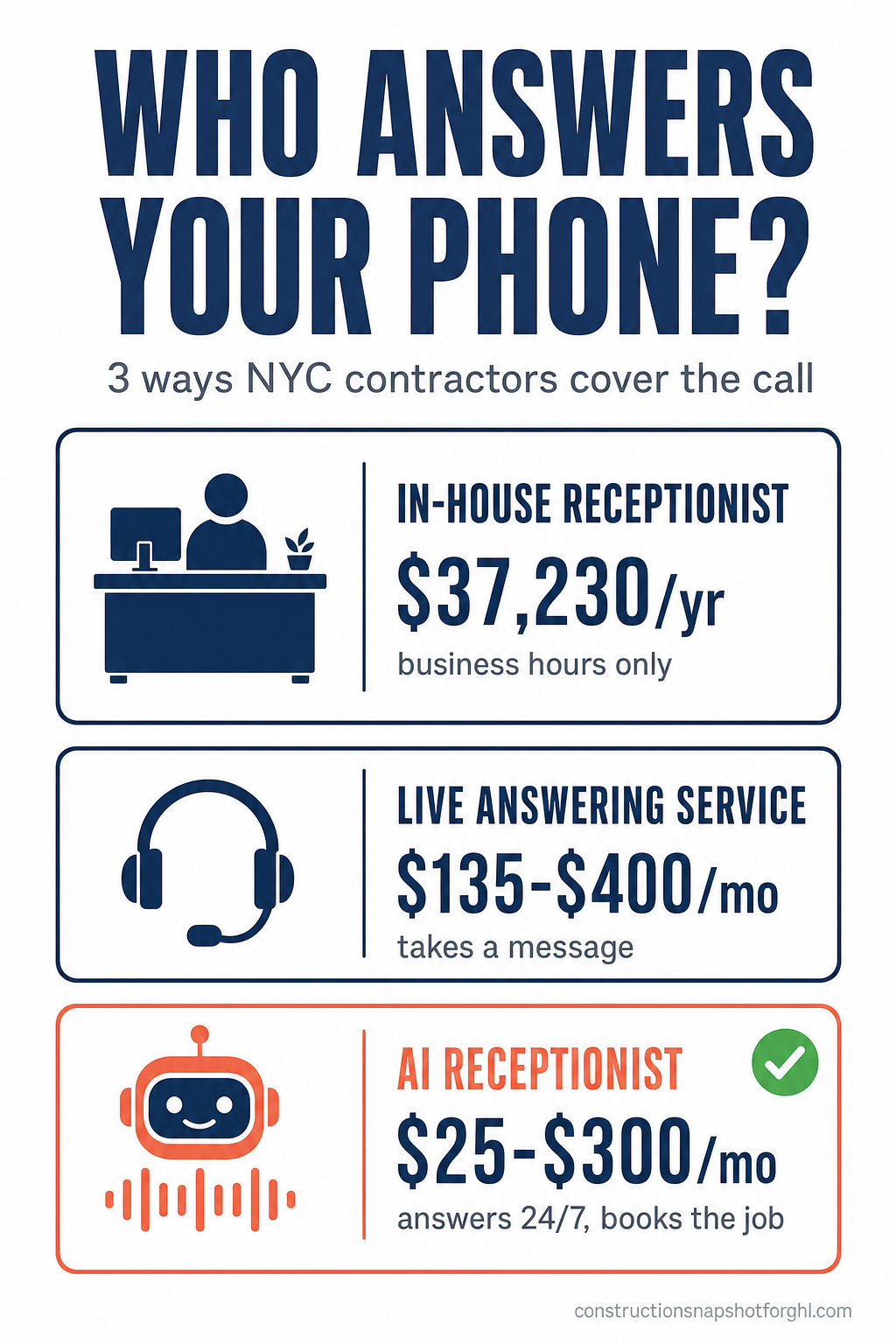
There are three realistic ways to make sure the phone gets answered, and they don’t cost anything alike.
- Hire an in-house receptionist. The median receptionist wage is $37,230/year ($17.90/hour) as of May 2024 (BLS). Add payroll taxes, benefits, and a desk, and the loaded cost lands around $47,000–$52,000/year (applying a standard ~1.3× employer-burden multiplier to the BLS base). And a single person still only covers roughly 40 hours a week — not nights, weekends, lunch breaks, or sick days.
- Contract a live answering service. Typical small-business plans run $135–$400/month, often billed per-minute at $0.75–$1.95/minute with a monthly minimum (Callin.io pricing guide; Housecall Pro). That’s roughly $1,600–$4,800/year, and the per-minute model means costs climb exactly when call volume is highest.
- Deploy an AI receptionist. AI answering typically runs $25–$300/month — a flat fee, unlimited calls, 24/7 — or comes bundled into a system like the Construction Snapshot. Call it ~$1,200/year for a mid-tier plan.
Representative annual cost to keep your phone answered ($/year): in-house receptionist loaded cost ($50,000), a mid-tier live answering plan ($3,600), and a mid-tier AI receptionist (~$1,200). Sources: BLS wage; answering-service pricing from Callin.io and Housecall Pro.
Cost isn’t the whole story — a human handles a grieving homeowner after a burst pipe better than any bot — but the gap is large enough that for pure lead capture, AI wins on price without giving up coverage.
Speed and availability: the metric that books jobs
The reason AI pulls ahead isn’t just price — it’s that it never has an “off.” A live answering service covers the hours you pay for and answers when an operator is free; a busy queue means hold time, and hold time on a contractor call means the homeowner hangs up and dials the next name. An AI receptionist answers on the first ring, every time, at 2 p.m. or 2 a.m., with no queue and no “all our operators are busy.”
That’s decisive because home-improvement inquiries don’t respect business hours — a substantial share of homeowners research and call in the evenings and on weekends, after they get home from work and start staring at the kitchen they want gutted. An answering service that clocks out at 6 p.m. (or bills extra for after-hours) simply isn’t there for those calls. AI is. Combined with the speed-to-lead math above, “always answered, instantly” is the single biggest lever on how many rings turn into booked estimates.
Booking, accuracy, and your CRM
Answering the call is step one; what happens next is where the two really diverge.
A live answering service typically takes a message and relays it — now the lead sits in your inbox until you can call back, re-explain, and try to find a time that works. Every handoff adds delay, and delay is exactly what the speed-to-lead research says kills the deal.
An AI receptionist closes the loop on the call itself: it qualifies the homeowner, checks your live availability through appointment automation, and books the site visit while they’re still on the phone. It logs the call to your CRM as a tagged contact, kicks off a confirmation text and reminder sequence, and — if the caller needs a human — routes to you or your office with the context already captured. Modern AI voice agents are accurate enough that Gartner expects them to autonomously resolve 80% of common customer-service issues by 2029 (Gartner), which is why 85% of customer-service leaders were set to explore or pilot conversational AI in 2025 (Gartner). Paired with the right CRM setup, the AI receptionist isn’t just answering — it’s feeding your whole pipeline.
When a live answering service is still the better call
An honest comparison names where the alternative wins. Keep (or add) a live answering service when:
- You dispatch true emergencies. Burst pipes, gas smells, storm damage — calls where a human needs to triage severity and reach an on-call tech immediately are still best handled by a trained person.
- Your calls are high-nuance or emotional. Legal disputes, sensitive insurance-loss situations, or a distressed homeowner mid-disaster benefit from real human judgment and empathy.
- Your clientele expects a person. Some high-end custom clients simply will not talk to an automated line, and for a boutique custom-home builder that expectation is worth honoring.
The strongest setup for many contractors isn’t either/or. It’s AI first for speed, availability, and booking, with a human fallback — the AI answers instantly, handles the routine 80%, and warm-transfers or escalates the calls that genuinely need a person. You capture every lead without paying a call center for every minute.
Why this matters more in New York City
New York is one of the most competitive construction markets on the planet, which raises the stakes on every ring. The New York Building Congress forecasts ~$74 billion in NYC construction spending in 2025 and $219 billion across 2025–2027 (New York Building Congress), and NYC averaged roughly 143,100 construction jobs in 2024, with the greater metro topping 388,700 — the largest of any U.S. metro (Crain’s New York, citing the NYS Comptroller).
Forecast NYC construction spending, in billions of dollars. Source: New York Building Congress, 2025–2027 NYC Construction Outlook.
For a contractor in Brooklyn, Queens, the Bronx, Manhattan, or Staten Island, that density cuts both ways: there’s abundant work, but a homeowner searching “kitchen remodeler near me” has a dozen names to try, and they call down the list until someone picks up. An AI receptionist means you’re always the one who picks up first — the structural edge that a busy field crew can’t provide on its own. It’s the same reason NYC contractors invest in local SEO and fast AI chat on the website: be the first, easiest yes in a crowded market.
How to add an AI receptionist without the headache
You have three practical paths:
- Buy a standalone AI receptionist tool. Fast to start, but you’ll wire up your own calendar, scripts, and CRM, and it lives outside your other systems.
- Build it yourself in GoHighLevel. Powerful and flexible if you know the platform — but the AI voice setup, calendars, and workflows are a real project to configure and maintain.
- Install a done-for-you snapshot. The Construction Snapshot for GHL drops a fully wired AI Caller into your GoHighLevel — natural-voice answering 24/7, lead qualification, live-calendar booking, CRM logging, and follow-up sequences — alongside the AI chatbot, review harvesting, and the rest of the system, installed in about 24 hours. If you’d rather have a person run it all, our GHL virtual assistants operate the system for you.
Whichever path you choose, hold the same standard: every call answered on the first ring, a booked appointment (not a message) as the default outcome, and every conversation logged so nothing leaks. In a market like New York, the front door has to open instantly — or the homeowner opens a competitor’s instead.
Frequently asked questions
Is an AI receptionist better than a live answering service for contractors?
For most contractors, yes — for everyday lead capture. An AI receptionist answers every call 24/7, books the appointment into your calendar, and logs it to your CRM for a flat $25–$300/month, while a live answering service usually just takes a message during covered hours for $135–$400/month, often billed per minute. A live service is still better for true emergency dispatch and high-nuance or emotional calls, so many contractors run AI first with a human fallback.
How much does an AI receptionist cost compared with an answering service or a hired receptionist?
AI answering typically runs $25–$300/month (flat, unlimited, 24/7). A live answering service runs about $135–$400/month, often at $0.75–$1.95 per minute. A full-time in-house receptionist earns a $37,230 median wage (BLS, May 2024), or roughly $47,000–$52,000/year loaded — and still only covers business hours.
Will an AI receptionist actually book the appointment, or just take a message?
A good AI receptionist books it. It checks your live calendar availability, schedules the site visit while the homeowner is on the phone, sends a confirmation and reminders, and logs the contact to your CRM. Taking a message is the answering-service model; booking the job is the AI advantage.
Why does answering speed matter so much for NYC contractors?
Because homeowners comparison-shop and call down the list until someone picks up. Harvard Business Review found firms responding within an hour are nearly 7× more likely to qualify a lead, and the MIT/InsideSales study found calling in 5 minutes versus 30 makes you about 21× more likely to qualify it. In a dense market like New York, being the first to answer is often the whole difference between booking the job and losing it.
Can I keep a human for emergencies and use AI for everything else?
Yes, and that is the setup we usually recommend. The AI receptionist answers instantly, handles routine questions, and books estimates 24/7; genuine emergencies or calls that need a person are escalated or warm-transferred with the context already captured. You capture every lead without paying a call center for every minute.
About the author
Travis Okafor is a GoHighLevel snapshot implementation consultant who deploys done-for-you systems for construction and trades businesses across the country. He writes the comparison and implementation pieces — platform migrations, snapshot-vs-DIY breakdowns, AI-vs-human tooling, and what to configure first — with a bias toward what actually moves booked jobs, not what looks good in a demo.
Related posts
- AI Receptionist for Contractors: Answer Every Call, Book Every Job
- Speed to Lead for Contractors: Why the First 5 Minutes Decide the Job
- Missed Call Text Back for Contractors: Never Lose a Lead to Voicemail
Sources
- Harvard Business Review — The Short Life of Online Sales Leads, 2011
- MIT / InsideSales — Lead Response Management Study
- U.S. Bureau of Labor Statistics — Receptionists (median wage, May 2024)
- Gartner — Agentic AI to resolve 80% of common customer-service issues by 2029, 2025
- Gartner — 85% of customer-service leaders to explore/pilot conversational AI in 2025, 2024
- New York Building Congress — 2025–2027 NYC Construction Outlook
- Crain’s New York (NYS Comptroller data) — NYC construction jobs, 2025
- Callin.io — Telephone answering service costs, 2025
- Housecall Pro — How much does an answering service cost?, 2026
- U.S. News (Houzz data) — Average cost to remodel a kitchen
- 411 Locals — Small businesses don’t answer 62% of calls, 2020 (marketing-firm study; industry illustration)